
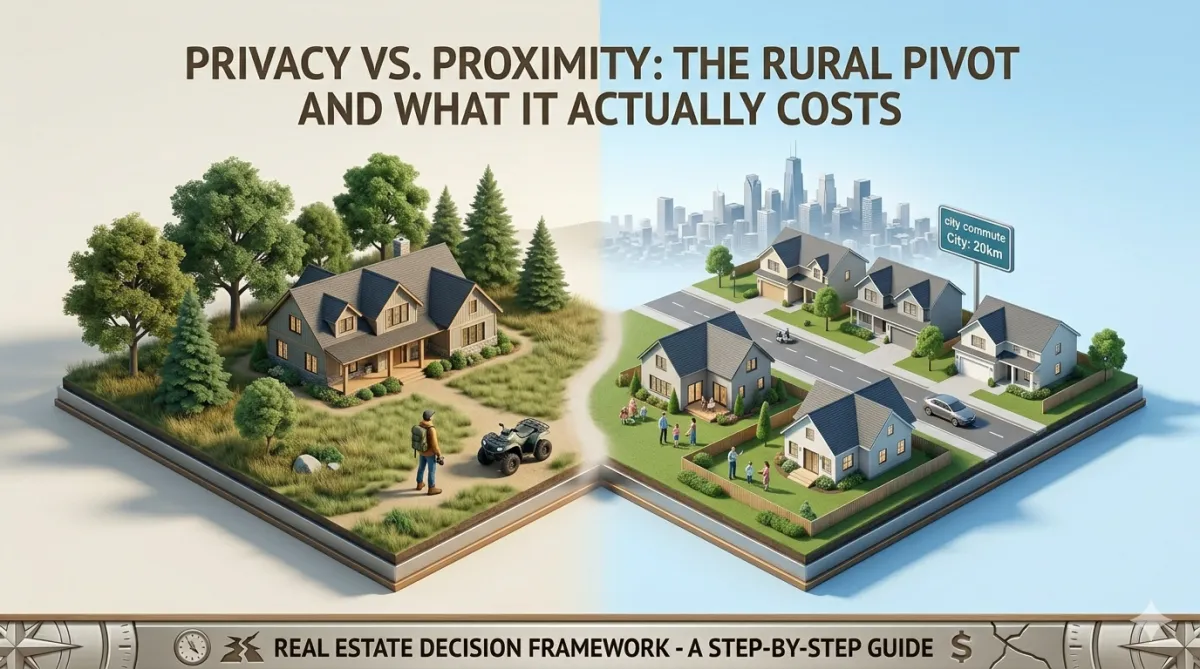
Privacy vs. Proximity: The Rural Pivot and What It Actually Costs
Introduction
You're sitting in traffic. Again. Rush hour in Calgary. Bumper to bumper. Sirens. Horns. Stress. You daydream about escaping. A quiet acreage property. Space. Privacy. No neighbors. Fresh air. Peace. You start browsing listings. Beautiful properties on 5-10 acres. Mountain views. Trees. Silence. You imagine your mornings: coffee on the deck, watching deer graze in your field. It sounds perfect. And for some people, it is. But for many others — maybe 40-50% of people who make 'the rural pivot' — the reality doesn't match the dream. Because what looks like escape and freedom comes with hidden costs that buyers don't anticipate:
- Infrastructure costs: Well maintenance, septic pumping, driveway upkeep, propane delivery — $2,000-$6,000+ annually that city dwellers never pay.
- Commute costs: That peaceful property is 55 minutes from your office. You're spending 110 minutes daily (9+ hours weekly, 450+ hours annually) in your car, plus $3,000-$6,000 annually in extra fuel and vehicle wear.
- Service limitations: Internet is $180/month for mediocre rural service vs. $80/month fiber in the city. Cell service drops calls. Emergency response is 25 minutes instead of 7 minutes.
- Lifestyle friction: Want coffee? 25-minute drive. Groceries? 30-minute round trip. Kids' activities? 35 minutes each way. Everything requires planning and driving.
The 'privacy premium' — the extra cost and effort required to live rurally — often means you're paying more for fewer immediate amenities, not less. This isn't an argument against rural living. For the right people (remote workers, retirees, those who genuinely value space over convenience), acreage life is incredible. But this post is for everyone else who needs to understand the real costs, trade-offs, and lifestyle implications before they commit. We'll break down the hidden costs of rural living, the lifestyle trade-offs most people don't anticipate, who rural living actually works for, and how to evaluate the privacy vs. proximity decision.
The Rural Pivot Dream vs. Reality
The Dream: What People Imagine
Wake up to silence. Coffee on the deck while deer graze in your field, mountains in the distance. Work from a home office with a view. Kids play in the yard — running, biking, building forts, safe and free. BBQ on the deck, stars at night with no light pollution. Weekends of gardening, horseback riding, ATV trails, and space for hobbies. The feeling: freedom, privacy, escape from the chaos of city life.
The Reality: What People Actually Experience
Wake up at 6:00 AM (instead of 7:00) because your commute is now 55 minutes instead of 15. Coffee on the deck only if you have time — usually you're rushing to leave by 6:45 to beat highway traffic. The commute is 55 minutes each way (in winter: icy roads, black ice, white-out conditions) — 110 minutes daily, 9+ hours weekly. If you work from home it's great; if you commute, you're exhausted by the time you get home. Kids want soccer practice 35 minutes each way (70 minutes of driving for a 1-hour practice). Your weekend 'relaxing day' gets eaten by a backing-up septic ($150 travel fee + $400 to pump), well water testing positive for bacteria (a $3,000 UV sterilization system), and a potholed driveway needing grading and gravel ($1,200). Still love the property — but exhausted by the logistics, frustrated by the unexpected costs, and isolated from friends and activities.
The Hidden Costs of Rural Living
Cost Category 1: Infrastructure Maintenance ($2,000-$6,000+ Annually)
City homes are connected to municipal services. Rural properties: you own and maintain all infrastructure. Well Water System: City water is $50-$80/month with no maintenance. A rural well requires annual water testing ($150-$300), pump maintenance/repairs ($200-$500), treatment system maintenance ($200-$600), and a replacement reserve ($100-$300; wells last 20-40 years, replacement $20,000-$35,000) — $650-$1,700 annually, plus $3,000-$35,000 if the well fails. Septic System: City sewer is bundled at $50-$80/month. Rural septic requires pumping ($400-$600 every 3-5 years), field maintenance ($100-$300), and a replacement reserve ($200-$500; systems last 20-30 years, replacement $20,000-$45,000) — $400-$1,000 annually, plus $25,000-$45,000 if the field fails. Driveway Maintenance: A city driveway costs $50-$150/year to seal. A rural gravel driveway (100-500 meters) requires grading and gravel ($400-$1,000 amortized), pothole repairs ($200-$500), and snow removal ($600-$2,400) — $1,200-$3,900 annually. Heating: City natural gas runs $1,000-$1,800/year; rural propane runs $2,400-$4,500 (a difference of +$1,400-$2,700). Waste Removal: City pickup is included in taxes; rural private service is $480-$720/year. Total Infrastructure Cost Differential: +$2,780-$8,310 annually — $27,800-$83,100 over 10 years.
Cost Category 2: Commute Costs ($3,000-$7,000+ Annually)
Time Cost: A city commute is 30-50 minutes daily (125-200 hours annually). A rural commute is 90-120 minutes daily (375-500 hours annually) — an additional 250-300 hours, or 6-7 full work weeks. At $25/hour, that's $6,250-$7,500 in lost time value. Fuel Cost: City commuting burns ~5,000 km/year ($500-$750 fuel). Rural commuting burns ~25,000 km/year ($2,500-$3,750) — a difference of +$2,000-$3,000. Vehicle Depreciation: Rural driving (35,000 km/year) adds $1,000-$2,000 annually in wear and faster depreciation. Total Commute Cost Differential: +$3,000-$5,000 annually (financial only), plus 250-300 hours of your life in a car.
Cost Category 3: Service Access Limitations ($1,200-$3,600+ Annually)
Internet: City fiber is $80-$100/month for 1 Gbps. Rural options are fixed wireless/satellite ($100-$180/month, 25-100 Mbps) or Starlink ($140/month + $600 equipment, 50-200 Mbps) — a difference of +$240-$1,200, plus reduced remote-work efficiency. Cell Service: City coverage is full and strong. Rural coverage is spotty with dropped calls and dead zones, often requiring a signal booster ($500-$2,000 upfront). Service Call Premiums: Rural plumbers, electricians, and HVAC techs add $100-$200 travel fees per call ($300-$1,000 extra annually for 3-5 calls). Total Service Access Cost Differential: +$590-$2,600 annually.
Grand Total: Hidden Annual Costs of Rural Living
- Cost Category: Infrastructure Maintenance — Annual Difference vs. City: +$2,780-$8,310
- Cost Category: Commute Costs (Financial) — Annual Difference vs. City: +$3,000-$5,000
- Cost Category: Service Access — Annual Difference vs. City: +$590-$2,600
- Cost Category: Total Annual Hidden Costs — Annual Difference vs. City: +$6,370-$15,910
Over 10 years: $63,700-$159,100 more than city living. Over 20 years: $127,400-$318,200 — plus 250-300 hours annually commuting (208-250 full days over 20 years).
The Lifestyle Trade-Offs Beyond Money
Trade-Off 1: Spontaneity vs. Planning. In the city, 'let's grab coffee' is a 5-minute drive. Rurally, it's a 50-minute commitment. Spontaneous activities disappear; many rural dwellers stop socializing because the friction is too high. Trade-Off 2: Community Connection vs. Isolation. City neighbors are nearby with casual interactions; rural neighbors are 300 meters to 1+ km away, and community events require 20-40 minute drives. Isolation increases. Trade-Off 3: Convenience vs. Self-Sufficiency. Forgot milk in the city? A quick 10-minute errand. Rurally, a 50-minute round trip. Everything requires planning, lists, and batching errands. Trade-Off 4: Emergency Response Time. City ambulance/fire/police: 5-15 minutes. Rural: 15-40 minutes. This delayed response scares some families. Trade-Off 5: Weather Vulnerability. City roads are plowed within hours and power restored quickly. Rural driveways may go unplowed for days and power outages are deprioritized — requiring generators, extra supplies, and the ability to handle multi-day isolation.
Who Rural Living Actually Works For
Profile 1: Remote Workers with No Commute — no commute cost, home all day to maximize the property, space for a dedicated office, breaks in nature. They get all the benefits without the biggest cost. Profile 2: Retirees with Time Flexibility — no commute, time to manage maintenance, full use of the space, less need for proximity. Profile 3: Families Who Value Space Over Convenience — kids have freedom to roam, room for horses/ATVs/gardens/workshops, willing to trade commute for lifestyle. Profile 4: People Who Hate Density and Noise — value privacy above all, willing to pay the premium for peace, with a self-sufficient mindset.
Who Rural Living Doesn't Work For
Profile 1: Commuters Who Underestimate the Grind — 2 hours daily driving becomes unbearable after 6-12 months; winter highway driving adds stress. Profile 2: Social People Who Underestimate Isolation — spontaneous socializing disappears, friendships atrophy, loneliness sets in (especially for non-working spouses home all day). Profile 3: People Who Don't Want Property Maintenance — constant upkeep and unexpected costs make rural ownership active management, not passive enjoyment. Profile 4: Families with Heavy Kid Activity Schedules — 5-10 hours weekly driving kids to activities means less family time, not more, despite the move.
How to Evaluate: Privacy vs. Proximity Decision Framework
Question 1: Do You Commute? If you work in Calgary, can you handle 90-120 minutes daily, absorb $3,000-$5,000 annually in extra fuel/vehicle costs, and give up 250-300 hours a year to driving? If you work remotely, rural living is much more viable. Question 2: Can You Absorb $6,000-$16,000 Annual Extra Costs? Add infrastructure (+$2,780-$8,310), commute if applicable (+$3,000-$5,000), and services (+$590-$2,600). Can your budget handle it without stress? Question 3: How Do You Handle Isolation? Introverts who love solitude may thrive; extroverts who need social interaction may feel lonely. Question 4: Do You Value Spontaneity or Planning? Spontaneous people will be frustrated; natural planners adapt. Question 5: Do You Have Hobbies That Need Space? Horses, ATVs, large dogs, workshops, gardens make rural space valuable. Without them, you're paying for space you won't use. Question 6: How Do Kids Factor In? Young kids (0-10) often thrive with safe outdoor play; teenagers (13-18) can struggle with social isolation and transportation dependence.
The Middle Ground: Semi-Rural Options
Option 1: Large Lot Suburban (Springbank, Bearspaw) — 0.5-2 acre lots, more privacy, still 20-30 minutes from Calgary, avoiding extreme commute and full rural infrastructure costs. Option 2: Small Acreage Close to Calgary (Bragg Creek, Priddis) — 2-5 acre properties with a rural feel, a 30-40 minute commute, and small communities nearby to avoid total isolation. Option 3: Urban Village Lifestyle (Mahogany, Quarry Park) — suburban space with walkable village centers and community connection, avoiding rural isolation, commute costs, and infrastructure maintenance.
FAQ: Privacy vs. Proximity
Can I work from home part-time and commute part-time? Hybrid schedules reduce commute costs but don't eliminate them. Calculate actual commuting days and run the numbers. What if we love rural living despite the costs? Then it's worth it — just budget realistically. Can we reduce costs by doing our own maintenance? Some tasks (lawn care, snow removal) yes; well/septic work requires professionals. You might save $1,000-$2,000 annually but not eliminate costs. What about resale value of rural properties? They appreciate moderately — less demand than city properties, but acreage buyers always exist. Should we rent rural first before buying? Excellent idea. Rent an acreage for 6-12 months to experience the commute, isolation, maintenance, and lifestyle before committing.
Conclusion
Privacy vs. Proximity: the rural pivot is a lifestyle decision with real financial and practical implications. Rural living costs $6,370-$15,910 more annually than city living, plus 250-300 hours of annual commute time (if you work in Calgary), and brings isolation, service limitations, weather vulnerability, and lifestyle friction. The benefits: privacy, space, peace, freedom, and room for hobbies, animals, and outdoor living. The privacy premium often means paying more for fewer immediate amenities — not less. It works for remote workers, retirees, families who value space over convenience, and people who need solitude. It doesn't work for commuters who underestimate the grind, social people who underestimate isolation, people who don't want maintenance, or families with heavy kid activity schedules. Before making the rural pivot, calculate the real costs, honestly assess your lifestyle needs, and consider renting rural first. Are you weighing privacy against proximity? Share your biggest concern in the comments, and let's discuss if the rural pivot is right for you.
Related Reading
If you found this useful, these posts go deeper on city vs. rural living:
- City Bungalow vs. Rocky View Acreage: The Real Cost Comparison
- The Suburban Suffocation Realization: When Your Dream Home Feels Isolating
- The Biggest Culture Shock When You Move From Calgary to an Acreage
About Kristen Edmunds
Kristen Edmunds is a Calgary-area REALTOR® and Associate Broker with KIC Realty, specializing in acreages, luxury homes, and smart buy/sell strategies. With expertise in rural properties (water wells, septic, equestrian facilities) and a client-obsessed approach, Kristen helps buyers and sellers achieve their real estate goals with confidence and ease.