The Suburban Suffocation Realization: When Your Dream Home Feels Isolating
Introduction
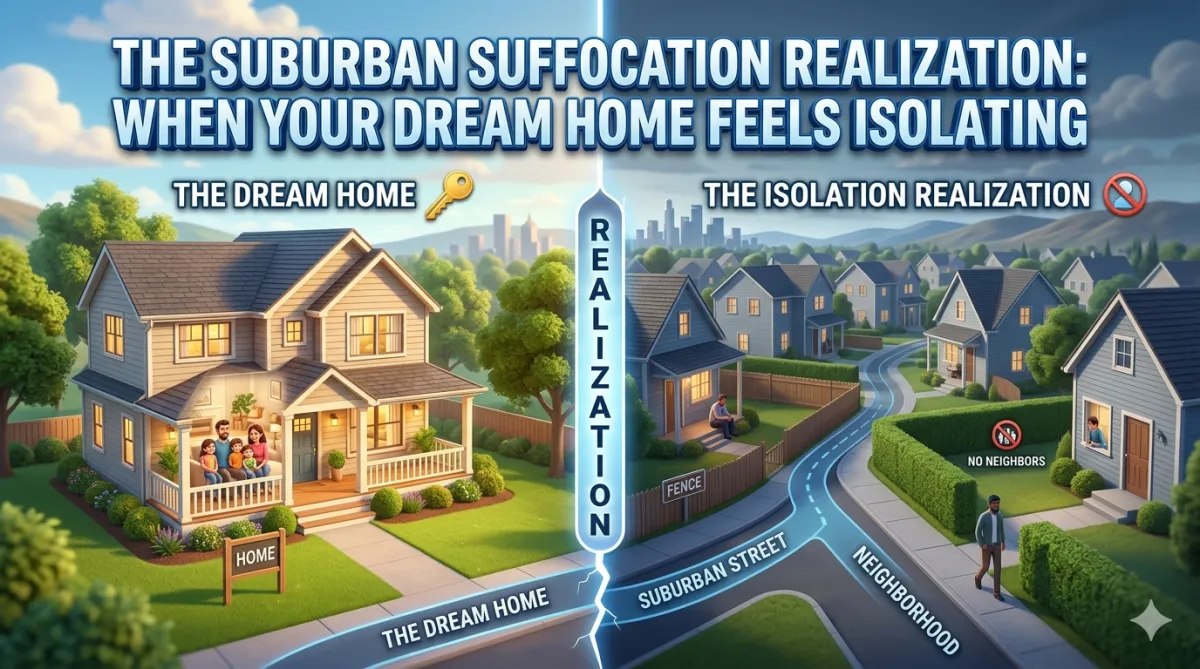
You bought your dream home five years ago. Beautiful suburban neighborhood. 2,500 sq ft. Four bedrooms. Big backyard. Double garage. Quiet street. Great schools nearby. Everything the real estate magazines and HGTV shows told you a 'perfect family home' should be. You loved it. It was your refuge after long days at the office. Your escape from the chaos of the city. Your private sanctuary. But something has changed. You work from home now. You've been remote for three years. And slowly, quietly, a realization has been building: You feel trapped. Not in your house — your house is beautiful. But in your location. In the suburban infrastructure that seemed perfect when you were commuting downtown every day but now feels suffocating when you're home all the time. You want a coffee? Drive 10 minutes. You want to walk to a park? There isn't one within walking distance. You want to run into neighbors and have spontaneous conversations? Everyone drives into their garage and disappears. You could live next to someone for years and never speak. You have space. You have quiet. You have privacy. But you're isolated. And you're realizing that what you optimized for pre-pandemic — space and escape from the city — doesn't serve your life now that you're not escaping anywhere. This is what I'm calling The Suburban Suffocation Realization — the growing recognition among remote workers and post-pandemic homeowners that traditional suburban sprawl, optimized for people who leave daily, creates isolation and car dependency that becomes unbearable when you're present constantly. This post breaks down what's driving this realization, why suburban infrastructure fails remote workers, what people are discovering they actually need, and where demand is shifting as homeowners recalibrate their priorities.
What Suburban Living Was Designed For
To understand the Suburban Suffocation Realization, we need to understand what suburbs were designed to provide.
The Original Suburban Value Proposition
Post-War Suburban Development (1950s-1990s): Suburbs were designed as residential zones — places where families lived but didn't spend their entire waking lives. The Assumption:
- Adults commute to work daily (downtown offices, industrial areas)
- Children attend school daily (gone 8+ hours)
- Evenings and weekends are family time at home
- Errands and social activities happen on weekends via car
What Suburbs Optimized For: 1. Space and Privacy Large lots (5,000-10,000 sq ft), detached homes, distance between houses, private backyards. Trade-off: Car dependency, isolation from neighbors. Why It Worked: People weren't home most of the time. Space and privacy felt valuable because evenings and weekends were 'recharge time.' 2. Quiet and Safety Residential-only zoning (no commercial, no mixed-use), cul-de-sacs, low traffic, separation from busy roads. Trade-off: Zero walkable amenities, no community gathering spaces. Why It Worked: Quiet was restorative after busy work days. Families wanted escape from urban noise. 3. Family-Oriented Environment Parks (but car-accessible, not walkable), schools, playgrounds, 'safe' streets. Trade-off: Adult social isolation, car-required activities. Why It Worked: Parents drove kids to activities. Adult social life happened at work or via planned weekend outings. 4. Affordability Through Sprawl Building outward (cheap land on city fringes) rather than upward (expensive urban density). Trade-off: Long commutes, car dependency. Why It Worked: People accepted 30-60 minute commutes in exchange for larger, cheaper homes.
The Commuter-Optimized Lifestyle
Suburban design assumed: Weekday Pattern:
- 6:00 AM - Wake up
- 7:00 AM - Commute to work (30-60 minutes)
- 8:00 AM - 5:00 PM - At office (away from home)
- 6:00 PM - Commute home (30-60 minutes)
- 7:00 PM - Arrive home, family time, quiet evening
- 10:00 PM - Sleep
Home was a refuge you inhabited 3-4 hours daily on weekdays. Weekend Pattern:
- Saturday/Sunday mornings - Family time at home
- Afternoons - Drive to activities, errands, social gatherings
- Evenings - Home
Home was a base you departed from for weekend activities. Total Time at Home: ~60 hours/week (sleeping + evenings + some weekend time) Total Time Away: ~100+ hours/week (work commute + work + activities) The Trade-Off Made Sense: You tolerated isolation, car dependency, and lack of walkable amenities because you weren't home enough for it to matter.
What Changed: The Remote Work Revolution
The Pandemic Shift
March 2020: Millions of workers sent home. Offices closed. Commutes eliminated. Temporary Assumption: 'We'll go back to the office in a few months.' Reality: Three years later, many workers are still remote or hybrid. The commute is gone permanently or reduced to 1-2 days per week.
The New Daily Pattern
Remote Worker Weekday:
- 6:00 AM - Wake up
- 7:00 AM - 5:00 PM - Work from home (in home office, at kitchen table, in bedroom)
- 5:00 PM - End work day... still at home
- 5:00 PM - 10:00 PM - Evening at home
- 10:00 PM - Sleep
Total Time at Home: ~110-120 hours/week Total Time Away: ~40-50 hours/week (occasional outings, errands, social plans) The Problem: You're spending 120 hours per week in a location designed for people who spend 60 hours per week there. The isolation, car dependency, and lack of walkable amenities that were tolerable when you were home 3-4 hours on weeknights become unbearable when you're home all day, every day.
The Suburban Suffocation Realization: What People Are Discovering
Realization 1: Isolation Isn't Peaceful — It's Lonely
The Pre-Pandemic Perspective: 'I love how quiet and private our neighborhood is. It's so peaceful after a busy day at the office.' The Post-Pandemic Reality: 'I've been home for three years and I barely know my neighbors. I see people drive into their garages and that's it. There's no community here.' What Changed: When you're home 12-14 hours daily, 'peaceful and private' starts to feel like 'isolated and lonely.' The Experience:
- You finish work at 5 PM. You want to get out of the house, take a walk, see people.
- You walk around the neighborhood. Empty streets. No one outside. No gathering places. Just houses and lawns.
- You come home feeling... disconnected.
- You realize: there's no organic community here. No spontaneous interaction. Just privacy and silence.
The Realization: Privacy and quiet are valuable when you need escape from overstimulation. But when you're isolated all day working from home, what you actually need is connection — and suburban design doesn't provide it.
Realization 2: Car Dependency Is Exhausting
The Pre-Pandemic Perspective: 'Sure, we have to drive everywhere, but we have a car. It's not a big deal.' The Post-Pandemic Reality: 'I'm so sick of having to drive for everything. I just want to walk to get a coffee without it being a whole production.' What Changed: When you commute daily, driving is already part of your routine. Adding a few errands doesn't feel like a burden. When you work from home and don't commute, every single drive to get coffee, run an errand, or grab food feels like unnecessary friction. The Experience:
- 10:30 AM. You want a coffee break.
- Nearest coffee shop: 8 minutes away by car.
- You think: 'I don't want to stop working, get dressed, drive 8 minutes, park, get coffee, drive 8 minutes back. That's 20-30 minutes just for coffee.'
- You make instant coffee at home instead. It's not what you wanted, but driving feels like too much effort.
- You realize: if there was a coffee shop you could walk to in 3 minutes, you'd go multiple times per week. But there isn't.
The Realization: Car dependency creates friction that prevents spontaneous activity. When everything requires driving, you do less. You stay home more. You feel stuck.
Realization 3: Lack of 'Third Places' Creates Monotony
What Are Third Places? Third places are social spaces that aren't home (first place) or work (second place):
- Coffee shops
- Bookstores
- Libraries
- Parks
- Community centers
- Local pubs/restaurants
- Farmers markets
- Town squares
The Pre-Pandemic Perspective: 'We have everything we need at home. We don't need to go out much during the week.' The Post-Pandemic Reality: 'I work from home. I spend my evenings at home. I'm losing my mind. I need somewhere to be that isn't my house.' What Changed: When you worked in an office, your office was your second place. You had colleagues, coffee shops near the office, lunch spots, social interaction built into your day. When you work from home, your home becomes your second place too. Home is now work and life. There's no separation. You desperately need third places — spaces to escape your home without having to drive 15 minutes to get there. The Experience:
- You finish work at 5 PM. You've been staring at your home office walls for 8 hours.
- You want to get out. Change scenery. Be around people.
- Your options: Drive 12 minutes to a strip mall with chain restaurants. Drive 15 minutes to a park. Drive 20 minutes to an urban neighborhood with actual vibrancy.
- You think: 'I just want to walk 5 minutes and sit in a coffee shop with a book. Why doesn't that exist here?'
- You stay home. Again.
The Realization: Suburban design has no third places within walking distance. You're trapped in your home because leaving requires effort, time, and driving.
Realization 4: Kids' Activities Don't Replace Adult Social Life
The Pre-Pandemic Perspective: 'We have a great community here. The kids have friends. We see other parents at school events and activities.' The Post-Pandemic Reality: 'The kids are fine. They have friends. But I'm isolated. Seeing other parents at drop-off isn't community.' What Changed: Many suburban families relied on children's activities (sports, school events, playdates) as their primary source of adult social connection. But post-pandemic, many remote workers realize:
- Kids' activities are child-focused, not adult social opportunities
- Seeing other parents briefly at drop-off/pick-up isn't meaningful connection
- You've built your social life around logistics (driving kids places) rather than genuine community
The Experience:
- You drive your kids to soccer practice.
- You sit in your car for an hour waiting for practice to end.
- You see other parents also sitting in their cars.
- You wave. Maybe exchange a few words.
- You drive home.
- You realize: this isn't community. This is parallel isolation while our kids have community.
The Realization: You want your own community — not one mediated through your children's activities. You want neighbors you actually know. Coffee shops where you run into familiar faces. A sense of belonging. Suburbs offer child-focused infrastructure but no organic adult community.
Realization 5: The 'Dream Home' Metrics Don't Match Your Life
The Pre-Pandemic Metrics: What defined a 'dream home':
- Square footage (2,500+ sq ft)
- Number of bedrooms (4+)
- Yard size (big backyard)
- Garage (double or triple)
- Privacy (large lot, distance from neighbors)
The Post-Pandemic Realization: 'We have all those things. And they don't matter as much as we thought.' What Changed: When you're home all the time, what matters most isn't:
- How big your house is (you use the same 3-4 rooms daily)
- How big your yard is (maintaining it is a chore, not a joy)
- How much privacy you have (privacy without community feels isolating)
What matters is:
- Can you walk to coffee shops, restaurants, parks?
- Do you see your neighbors organically?
- Are there gathering spaces in your community?
- Can you exist outside your home without driving?
The Realization: The suburban 'dream home' was optimized for metrics (square footage, bedrooms, yards) that made sense for a commuter lifestyle. For a remote work lifestyle, what matters is proximity to life — not size of space away from life.
Where People Are Moving Instead
The Suburban Suffocation Realization is driving a shift in housing demand.
Destination 1: Urban Inner-City Neighborhoods
Examples (Calgary):
- Kensington
- Inglewood
- Marda Loop
- Bridgeland
- Mission
- Hillhurst/Sunnyside
What They Offer: Walkability: Coffee shops, restaurants, bookstores, gyms, parks within 5-10 minute walk. Third Places: Community gathering spaces — cafes with patios, local pubs, libraries, farmers markets. Density Creates Vibrancy: Enough people walking around that streets feel alive. You see neighbors. You run into familiar faces. Mixed-Use Design: Residential above commercial. You live above or beside the places you frequent. Trade-Offs:
- Smaller homes (1,200-1,800 sq ft condos/townhouses vs. 2,500 sq ft suburban houses)
- Smaller or no yards
- Higher prices per square foot
- Street parking instead of double garages
- More noise (traffic, people, activity)
Who's Choosing This: Remote workers, couples without kids or with older kids, people who value walkability and community over space.
Destination 2: Urban Villages and Mixed-Use Suburbs
Examples (Calgary):
- Mahogany (lake community with walkable village center)
- Quarry Park (mixed-use development with retail/residential integration)
- West District (mixed-use, walkable retail)
- Currie Barracks (redevelopment with urban village design)
What They Offer: Suburban Space + Urban Walkability: Larger homes (2,000-2,500 sq ft) with yards, but designed around walkable village centers with shops, cafes, services. Community Gathering Spaces: Central plazas, parks, community centers designed for spontaneous interaction. Planned Density: Enough residential density to support local businesses and create vibrancy. Trade-Offs:
- Higher price premium (developer-designed communities cost more)
- Less privacy than traditional low-density suburbs
- Still some car dependency (not full urban walkability)
Who's Choosing This: Families who want space for kids but also want walkability and community connection.
Destination 3: Small Towns with Main Streets
Examples (Near Calgary):
- Okotoks (historic main street, walkable downtown)
- Cochrane (walkable main street, community feel)
- High River (small-town main street character)
What They Offer: Small-Town Community: Know your neighbors. See familiar faces. Organic social connection. Walkable Main Streets: Local coffee shops, restaurants, boutiques, farmers markets within walking distance of residential areas. Slower Pace: Less hustle, more connection, community events and festivals. Trade-Offs:
- Farther from Calgary (20-40 minute drives for city amenities)
- Fewer job opportunities locally (but doesn't matter for remote workers)
- Less diversity of services and entertainment
Who's Choosing This: Remote workers who no longer need proximity to Calgary offices and value community over big-city amenities.
The Psychology Behind the Shift
Why This Realization Is So Uncomfortable
Cognitive Dissonance: You bought your 'dream home.' You achieved what you were supposed to achieve. But now you're unhappy with it. Admitting that feels like:
- Failure ('We made the wrong choice')
- Ingratitude ('We should be happy — we have everything')
- Instability ('If this isn't right, what is?')
Sunk Cost Fallacy: You've invested in this home:
- Down payment
- Mortgage payments for years
- Renovations and improvements
- Emotional attachment
Walking away from that investment feels wasteful. Social Pressure: Friends, family, society tell you:
- 'You have a beautiful home! Why would you leave?'
- 'Suburbs are great for families. You're supposed to want this.'
- 'You're just going through a phase. You'll appreciate it again.'
Defying those expectations feels like rebellion.
Why It's Actually Rational to Change
Your Life Changed: You made a housing decision based on a specific lifestyle (commuter, office-based work). That lifestyle changed fundamentally. It's rational to reassess. Housing Should Serve Your Life: You don't exist to serve your house. Your house should serve the life you're actually living now. Preferences Evolve: What you valued at 30 (space, privacy) might not be what you value at 40 (community, walkability). That's growth, not failure.
How to Evaluate If You're Experiencing This
Ask yourself these questions:
Question 1: Do I Feel Trapped?
- Do you feel like leaving your home requires significant effort (getting dressed, driving)?
- Do you stay home more than you want to because going out feels like too much work?
- Do you feel isolated even though you're surrounded by neighbors?
If yes: You might be experiencing suburban suffocation.
Question 2: Do I Miss Spontaneous Activity?
- Do you wish you could walk to get coffee without it being a 20-minute production?
- Do you miss being able to walk outside and stumble upon something interesting?
- Do you feel like you have to plan and drive for every single outing?
If yes: You're craving walkability.
Question 3: Do I Feel Like I Don't Know My Community?
- Have you lived in your neighborhood for years and barely know your neighbors?
- Do you feel like there's no 'community' — just houses near each other?
- Do you wish there were places where you'd naturally run into neighbors and build connections?
If yes: You're craving genuine community infrastructure.
Question 4: Has Remote Work Changed What I Value?
- Did you buy your home when you commuted daily?
- Are you now remote or hybrid and home significantly more?
- Do the things that mattered when you were gone 10+ hours daily (space, quiet, privacy) matter less now?
If yes: Your housing needs have shifted.
Question 5: Do I Feel Guilty for Wanting Something Different?
- Do you feel like you 'should' be happy because you have a nice home?
- Do you feel ungrateful for wanting to leave a beautiful house?
- Are you afraid to admit to friends/family that your 'dream home' doesn't feel right anymore?
If yes: You're experiencing the cognitive dissonance of the realization.
What to Do If You're Feeling This
Option 1: Experiment Before You Commit
Try Urban Living Temporarily: Rent an Airbnb in an urban neighborhood for 1-2 weeks. Live the walkable lifestyle. See how it feels. Questions to Ask:
- Do I love being able to walk to coffee, restaurants, parks?
- Do I miss my suburban space and yard?
- Does the noise bother me or do I enjoy the vibrancy?
- Do I feel more connected or just overwhelmed?
If You Love It: Start seriously considering a move. If You Don't: Maybe you need small changes (joining local groups, creating community where you are) rather than moving.
Option 2: Create Community Where You Are
Sometimes the issue isn't location — it's lack of intentional community building. Strategies: Host Regular Gatherings: Weekly coffee meetups, block parties, neighborhood walks. Create the third places that don't exist naturally. Join Local Groups: Community associations, hobby groups, volunteer organizations. Frequent Local Businesses: If there are any walkable or driveable spots you like, become a regular. Familiarity builds community. Work from Third Places: Drive to a coffee shop or coworking space a few times per week to break up isolation. Reality Check: This works for some people. But if the fundamental infrastructure (walkability, density, gathering spaces) doesn't exist, you're fighting against design limitations.
Option 3: Make the Move
If you've tried to create community and it's not working: If walkability genuinely matters to you: If you're willing to trade space for proximity: It might be time to sell your suburban home and move to a more urban or walkable community. How to Approach It: 1. Define What You Actually Need: Not what you 'should' want. What you actually need for your life now.
- Walkability? (How important on a scale of 1-10?)
- Space? (How much do you actually use?)
- Community? (What does that look like for you?)
- Yard? (Do you use it or is it a burden?)
2. Identify Neighborhoods That Match: Research walkable Calgary neighborhoods. Visit them. Walk around. Sit in coffee shops. See how it feels. 3. Run the Numbers:
- What's your current home worth?
- What do walkable neighborhood homes cost?
- Can you afford the trade (likely smaller space, higher price per sq ft)?
- What are the financial implications?
4. Make a Decision: If the numbers work and the lifestyle alignment is there, move forward.
FAQ: The Suburban Suffocation Realization
Am I just being ungrateful? We have a beautiful home. No. Housing should serve your life. If your life has changed and your housing no longer fits, that's not ingratitude — it's rational assessment. Will I regret giving up space and a yard? Maybe. That's why experimenting (renting in a walkable area temporarily) helps. Some people realize they love urban living. Others realize they miss suburban space. What if my partner doesn't feel the same way? This is common. One partner works from home and feels suffocated. The other still commutes and loves coming home to quiet. You need honest conversation about whose needs get prioritized. Is this just a pandemic thing that will pass? For some people, yes. For others, remote work is permanent and the realization is too. Only you can assess whether this is temporary or fundamental. Can suburbs change to offer walkability? Some newer developments (mixed-use urban villages) are trying. But retrofitting existing low-density suburbs is very difficult. Change happens slowly over decades. What if we can't afford to move to a walkable neighborhood? Walkable urban neighborhoods are often more expensive per square foot. If finances are a barrier, focus on creating community where you are or look at smaller walkable towns outside Calgary.
Conclusion
The Suburban Suffocation Realization: loving your home but feeling isolated, trapped, and disconnected because the infrastructure designed for commuters doesn't serve remote workers. When you're home 120 hours per week instead of 60, the isolation, car dependency, and lack of walkable amenities that were tolerable become unbearable. What you thought you wanted — space, privacy, quiet — might not be what you actually need now. What you might need is proximity, community, walkability, and spontaneous connection. This isn't about suburban homes being 'bad.' It's about recognizing that your life has changed fundamentally and your housing might need to change too. If you're feeling this — trapped in a beautiful home that doesn't fit your life anymore — you're not alone. And you're not ungrateful. You're realizing that the 'perfect' family home isn't about square footage and yards, but about daily life alignment and genuine community. If you're experiencing this suburban shift, share your thoughts below. What truly makes a community feel like home to you now?
Related Reading
If you found this useful, these posts go deeper on lifestyle and housing alignment:
- The Anti-Downsize Movement: Why Going Smaller Might Be Your Biggest Mistake
- How to Know If You're Ready to Leave the City (Honest Version)
- City Bungalow vs. Rocky View Acreage: The Real Cost Comparison
About Kristen Edmunds
Kristen Edmunds is a Calgary-area REALTOR and Associate Broker with KIC Realty, specializing in acreages, luxury homes, and smart buy/sell strategies. With expertise in rural properties (water wells, septic, equestrian facilities) and a client-obsessed approach, Kristen helps buyers and sellers achieve their real estate goals with confidence and ease.