
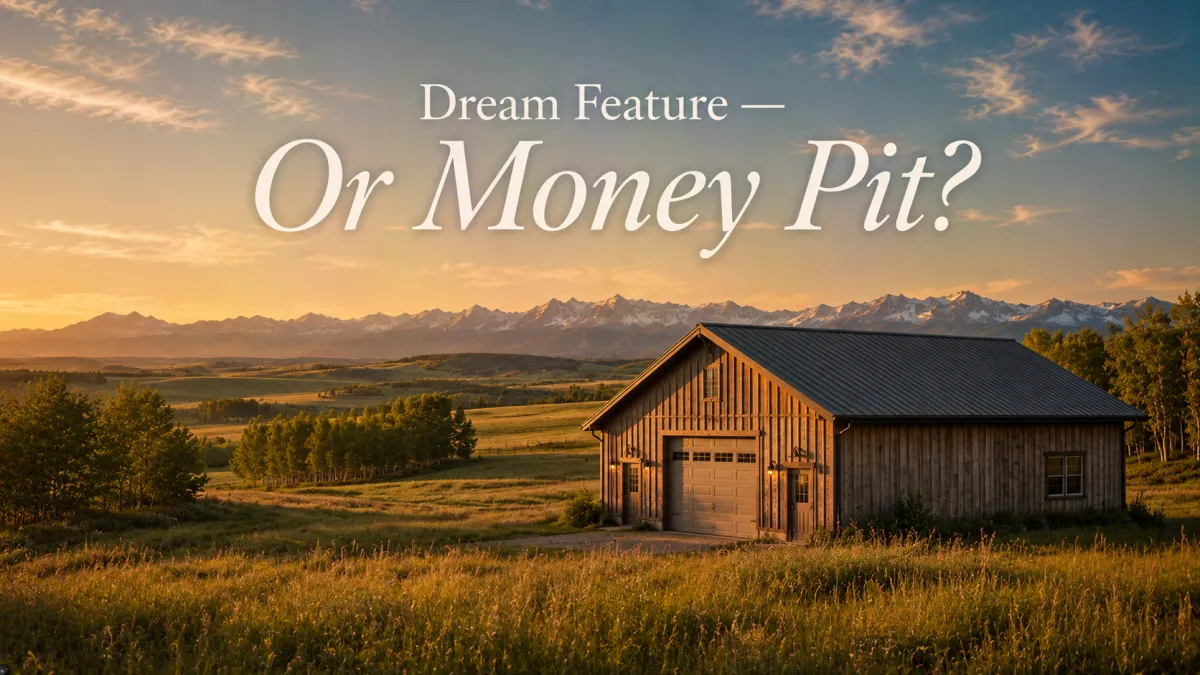
Outbuildings & Shops on an Acreage: What Adds Value vs What's a Money Pit
The shop, the barn, or the substantial outbuilding is often the specific feature that sells an acreage buyer on a property. I watch it happen almost every time. The buyer walks the house, walks the land, and then they see the shop — the big doors, the concrete floor, the space to build the life they have been picturing — and something shifts. The property stops being one option among several and becomes the option.
That is a completely understandable reaction. A well-built acreage shop is a genuinely valuable feature, and the ability to have one is often the whole point of moving from a city lot to an acreage. But it is also the exact moment where a buyer's judgment starts to skew — and where the specific outbuilding that just sold them can turn out to be a project rather than an asset once possession happens.
This post is about what actually separates an outbuilding that adds value from one that becomes a money pit — and about the verification work that protects you from confusing the two before you commit.
Why the outbuilding sells the property
Understanding why this specific feature has such outsized influence on acreage decisions is worth pausing on, because the psychology is doing real work in the buying process.
Most acreage buyers are moving out of a city lot where "outbuilding" meant a shed, if it meant anything at all. Space for a shop, a workshop, a barn, a greenhouse, an equestrian setup — those were things that existed for other people, in a different kind of life. The acreage listing where those things already exist represents a version of the buyer's future that is already partially built. They can see themselves in it immediately.
That emotional pull is legitimate. It is also exactly why the outbuilding deserves scrutiny that matches the price it is adding to the property. A great shop can add real value. A questionable one adds risk. The specific work of a good buyer's agent is making sure you can tell which one is in front of you before you write the offer.
What actually makes an outbuilding an asset
An outbuilding that genuinely adds value to an acreage — and that will continue to add value across your ownership rather than costing you — meets a specific set of conditions. None of these are exotic. All of them are worth verifying before an offer goes firm.
It was built legally. Permits pulled, inspections done, county approval on file. This matters not just for the current transaction but for everything downstream — future insurance, future re-sale, future permits for additions or modifications. A structure with a proper paper trail is a structure whose legality is not in question. A structure without one is a question mark carried forward to every subsequent transaction.
It matches the parcel's zoning. The land use classification of the parcel needs to actually support the outbuilding that is on it, and support your intended use for that outbuilding. A shop that was built under a previous zoning that no longer applies, or that was built for a use the current zoning does not permit, is a legal exposure — not necessarily one that gets flagged in a routine transaction, but one that can surface later.
It is in real condition. Foundation intact, framing sound, roof in reasonable shape, power and heat installed to code, drainage handled properly. What looks solid on a first walk-through can have material issues under the surface — moisture damage, foundation settling, aging electrical, roof structure fatigue. A visual walk-through is not a substitute for a proper inspection.
It fits your intended use. A shop that is perfectly configured for a small-business auto restorer is not the same shop for someone who wants a woodworking space, or a horse tack storage building, or a greenhouse operation. The specific dimensions, door heights, floor load ratings, power capacity, heating adequacy, and ventilation matter differently depending on what you actually plan to do inside the building. A great shop for someone else's hobby is not necessarily a great shop for yours.
All four of these together define an outbuilding that genuinely adds value to the property. Missing any one of them meaningfully changes the risk profile.
What makes an outbuilding a money pit
The failure modes are the mirror image of the asset conditions above, and it is worth naming each one specifically because acreage buyers routinely underweight them.
Unpermitted builds. Structures built without pulling permits, without inspection, without county approval. Alberta acreage properties have a long history of "just build it" outbuildings from previous eras. Some are structurally fine. Some are not. Either way, the absence of documentation shifts the risk to whoever owns the property when a problem surfaces. That new owner is you.
Structures that no longer match zoning. Whether because zoning changed after the structure was built, or because the current use of the building has drifted from what the zoning supports. Either way, it creates a compliance gap that could become a real problem depending on how future situations unfold.
Aging with deferred maintenance. Every outbuilding has a maintenance timeline. Roofs eventually need work. Framing eventually settles. Power systems eventually age out. When previous owners have deferred that maintenance — because it was not urgent, or because they were planning to sell — the deferred cost lands on the buyer. What looks like a solid $60,000 outbuilding on the listing can arrive at possession as a $60,000 outbuilding that also needs $20,000 of near-term work.
Additions no one ever inspected. A common pattern: a legally-permitted original outbuilding, plus one or more additions that were "just built" over the years without any inspection or approval. Even if the original structure is sound, the additions can introduce structural issues, electrical issues, or code violations that were never caught. The buyer inherits all of it.
How to verify before committing
None of the above list requires the buyer to become an outbuilding expert. It requires the buyer to work with an agent and inspector who coordinate proper verification before the offer goes firm.
The specific work that happens on my side for every acreage buyer with a significant outbuilding on the property:
Pull the property's permit history from the county. This confirms what was built with paperwork and when.
Verify the current zoning supports both the existing outbuilding and the buyer's specific intended use for it.
Coordinate a proper inspection that includes the outbuilding — not just the house — with attention to foundation, framing, electrical, heating, roof, and any additions.
Review the findings with the buyer in plain language, so any issues connect to actual offer decisions rather than getting glossed over.
Build any concerns into offer strategy — price adjustment, holdback, subject-to-inspection language, or walk-away depending on severity.
This is the work the Inspection Negotiation Playbook walks through — what to inspect, how to interpret findings, and how to translate any issues into an offer structure that protects the buyer rather than leaves them holding the risk.
Frequently asked questions
Can I add my own outbuilding after possession instead of buying one with a shop already?
Sometimes, depending on the parcel's zoning, current outbuildings on the property, and county permitting process. This is exactly the kind of question that needs to be verified with the specific county before you commit — some counties support routine outbuilding additions on rural parcels; some restrict them meaningfully.
Does the seller's disclosure cover me on outbuilding issues?
Seller disclosure is a starting point, not a substitute for buyer-side verification. Sellers may not know the full permit history of structures built by previous owners. Rely on your own inspection and permit-history pull, coordinated by an advisor who represents your interests.
What if the outbuilding was built decades ago before current permitting?
That is common on older acreage properties and requires specific handling. In some cases, older structures are grandfathered under previous rules. In other cases, they are exposures. The right approach depends on the specific structure, the specific county, and the specific circumstances — again, verification work rather than assumption.
Does the shop premium in a listing price reflect proper verification of its value?
Not necessarily. Listing prices reflect what the seller and listing agent think the property is worth, which may or may not accurately account for permit status, condition, or use-fit for a specific buyer. A specialist buyer's agent evaluates the shop premium against the actual verified value of what is on the property.
The bottom line
An acreage outbuilding can be one of the highest-value features on a rural property, or it can be one of the highest-risk. The difference lives in permits, condition, and use-fit — and it is not visible from a walk-through, no matter how impressive the shop looks.
An impressive-looking outbuilding sells the property. What is underneath decides whether it is an asset or a money pit. The verification work that separates the two is exactly what the Acreage Protection Protocol covers — and it happens before the offer goes firm, not after possession.
Comment INSPECT on the video and I will send you my Inspection Negotiation Playbook — how to verify outbuildings and negotiate what you find before you close on any acreage.