
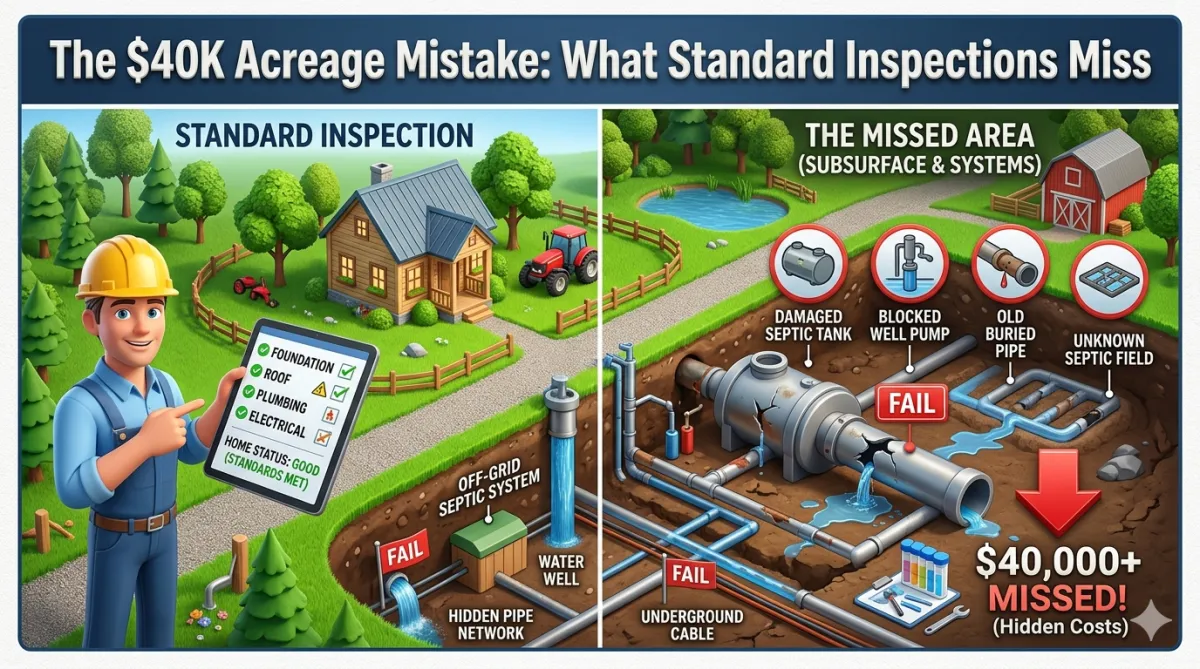
The $40K Acreage Mistake: What Standard Inspections Miss
Introduction
You've found your dream acreage. Beautiful property. Great location. The house looks solid. You're ready to make an offer. Your realtor recommends a home inspection. You hire a reputable inspector. They spend 3-4 hours examining the house. They produce a detailed report. The inspection comes back clean. A few minor issues, but nothing major. You proceed with confidence. You close on the property. And then, 3-6 months later, the problems start appearing. The well stops producing adequate water. The septic system backs up. You discover your fence is actually on your neighbor's property. Your utility bills are double what you budgeted. You call contractors. You get quotes. Well replacement: $28,000. Septic repair: $18,000. Legal resolution for boundary dispute: $8,000. Unexpected utility costs: $4,000 annually. Total unexpected costs in the first year: $58,000. And you realize: your home inspection didn't catch any of this. Because standard home inspections aren't designed to assess acreage-specific systems. This is the $40K Acreage Mistake (sometimes $60K+), and it happens to acreage buyers constantly — buyers who assume a standard home inspection is sufficient for rural property purchases. This post breaks down what standard inspections miss on acreage properties, what specialized inspections actually cover, real examples of costly post-purchase discoveries, and how to protect yourself with proper due diligence before you close.
What Standard Home Inspections Cover (And Don't Cover)
Let's start by understanding what a typical home inspection actually includes.
What Standard Home Inspections Cover
Structure and Foundation:
- Foundation cracks, settling, water intrusion
- Structural integrity of walls, floors, roof framing
- Basement/crawl space condition
Roof:
- Shingle condition, flashing, gutters
- Visible damage or wear
- Estimated remaining lifespan
Electrical System:
- Panel capacity and condition
- Visible wiring issues
- GFCI outlets, grounding
Plumbing System:
- Interior plumbing fixtures
- Visible pipe condition
- Water pressure (at the house)
- Drainage
HVAC Systems:
- Furnace/AC condition and operation
- Ductwork (visible portions)
- Filters, basic functionality
Interior:
- Windows and doors
- Walls, ceilings, floors
- Insulation (visible areas)
Appliances (if included):
- Basic operational testing
What Standard Home Inspections DON'T Cover on Acreages
Well System:
- Well yield (how much water it produces)
- Water quality and contamination
- Well depth and static water level
- Pump condition and age
- Pressure tank condition
Septic System:
- Tank condition and capacity
- Septic field condition and absorption
- System compliance with current standards
- Required pumping frequency
Property Boundaries:
- Accurate property lines
- Fence locations relative to boundaries
- Encroachments (yours or neighbors')
- Easements and right-of-ways
Outbuildings:
- Barns, shops, sheds (often excluded or superficially assessed)
- Structural soundness of agricultural buildings
- Permits and compliance
Land Conditions:
- Drainage and grading beyond immediate house area
- Soil quality
- Environmental issues
- Wetlands or protected areas
Rural Utilities:
- Propane system condition
- Water delivery arrangements
- True operating costs
The Gap
Standard home inspections are designed for city homes connected to municipal services. They assume:
- Municipal water (no well assessment needed)
- Municipal sewer (no septic assessment needed)
- Surveyed lot boundaries (no survey needed)
- Standard utilities (no propane, water delivery, etc.)
When you apply a standard home inspection to an acreage, you're leaving massive gaps in your due diligence.
Mistake 1: Skipping Well Inspection ($15,000-$35,000 Risk)
This is the single most expensive mistake acreage buyers make.
What Buyers Assume
'The house has water. The taps work. The well must be fine.'
The Reality
Well Condition Varies Dramatically: A 'working' well can have serious problems:
- Low yield (produces 2 GPM when you need 5-8 GPM)
- Declining production (yield dropping over time as well ages)
- Contaminated water (bacteria, nitrates, minerals)
- Aging pump nearing failure
- Shallow depth vulnerable to seasonal fluctuations
Standard Home Inspectors:
- Turn on taps and check water pressure at the house
- Don't measure actual well yield
- Don't test water quality
- Don't assess well or pump condition
What Can Go Wrong
Scenario 1: Low Yield Well You move in. Everything seems fine for the first month. Then you start running multiple showers, laundry, and dishwasher simultaneously. The well can't keep up. Water pressure drops. The pump runs constantly. You run out of water. You call a well company. They test the well: 2.5 GPM yield. You need 5+ GPM for a family. Solution: Drill a new well. Cost: $18,000-$35,000 Scenario 2: Contaminated Water You move in. The water tastes a bit off, but you assume that's normal for well water. Three months later, you finally get the water tested. Results: Total coliform bacteria present. Nitrate levels at 15 mg/L (unsafe, especially for infants). Solution: Install UV sterilization system and reverse osmosis filtration. Cost: $4,000-$8,000 Or, if contamination is severe and source can't be identified: Drill new well. Cost: $18,000-$35,000 Scenario 3: Aging Well Infrastructure You move in. Everything works for 6 months. Then the well pump fails. It was 22 years old and reached end of life. Solution: Replace pump and pressure system. Cost: $3,500-$8,000 But while diagnosing the pump, the well company notices the well casing is corroding and the static water level has dropped significantly. The well is failing. Solution: New well. Cost: $20,000-$35,000
What a Proper Well Inspection Covers
Flow Testing: Pump test to measure actual well yield (GPM). Static Water Level: Measurement of how deep water sits in the well when pump isn't running. Total Well Depth: How deep the well was drilled (determines water column depth). Recovery Rate: How quickly water level recovers after pumping (indicates aquifer recharge). Water Quality Testing:
- Bacterial testing (total coliform, E. coli)
- Chemical testing (nitrates, arsenic, iron, hardness, pH, etc.)
Pump and Pressure System:
- Pump age and condition
- Pressure tank condition
- Control systems
Well Construction:
- Casing condition
- Well cap and seal integrity
- Compliance with current standards
Cost: $500-$1,200 Value: Identifies $15,000-$35,000 in potential well replacement costs before you buy.
Mistake 2: Skipping Septic Inspection ($18,000-$50,000 Risk)
The second most expensive mistake.
What Buyers Assume
'The toilets flush. The drains work. The septic must be fine.'
The Reality
Septic Systems Fail Gradually: Septic systems can appear to function normally while actually being:
- Near capacity (tank needs pumping desperately)
- Field failing (absorption declining, wastewater surfacing)
- Undersized for current home (additions increased water use beyond system capacity)
- Non-compliant (doesn't meet current code, will require replacement when it fails)
Standard Home Inspectors:
- Flush toilets and run drains
- Don't inspect septic tank or field
- Don't assess system condition, age, or compliance
What Can Go Wrong
Scenario 1: Field Failure You move in. Everything works for 4-6 months. Then you notice wet spots in the yard. Sewage odor. Drains backing up. You call a septic company. They inspect: the septic field is saturated and failing. Wastewater isn't absorbing into the soil anymore. Solution: Replace septic field or install new advanced treatment system. Cost: $25,000-$45,000 Scenario 2: Tank at Capacity You move in. Within 2 months, drains start backing up. You call a septic company. The tank is completely full and hasn't been pumped in 8+ years. They pump it out (cost: $400-$600) and discover the tank is cracked and deteriorating. It needs replacement. Solution: Replace septic tank. Cost: $8,000-$15,000 And while replacing the tank, they discover the field is also compromised. Total cost: $25,000-$35,000 Scenario 3: Non-Compliant System You move in. Everything works. Five years later, you want to build an addition. The county requires septic inspection and compliance verification. The inspector finds: your septic system is a 40-year-old conventional system that doesn't meet current environmental standards. You can't get permits for your addition until you upgrade the septic. Solution: Install compliant advanced treatment system. Cost: $30,000-$50,000
What a Proper Septic Inspection Covers
Tank Inspection:
- Locate and uncover tank access
- Assess tank condition (cracks, deterioration)
- Measure sludge and scum levels (determine if pumping needed)
- Check baffles and filters
Field Assessment:
- Evaluate field location and condition
- Look for surfacing effluent, wet spots, odors
- Assess soil absorption
System Design:
- Verify system is adequate for home size and water use
- Check compliance with current county standards
Records Review:
- Installation date
- Pumping history
- Previous inspections or repairs
Cost: $400-$800 Value: Identifies $18,000-$50,000 in potential septic replacement costs before you buy.
Mistake 3: Skipping Property Survey ($5,000-$25,000 Risk)
This mistake creates legal nightmares.
What Buyers Assume
'The fences show the property lines. The listing says 5 acres. It's fine.'
The Reality
Fences Don't Define Property Lines: Fences are often placed incorrectly:
- Previous owner guessed at boundaries
- Fence was placed for convenience (straight line, avoiding obstacles)
- Property lines are irregular and fences don't follow them
- Neighbor built fence on your land (or you on theirs)
Standard Home Inspectors:
- Don't verify property boundaries
- Don't identify encroachments
What Can Go Wrong
Scenario 1: Your Fence Is on Neighbor's Property You close on your 5-acre acreage. Six months later, you decide to build a shop near the back fence line. You hire a surveyor to mark the building location. The surveyor discovers: your back fence is 15 feet onto your neighbor's property. Your neighbor now demands you remove the fence and rebuild it on the correct property line. Solution: Legal negotiations, fence removal and reinstallation, possible compensation to neighbor for use of their land. Cost: $8,000-$15,000 Scenario 2: Neighbor's Structure Is on Your Property You buy your acreage. A year later, you review the property more carefully and suspect the neighbor's shed is on your land. You hire a surveyor. Confirmed: the neighbor's shed is 6 feet onto your property. You approach the neighbor. They've been using that location for 20 years and refuse to move it. Solution: Legal action to force removal or negotiate easement/compensation. Cost: $5,000-$20,000 in legal fees, or ongoing loss of property use Scenario 3: You Own Less Land Than You Thought The listing says '5 acres.' You close on the property assuming you're getting 5 acres. Two years later, you hire a surveyor for an unrelated project. The surveyor measures: your property is 4.2 acres, not 5 acres. You overpaid based on incorrect acreage size. Solution: Legal action against seller for misrepresentation (difficult to win if you didn't verify with survey before closing). Potential Recovery: Limited, expensive legal battle Scenario 4: Easements You Didn't Know About You buy your acreage. You start planning to build a barn in what seems like a perfect location. You apply for a building permit. The county identifies an easement running through your property that you weren't aware of. You can't build on the easement. Your barn location is now impossible. You need to redesign or choose a different, less ideal location. Cost: Redesign costs, potentially thousands in lost value or functionality
What a Proper Survey Covers
Boundary Location: Professional surveyor marks exact property boundaries with pins/stakes. Acreage Verification: Confirms actual property size matches listing/title. Encroachment Identification: Identifies any structures (yours or neighbors') that cross property lines. Easement Location: Maps utility easements, access easements, rights-of-way. Legal Description Verification: Confirms legal description matches physical property. Cost: $1,500-$3,500 depending on property size and complexity Value: Identifies $5,000-$25,000 in potential boundary disputes and legal costs before you buy.
Mistake 4: Not Understanding Rural Utility Costs ($3,000-$6,000+ Annual Risk)
This doesn't cause a single catastrophic expense, but it creates ongoing budget strain.
What Buyers Assume
'We budget $200/month for utilities based on our current city home. Should be similar on the acreage.'
The Reality
Rural Utilities Cost More: City Home Utilities (Typical):
- Natural gas (heat, hot water): $80-$150/month
- Electricity: $80-$120/month
- Water/sewer: $80-$120/month
- Total: $240-$390/month
Acreage Utilities (Typical):
- Propane (heat, hot water, cooking): $150-$300/month (seasonal spikes in winter)
- Electricity: $100-$150/month
- Well maintenance (amortized): $30-$50/month
- Septic pumping (amortized): $30-$50/month
- Water delivery (if well inadequate): $0-$150/month
- Waste removal: $40-$60/month
- Total: $350-$760/month
Difference: $110-$370/month = $1,320-$4,440/year
What Can Go Wrong
Scenario: Underbudgeting Utilities You budget $250/month for utilities based on your city home experience. You move into your acreage. First winter arrives. Your propane bills are:
- November: $220
- December: $320
- January: $380
- February: $340
You're spending $300-$400/month on heating alone — $1,000-$1,500 more than you budgeted over the winter. Add electricity ($120/month), well maintenance ($40/month), septic ($40/month), waste removal ($50/month), and you're at $550-$650/month total utilities. Annual utility costs: $6,000-$7,800 Budget assumption: $3,000 Shortfall: $3,000-$4,800/year Over 5 years, that's $15,000-$24,000 more than you budgeted.
How to Avoid This
Ask for Utility History: Request 12 months of utility bills from the seller:
- Propane delivery invoices
- Electricity bills
- Well maintenance/repair invoices
- Septic pumping receipts
- Waste removal costs
Calculate Real Annual Costs: Add up actual costs from the past year. That's your baseline budget (adjust for your family size if different from seller's). Budget Realistically: If actual costs are $500-$600/month, budget $600-$700/month to account for price increases and your usage patterns.
The Complete Acreage Inspection Checklist
Here's what you need for proper acreage due diligence.
1. Standard Home Inspection
What It Covers: House structure, roof, electrical, plumbing, HVAC, interior Cost: $400-$700 Essential: Yes
2. Well Inspection
What It Covers: Yield testing, water quality, pump condition, well depth, static level Cost: $500-$1,200 Essential: Yes (if property has well)
3. Septic Inspection
What It Covers: Tank condition, field assessment, compliance, pumping needs Cost: $400-$800 Essential: Yes (if property has septic)
4. Property Survey
What It Covers: Boundary location, acreage verification, encroachments, easements Cost: $1,500-$3,500 Essential: Highly recommended (especially if fences/structures near boundaries or property size is critical)
5. Outbuilding Inspection
What It Covers: Structural condition of barns, shops, sheds Cost: $200-$500 (often can be added to home inspection) Essential: If outbuildings are valuable/important to you
6. Environmental Assessment (If Concerns Exist)
What It Covers: Soil contamination, previous land use, environmental hazards Cost: $1,500-$5,000 Essential: If property has history of industrial use, fuel storage, or other concerns
Total Inspection Investment: $3,000-$7,000
Total Risk Avoided: $40,000-$100,000+
Real Example: The Full $58K Mistake
Let me share a real scenario (details changed for privacy). Property: 5-acre acreage near Priddis, listed at $825,000 Buyer's Approach:
- Standard home inspection only ($600)
- No well inspection
- No septic inspection
- No survey
- Total due diligence: $600
Inspection Results: Home inspection found minor issues (weather stripping, minor roof wear). Buyer proceeded. Post-Closing Discoveries: Month 3: Well Failure
- Well yield dropped to 1.8 GPM (inadequate)
- Water quality test: nitrates at 14 mg/L (unsafe)
- Solution: New well + water treatment
- Cost: $32,000
Month 5: Septic Issue
- Drains backing up
- Septic field saturated and failing
- Solution: New advanced treatment system
- Cost: $38,000
Month 6: Boundary Dispute
- Neighbor complained about fence location
- Survey revealed fence 10 feet onto neighbor's property
- Solution: Legal negotiation + fence relocation
- Cost: $9,500
Month 12: Utility Bill Shock
- Annual propane costs: $3,600 (vs. $1,200 budgeted)
- Septic pumping: $500
- Well maintenance: $600
- Annual overage: $2,800
Total First-Year Costs: $82,300 If Proper Inspections Had Been Done: Well Inspection ($800): Would have identified low yield and water quality issues. Buyer could have negotiated a $30,000 price reduction, required seller to drill new well before closing, or walked away. Septic Inspection ($600): Would have identified failing field. Buyer could have negotiated a $35,000 price reduction, required seller to replace system before closing, or walked away. Survey ($2,500): Would have identified fence encroachment. Buyer could have required seller to correct before closing, negotiated a price reduction for correction costs, or walked away. Total Inspection Investment If Done Properly: $4,500 Total Costs Avoided: $80,000+ Net Savings: $75,500
How to Protect Yourself: Step-by-Step
Step 1: Make Your Offer Conditional on Inspections
Include in Offer: 'This offer is conditional upon the buyer obtaining, at buyer's expense, and being satisfied with: (a) A home inspection of the property; (b) A well inspection including flow testing and water quality analysis; (c) A septic system inspection; (d) A current survey of the property. Buyer shall have [10-14] business days from acceptance to complete inspections and either waive conditions or provide notice of withdrawal.' This gives you time to complete all inspections and walk away if major issues are discovered.
Step 2: Hire Specialized Inspectors
Don't rely on a general home inspector for well and septic. Well Inspection: Hire a licensed well contractor or hydrogeologist who specializes in well testing. Septic Inspection: Hire a septic system designer or licensed septic inspector (not just a general home inspector who 'looks at' the septic). Survey: Hire an Alberta Land Surveyor for legal survey work.
Step 3: Review All Reports Carefully
Red Flags in Reports: Well Report:
- Yield below 3-5 GPM
- Bacteria or high nitrates detected
- Static water level very deep or minimal water column
- Well age 30+ years
Septic Report:
- Tank at or near capacity
- Field showing signs of saturation
- System non-compliant with current standards
- Age 25+ years
Survey:
- Encroachments identified
- Acreage significantly less than listing
- Easements limiting usable land
Step 4: Negotiate or Walk Away
If Major Issues Found: Option A: Negotiate Price Reduction Request reduction equal to repair/replacement costs. Example: Well needs replacement ($28,000) — Request $28,000-$30,000 price reduction. Option B: Require Seller to Fix Make closing conditional on seller completing repairs and providing documentation/warranties. Option C: Walk Away If issues are too severe or seller won't negotiate, exercise your condition and withdraw from purchase.
Step 5: Budget Realistically
Use actual data from inspections and seller disclosures:
- Well condition — Budget for replacement timeline
- Septic age — Budget for future replacement
- Utility bills (request 12 months) — Budget actual costs, not assumptions
FAQ: Acreage Inspections
Do I really need all these inspections? If you're buying an acreage with well and septic, yes. The cost of inspections ($3,000-$5,000) is minimal compared to the risk ($40,000-$100,000+ in unexpected repairs). Can't a general home inspector check the well and septic? They can do a superficial visual check, but they won't do flow testing, water quality analysis, or septic field assessment. You need specialists. What if the seller refuses to allow inspections? Walk away. A seller who won't allow well, septic, and survey inspections is hiding problems. Should I get a survey even if there are no fences or structures near boundaries? Yes. Easements, acreage verification, and future boundary certainty are worth the cost. Can I negotiate inspection costs with the seller? You can try, but typically buyers pay for inspections. It's your due diligence to verify what you're buying. What if inspections find issues but seller won't negotiate? Walk away. If the seller won't reduce price or fix major issues (well failure, septic failure), you'll be stuck with those costs after closing.
Conclusion
The $40K Acreage Mistake: skipping specialized inspections and assuming standard home inspections are sufficient. Standard home inspections don't cover well systems, septic systems, property boundaries, or rural utility realities. Without proper due diligence, you risk:
- $15,000-$35,000 well replacement
- $18,000-$50,000 septic replacement
- $5,000-$25,000 boundary dispute resolution
- $3,000-$6,000 annual utility cost overruns
Total exposure: $40,000-$100,000+ in unexpected costs. Prevention cost: $3,000-$5,000 in specialized inspections. Don't let your dream acreage become a financial nightmare. Invest in proper due diligence before you close. If you're considering an acreage purchase and you want help coordinating the right inspections and protecting yourself from costly post-purchase surprises — that's exactly the kind of strategic guidance I provide acreage buyers. Save this, and reach out if you're thinking about buying acreage.
Related Reading
If you found this useful, these posts go deeper on acreage buying due diligence:
- How to Read a Well Report Like a Pro (In 60 Seconds)
- 5 Things Nobody Tells You Before Buying an Acreage Outside Calgary
- 3 Zoning Red Flags That Will Kill Your Horse Property Dreams
About Kristen Edmunds
Kristen Edmunds is a Calgary-area REALTOR and Associate Broker with KIC Realty, specializing in acreages, luxury homes, and smart buy/sell strategies. With expertise in rural properties (water wells, septic, equestrian facilities) and a client-obsessed approach, Kristen helps buyers and sellers achieve their real estate goals with confidence and ease.