
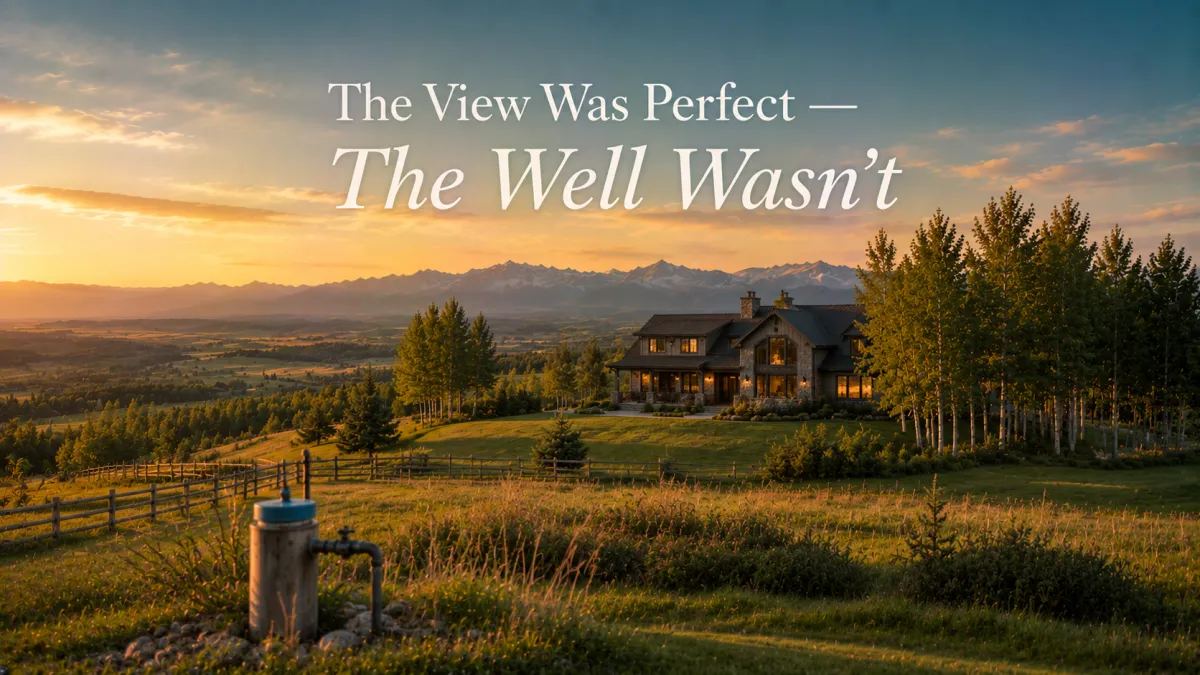
The View Was Perfect. The Well Wasn't. Here's How We Caught It in Time.
This post is a composite scenario, drawn from how I handle acreage due diligence on the buy side — not a specific identifiable client, property, or address. What I want to walk through is the process. The specific example is a well red flag, because well issues are one of the most common "beautiful disaster" hiding places on Calgary-area acreages. But the shape of the story is the same whether the hidden issue is water, septic, zoning, outbuildings, drainage, or anything else on the Acreage Protection Protocol. The point is not this specific well. The point is what the process is designed to do.
The scenario
A buyer had fallen in love with an acreage. Sweeping views. A house that felt right walking through it. The right acreage size for what they had pictured. Every element on the surface was what they had been looking for during months of quietly narrowing their criteria. By the end of the walkthrough, they were emotionally locked in. They wanted this property.
In acreage buying, that moment — emotional lock-in on the walkthrough — is often the exact moment when the ability to see the property clearly starts to disappear. It is normal. It is human. And it is exactly why my process does not rely on the buyer being clear-headed at that moment. The process is what stays clear-headed for them.
What the process actually did
Before conditions came off — while the buyer still had the leverage that only exists during the due-diligence window — we did what the Acreage Protection Protocol calls for on every acreage transaction I handle:
Dug into the guts of the land systematically — well, septic, zoning, outbuildings, systems, condition — rather than eyeballing any of it at the walkthrough.
Brought in proper technical professionals to do proper testing and assessment on each of those components. Water testing and well assessment by the right specialist. Septic inspection. Zoning verification against the current land-use bylaw. Outbuilding condition assessment. The full workflow, not a partial version of it.
Coordinated the timeline so that all of the findings would come back inside the condition window, giving the buyer real time to review them and real options if something surfaced.
Nothing about that process is dramatic. It is just deliberate. It happens whether or not the surface presentation of the property suggests anything might be wrong. The whole point of the process is that you cannot tell from the walkthrough what the systems are actually doing.
What the well revealed — directionally
The well testing surfaced a red flag. I am going to keep this deliberately general, because the point is not the specific well — the point is the pattern.
Directionally, the finding was the kind of water supply concern that would not reliably support the household on the property long-term. Not a hypothetical concern. Not a "worth watching" concern. A real, documented finding that would have material consequences for how the buyer lived on the property day-to-day, and for what the property could reasonably be relied on to provide.
The beautiful surface presentation of the property had hidden it entirely. The taps ran on the walkthrough. The house had been lived in. Nothing at the visible level of the property flagged what the well was actually doing. That is not unusual. Well issues rarely announce themselves at the front door.
Why "when" the issue was caught mattered more than "what" it was
This is the part of the story that most buyers do not fully understand until they have been through it: the same red flag surfaced at different points in the transaction leads to very different outcomes.
Caught during the due-diligence window — while the offer's conditions are still in place — the buyer has real options. They can go back to the seller and renegotiate the price to reflect the reality of the finding. They can require the seller to remediate the issue as a condition of the sale. Or they can walk away from the property entirely without penalty, keep their deposit, and continue looking for the right acreage for them. All three options are on the table. The buyer has leverage. The buyer is protected.
Caught after possession — when the buyer is already the owner of the property — the same red flag becomes the buyer's problem to solve. There is no seller across the table. There is no renegotiation. There is no walk-away. There is a bill, and there is the practical reality of a household that has to make the property work while the issue is being resolved. Water issues in particular are typically five figures to remediate properly, and sometimes more, depending on the specifics of the situation.
Same buyer. Same property. Same finding. Very different outcome. The difference is the timing of the discovery, and the timing is entirely determined by whether the due diligence gets done properly during the condition window or not.
What this teaches about acreage buying more broadly
The takeaway from this composite is not "always test the well" — although you should always test the well. The takeaway is a mental model that applies to every acreage decision:
The view sells the property. The systems determine whether it is actually a good buy.
These are two completely different questions. The view — meaning the surface presentation, the aesthetic, the emotional resonance of the walkthrough — is what makes a buyer want a property. That is real, and it matters, and I do not try to talk buyers out of it. My clients want to love the property they buy, and they should.
But the systems — water, septic, zoning, outbuildings, drainage, condition, infrastructure — are what determine whether the property will actually work for them over the years they intend to live there. The systems are what determine whether the property is a good buy at the price they are paying. And the systems, unlike the view, cannot be assessed at the walkthrough. They have to be tested.
An acreage buyer who is only assessing the property based on the view is buying on incomplete information. An acreage buyer who is assessing the property based on the view AND the systems, in that order, is buying on complete information. The difference between the two, in a market where the beautiful disaster is a real risk, is the difference between owning an acreage that keeps working for you and owning an acreage that costs you.
What the Acreage Protection Protocol is, and what it is not
The Acreage Protection Protocol is the systematic due-diligence framework I run for every acreage buyer I work with. It is not a marketing brochure. It is the actual checklist I use to make sure nothing gets missed on the systems side of a property before the offer goes firm.
It is not about being pessimistic on properties. Most of the time, the properties my buyers seriously consider come back clean, and we move forward with the deal confidently. The protocol is what allows the confidence to be earned rather than assumed. When the property does come back with a finding, the same protocol is what turns the finding into decision-quality information the buyer can act on with leverage.
It is also not a substitute for the right technical professionals. The protocol coordinates them, sequences them, and interprets the findings for the buyer in decision-quality terms. The professionals themselves do the specialist work. That combination — process plus specialist expertise — is what makes the protocol work.
The bottom line
The view was perfect. The well was not. Because the process was in place and the timing was right, the buyer in this composite scenario had real options — renegotiate, remediate, or walk — instead of a five-figure problem they would have owned outright.
The beautiful disaster is a real risk on Calgary-area acreages. The Acreage Protection Protocol is the process built to prevent it. If acreage is on your radar in the next 12-18 months, comment PROTECT on the video and I will send you the Acreage Protection Protocol — the framework I use with every acreage buyer to make sure the systems side of the property gets properly assessed before conditions come off.