
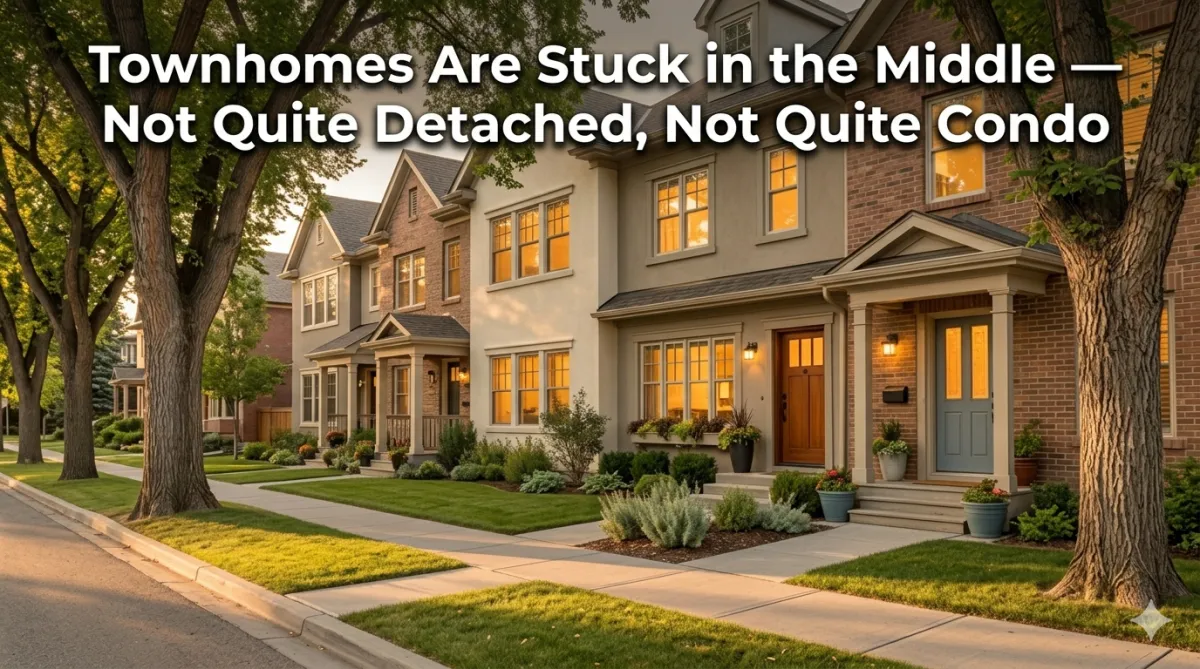
Calgary Townhomes: Why They're Stuck in the Middle
Townhomes in Calgary face a market dynamic that gets less honest analysis than the segment deserves. They are stuck in the middle — too fee-laden and small to compete cleanly against entry detached, too expensive and house-like to compete cleanly against condos, and saddled with a buyer pool that's actively comparing across all three categories simultaneously.
What follows is a calm walk-through of why the townhome market behaves the way it does in 2026 Calgary, the three buyer pools the segment is competing against, how to price and present a townhome honestly, and where in the market townhomes actually make excellent sense.
The Three Buyer Pools
The townhome segment doesn't compete in isolation. A buyer evaluating a $475,000 townhome is, in most cases, also evaluating a $425,000 condo and a $625,000 entry detached. Each option offers something the others don't, and the townhome has to win the comparison on the dimensions where it actually leads.
Condos ($350,000 to $500,000).Price-similar to many townhomes, with lower square footage, no individual entries, often more amenities, and typically lower condo fees in well-managed buildings. The buyer who chooses condo over townhome usually values walkability, less maintenance, and a tighter price point.
Entry detached ($550,000 to $700,000).More space, no fees, no shared walls, more maintenance. The buyer who chooses entry detached over townhome usually values yard, garage, and the long-term equity story of a detached title.
Other townhomes.The direct comp set. Within this pool, buyers compare floor plans, finishes, condo fees, building condition, location, and the specific complex's reputation.
The townhome that wins is the one that understands which of these three pools is actually deciding to buy it, and positions accordingly.
The Condo-Fee Math
Calgary townhome condo fees typically run $200 to $450 per month. That's $2,400 to $5,400 annually, paid for the life of the ownership.
Buyers translate this into mortgage-equivalent math, often subconsciously. A $300 monthly fee at current rates is roughly equivalent to carrying an additional $50,000 to $70,000 of mortgage debt. That number affects what the buyer is willing to pay for the unit itself. A townhome at $475,000 with $400/month fees competes, in the buyer's mental math, against a $525,000 detached with no fees — not against a fee-less townhome priced at the same number.
Sellers who don't account for this when pricing typically sit on the market longer than expected, and accept reductions that wouldn't have been necessary if the price had been calibrated for the buyer's actual comparison.
The Maintenance Split Most Sellers Underplay
Townhomes have an awkward maintenance arrangement that confuses both buyers and sellers. In most Calgary townhome complexes:
Roof, structure, and exterior siding are typically condo-board responsibility (paid from fees and reserve fund).
Interior finishes, plumbing fixtures, appliances, and most yard maintenance fall to the unit owner.
Windows, doors, and decks vary by complex — sometimes shared, sometimes individual.
This matters for two reasons. First, buyers want to know clearly what they're responsible for and what the board handles. Second, the reserve fund — what's accumulated to pay for the major shared repairs — is one of the most important documents to review during the conditional period. A complex with a thin reserve fund and an aging roof is essentially deferring a special assessment that will land on owners in the next 2 to 5 years.
Where Townhomes Actually Make Sense
Townhomes work — meaningfully well — for three specific buyer profiles in Calgary.
The first is the first-time buyer who wants walkability and inner-city access without the detached price point. Townhomes in established Calgary inner-city communities (Killarney, Hounsfield Heights, Mission, Inglewood, Bridgeland) offer a meaningful slice of detached lifestyle at a meaningfully lower entry price. For this buyer, the comparison isn't "townhome vs detached" — it's "townhome inner-city vs detached suburban," and the townhome wins on commute, walkability, and lifestyle.
The second is the downsizer who wants less yard but more space than a condo. A 1,400 to 1,800 square foot townhome with two or three bedrooms, a small private outdoor space, and shared structural maintenance is genuinely the right product for a meaningful subset of empty nesters and near-retirees. The condo alternative often feels too small; the detached alternative carries maintenance they're explicitly trying to leave behind.
The third is the young professional couple or single buyer who wants multi-floor space and a bit of outdoor without the maintenance burden of detached. For dual-income households earning $120,000 to $200,000 combined, a $500,000 to $650,000 townhome in the right complex often makes more financial sense than either the condo or the detached alternative.
Outside these three profiles, the segment runs harder than the broader market data suggests. Townhomes are not for everyone — and they sell best when they are positioned for the buyers who actually fit.
How to Sell a Townhome Well
Three practical guidelines for sellers in this segment.
First, price against the actual competition, not the wishful comp set. A townhome priced against other townhomes alone, in a market where buyers are also looking at condos and entry detached, will be slow. The right price reflects what the buyer's full comparison set actually looks like.
Second, present the condo-fee math proactively. A clean summary of what the fees cover, the reserve fund position, and any pending special assessments removes a meaningful buyer objection. Hiding the fee math or treating it as a buyer's problem typically extends days on market.
Third, highlight what townhomes actually win on. Multi-floor space without yard work. Walkability with private entry. Lower entry price than detached with more space than condo. These are real advantages — for the right buyer.
How to Buy a Townhome Wisely
Three practical guidelines for buyers.
First, review the condo documents seriously. Reserve fund study, last two years of AGM minutes, current financials, and disclosure of any current or pending special assessments. This is the single most predictive document set for whether the townhome is a good buy or a hidden liability.
Second, run the all-in monthly cost honestly. Mortgage, plus condo fee, plus property tax, plus utilities, plus the maintenance you'll cover yourself. Compare to what you'd pay for an equivalent condo or detached. Make sure the math works at the actual all-in number, not the headline mortgage figure.
Third, understand the buyer-pool dynamic when you go to sell in 5 to 10 years. The townhome you buy today will compete against the same three pools when you list. Properties that compete poorly from any of those angles (small floor plan, high fees, aging building) will face the same challenges then.
Frequently Asked Questions
What's the difference between a fee-simple townhome and a condo townhome?
A fee-simple townhome is true freehold ownership with no condo association, no condo fees, and no shared governance. The owner is fully responsible for everything. These are rare in Calgary and typically command a price premium over condo-titled townhomes. Most Calgary townhomes are condo-titled in some form (conventional condo or bare land condo).
How do bare land condo townhomes work?
In a bare land condo (BLC) townhome, the owner owns the land beneath the unit (not the airspace, as in a conventional condo). Maintenance and management of common elements are still handled by a condo board, but the structure of ownership is slightly different. Buyers should look at the specific BLC bylaws and reserve fund the same way they would a conventional condo.
Why are some Calgary townhome complexes priced significantly higher than others?
Three drivers: location (inner-city vs. suburban), building age and condition (reserve fund position matters more than buyers usually appreciate), and the specific buyer profile the complex appeals to. A 1990s townhome with thin reserves in a suburban location is a very different product from a 2018-built inner-city complex with strong reserves, even if both are technically townhomes.
Are townhomes a good investment?
For owner-occupiers who fit one of the three buyer profiles, yes — meaningful equity accumulates with the right purchase. For pure investment (rental hold), the math is harder. Condo fees compress yield, and townhomes typically appreciate less aggressively than detached. Investors who buy townhomes in Calgary do so with a specific buyer-pool thesis, not a generic rental hold.
Closing Thought
Townhomes are not a failed housing type — they are a specific one. They serve specific buyers exceptionally well and serve others poorly. The market mistake on both the buy and sell sides is treating townhomes as either "small detached" or "fancy condo" rather than the distinct category they actually occupy.
If you're selling a townhome and frustrated by the pace, the issue is rarely the product itself. It's usually how it's priced and presented against the wrong buyer pool. If you're buying, the issue is rarely whether townhomes are "worth it" — it's whether this specific townhome fits the specific household honestly.
The work I do in this segment is structured, segment-specific, and built around understanding the three buyer pools the property is actually competing against — not the generic Calgary market data. If you're a townhome buyer or seller looking at this market in 2026, the conversation worth having runs all three comparison sets honestly.