
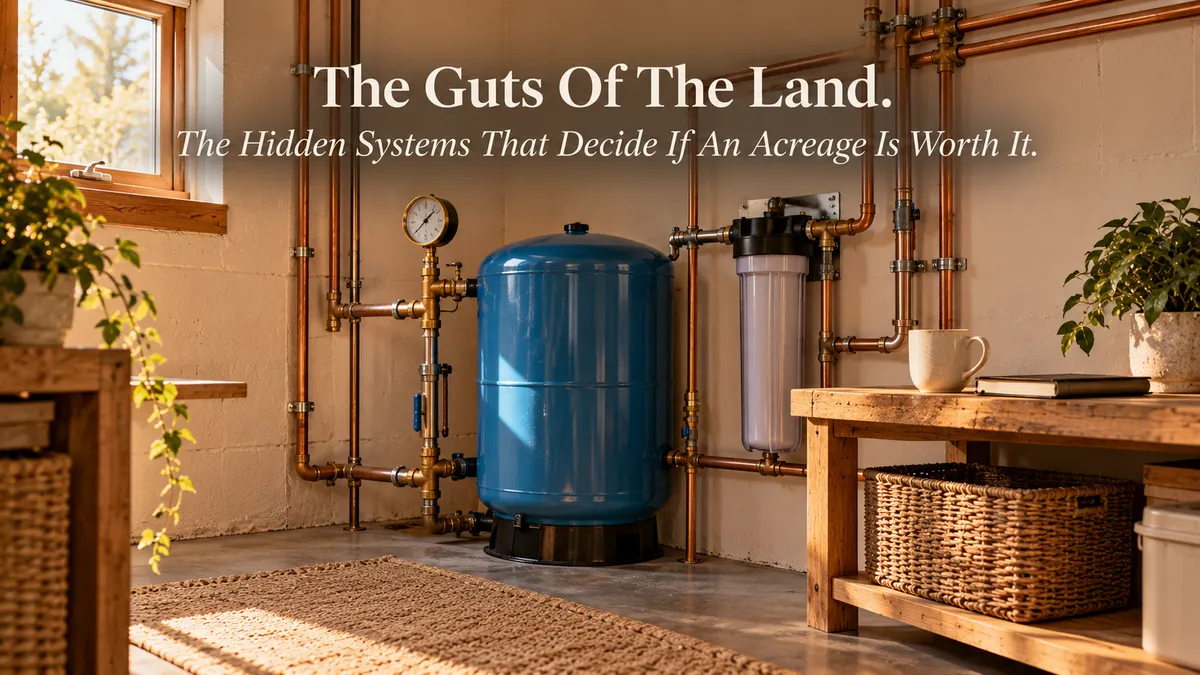
The Guts of the Land. The Hidden Systems That Decide If an Acreage Is Worth It
City buyers tend to judge a home by what they can see. The kitchen. The finishes. The light. The view. That is a reasonable instinct in a city market, because most of what actually determines whether a city home is sound is also what the buyer can see, or what a standard home inspection will surface in an afternoon. The visible part and the sound part are roughly the same part.
On an acreage, that stops being true. The visible part is still the visible part (and it is often beautiful, which is part of what pulls buyers to acreage in the first place), but the sound part moves underneath. The things that actually decide whether an acreage property is a good buy are mostly invisible. I call them the guts of the land, and this post is the high-level tour of them.
The point of the piece is not to teach any one system in depth. The point is to reset how a buyer looks at an acreage. The beautiful part sells the property. The guts of the land decide whether it is a good buy. Learning to look past the finishes to the systems underneath is the single biggest mindset shift that protects an acreage buyer from the kind of expensive, permanent problem that a stunning property can quietly carry.
Why acreage is different in this specific way
A city home sits inside a municipal infrastructure. Water comes in through a pipe someone else owns. Waste leaves through a sewer someone else maintains. The road is cleared by the city. Zoning is generally straightforward within a given neighbourhood. The utility companies manage the heat and power supply. The buyer inherits a house, and the infrastructure around the house just works.
An acreage sits inside its own infrastructure. The water comes from a well on the property. The waste goes to a septic system on the property. The road and driveway may be the owner's responsibility in whole or in part. Zoning is governed by county rules that vary by parcel. The heating source may be propane or wood or natural gas, each with its own supply arrangement. The electrical access may involve specific rural considerations. Nothing about this is complicated once understood. All of it belongs to the property, not to the municipality.
Which means an acreage buyer is not just buying a house. They are buying an entire set of systems that the municipality would otherwise handle. Those systems are the guts of the land, and they are what the due diligence process actually spends most of its real work on.
The five categories that make up the guts of the land
1. The well
The well is where the water comes from. The questions that matter are whether the well can reliably supply the home for the household's actual use, what the water quality looks like, what treatment the well requires (if any), and what the well's maintenance picture looks like over the realistic timeline of ownership.
None of this is a judgment call the buyer should make alone. A proper well evaluation involves a specific set of professionals and a specific set of reports. The buyer's job, with the right advisor, is to make sure the evaluation happens with the right people and to understand the answer in plain language.
2. The septic
The septic system handles waste from the home. The questions that matter are what type of system it is, what condition it is in, what its remaining useful life looks like, and what the maintenance picture looks like going forward.
A septic in good condition on an acreage is a non-issue. A septic nearing the end of its life, with the buyer not knowing it, is one of the most expensive and avoidable surprises in acreage ownership. The due diligence window exists in meaningful part to prevent that surprise.
3. The land itself
The land is a system too. How it drains, how it is graded, and how it handles water in the spring and after storms all matter to whether the property is going to behave the way the buyer expects it to over the course of ownership.
A beautiful property with poor drainage can produce a basement issue every spring, outbuilding damage in a wet year, and chronic frustration for an owner who did not understand what the land was telling them before they bought it. A buyer who learns to read the land as part of the evaluation, rather than only looking at the house that sits on it, is a different kind of buyer.
4. Zoning and permitted use
Zoning and permitted use govern what the buyer is actually allowed to do with the property. This matters most when the buyer has a specific plan for the land (a home business, a workshop, animals, a project), but it also matters in general, because the land-use classification of the parcel shapes a lot of what the buyer can and cannot do with the property over the course of ownership.
This is one of the categories where a buyer's assumption is most likely to be partially wrong, because the intuition that rural means "do whatever you want" is a persistent and understandable one. In practice, every parcel is governed by specific rules, and those rules are knowable in advance.
5. The other systems rural properties run on
Beyond the four above, there is the general category of other systems that acreage properties depend on. The heating source. The electrical access. The road and driveway. The outbuildings and their condition. The fencing. Any irrigation or water-management systems the property carries.
None of these needs to be perfect on day one. All of them should be understood on day one. A buyer who moves through the due diligence window with a clear picture of what each of these systems looks like on the specific property has a materially different experience of ownership than a buyer who assembles the picture one surprise at a time after possession.
What the mindset shift actually looks like
Buyers who adopt the guts-of-the-land framework stop asking "do I love it" as their first question on an acreage, and start asking "is it sound" as their first question, with "do I love it" following naturally once the first question is answered.
That is not a shift away from loving the property. It is a shift in the sequence. The beautiful part is why anybody is looking at a specific acreage in the first place. The guts of the land are what tells the buyer whether loving it is a good idea. Both questions matter. The order in which they get asked is what changes the outcome.
Buyers who ask the two questions in that order almost always end up either in a property they love that is also sound, or in a property they walked away from because the systems underneath did not support loving it long-term. Both of those outcomes are good. Buyers who ask them in reverse order sometimes end up in beautiful properties with expensive hidden problems, and those are the stories that nobody wants to be the subject of.
How I use this framework with clients
The guts-of-the-land framework is embedded in how I run due diligence on every acreage property. The specific evaluation of each system involves specific experts (well testers, septic inspectors, home inspectors, county planning offices, lawyers familiar with land-use matters, trades who work rurally), and my role is to coordinate the sequence, make sure each system gets its proper look, and help the buyer make sense of the answers in plain language.
I am not a technical authority on any one of these systems. No responsible acreage advisor is. What I am is the person who makes sure every one of them gets investigated properly for the specific property, by the right people, before the offer becomes unconditional. That is what "protection over persuasion" actually looks like at the technical level.
The bottom line
The guts of the land are the five categories of systems that mostly decide whether an acreage is a good buy: the well, the septic, the land itself, zoning and permitted use, and the other systems rural properties run on. The beautiful part sells the property. The guts decide whether it is a good buy. Learning to look past the finishes to the systems underneath is the single biggest mindset shift that protects an acreage buyer.
The full Guts of the Land guide is available at kristenedmunds.ca/the-guts-of-the-land, or comment GUTS on the video and I will send it over.