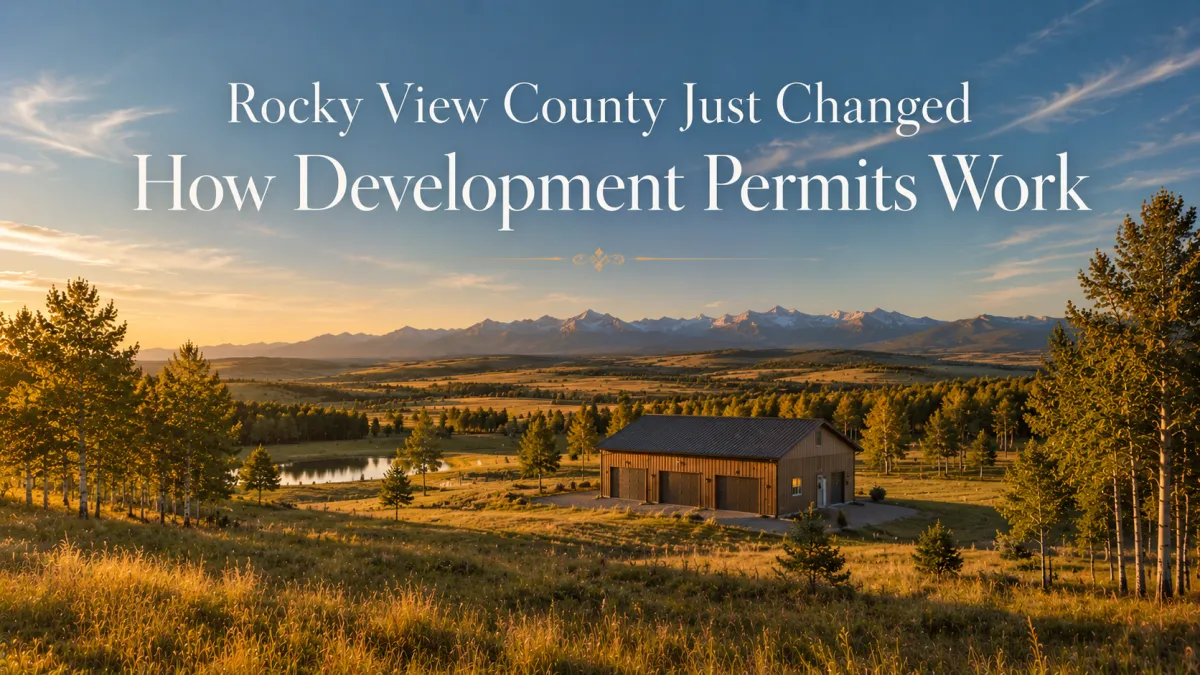
Rocky View County Just Changed How Development Permits Work — Here's What Acreage Buyers and Owners Need to Know
If you are considering an acreage purchase in Rocky View County and you have plans for the property after possession — a shop, a barn, a greenhouse, a secondary suite, or even routine improvements to what is already there — Rocky View County has been quietly changing how the development permit process works. Most buyers do not know about it. Most agents outside the acreage specialty do not know about it. And it directly affects your timeline, your carrying costs, and what you can realistically do with the property in the first twelve months after you take the keys.
This is the kind of county-level detail I walk every one of my acreage buyers through — usually before they write the offer, not after. Here is what is changing, why it matters, and the questions to ask before you sign anything.
What the Development Approvals Transformation Program actually is
Rocky View County has been overhauling its Land Use Bylaw as part of what the County calls the Development Approvals Transformation Program. It is a multi-phase effort to make development approvals clearer, more consistent, and faster to navigate. The high-level goal is to stop applying the same heavy review process to a routine shed application that gets applied to a complex multi-parcel commercial development — which is what the current system does.
Right now, Rocky View's development permit system is essentially binary. Either what you want to build is fully exempt from a development permit — meaning you can proceed under the general rules of the Land Use Bylaw without a specific approval — or it requires a full development permit, which is a much heavier lift.
A full development permit in Rocky View can involve internal County review, external agency review, a formal public notice period, a written appeal window during which neighbours or affected parties can appeal the decision, and the timeline that goes with all of that. For a straightforward shop or shed that has zero real impact on any neighbour, that entire process can feel disproportionate to what is actually being built.
The proposed Conditional Exemption tier — the change buyers need to understand
The key change under the current phase of the Development Approvals Transformation Program is a proposed new Conditional Exemption category that sits between fully exempt development and a full development permit.
The purpose of the Conditional Exemption tier is to streamline routine, lower-impact types of development — things like shops, sheds, decks, smaller outbuildings, and minor property improvements — so that they move through a faster, lighter review process rather than being pushed all the way through a full development permit review. The goal is straightforward: match the level of review to the level of impact.
What this means in practice, if the proposed changes proceed:
Lower-impact builds that meet the conditional criteria move through a faster review path with less procedural weight
County planning staff spend less time on routine applications and more time on complex or genuinely higher-impact ones
The full development permit process — with public notice and appeal periods — is reserved for the applications where that level of review genuinely matters
For a buyer who plans to add a shop, a shed, or a routine outbuilding to their new acreage, the timeline gap between "we took possession" and "the shop is up" gets meaningfully shorter
None of this eliminates due diligence on the buyer's side. It changes the review path — not the underlying rules of what is allowed on a given parcel under the Land Use Bylaw.
The 2024 setback amendment was the preview
If you want a sense of the direction Rocky View has been moving, the 2024 amendment to the Land Use Bylaw is the most useful reference point. Prior to that change, even a minor setback issue on an existing building — say a shop that was built years ago and turned out to be a few feet too close to a property line — could trigger a full development permit application for a variance. That is a heavy, expensive, time-consuming process for a small pre-existing measurement error.
The 2024 amendment introduced a tolerance: setback variances of up to 5% on existing buildings no longer automatically trigger a full development permit. That single change saved a lot of Rocky View property owners a lot of time and money on issues that, on inspection, were never really issues in the first place.
The Conditional Exemption tier that is now being proposed builds on that same logic. Match the review to the actual impact. Stop treating routine issues as complex ones.
What this means for a buyer's timeline and carrying costs
If you are buying an acreage in Rocky View with post-possession plans, the development permit process is not an abstract policy question. It is directly connected to the arithmetic of your first year of ownership.
Here is what I mean. If you are buying a $1.2M acreage with a mortgage, you are carrying real monthly costs from day one. If your plan involves building a shop or an outbuilding — and if that build has to go through a full development permit — the timeline from possession to construction start can be months. During those months, you are carrying the property, paying the mortgage, paying property taxes, paying utilities, without the use or enjoyment of the shop you bought the property to have.
If the same build can move through the proposed Conditional Exemption tier instead, you compress that timeline meaningfully. The build starts sooner. The property gets to serve the purpose you bought it for sooner. And the "wait" between possession and actually living the acreage life you had planned shrinks.
This is a real number. It is not a theoretical policy detail. And it is exactly the kind of thing that never comes up in a typical urban buyer conversation — because urban buyers rarely need a development permit for anything after they take possession of a residential lot inside city limits.
The questions to ask before you write the offer
If you are considering an acreage in Rocky View County and you have any plan at all for post-possession improvements or builds, these are the questions worth working through before you sign anything:
What does the current zoning on this specific parcel allow — and what does it require a permit for?
Are there any existing setback issues, non-conforming structures, or open permits on the property that will follow me post-possession?
Under the current Land Use Bylaw, what would my planned build — shop, barn, greenhouse, secondary suite, arena — require in terms of permit process?
If the Development Approvals Transformation Program's proposed changes proceed, would my planned build shift into the Conditional Exemption tier or stay in full permit review?
What is the realistic timeline from possession to build completion for what I actually want to do?
These are questions I work through with buyers before we go firm on a property, not after. The answers materially change the offer strategy, the negotiation, and — sometimes — whether a specific property is even the right fit for what the buyer actually wants to do.
Frequently asked questions
Are the Conditional Exemption tier changes in effect now, or still being proposed?
As of mid-2026, the Conditional Exemption tier is part of the current phase of the Development Approvals Transformation Program and is being consulted on with residents. Timing on formal adoption depends on Council process and the public consultation phase. Before you rely on it for a specific build, check with the County directly — engage.rockyview.ca/land-use is the current engagement page — or ask your agent to confirm the current status.
Does this only apply to Rocky View County, or do other counties have similar programs?
The Development Approvals Transformation Program is specifically a Rocky View County initiative. Foothills County, Mountain View County, and Wheatland County each have their own Land Use Bylaws and their own approval processes. They are structured differently, and the review paths for the same type of build can vary meaningfully from county to county. If you are considering acreages in more than one county, expect the development permit reality to look different in each one.
If a build qualifies for the Conditional Exemption tier, does that mean I don't need to worry about setbacks or zoning?
No. The Conditional Exemption tier is about the review path, not about the underlying rules. Setbacks, zoning classifications, height restrictions, and lot coverage requirements still apply. What changes is the process for getting the build approved — not what is allowed in the first place. This is why understanding the parcel's specific zoning designation before you make an offer still matters.
Can my agent look this up for me, or do I have to figure it out myself?
This is exactly the kind of research an acreage-specialist agent should be doing on your behalf as part of due diligence. That said, most agents who do not specialize in acreage do not track county-level bylaw updates and do not routinely walk buyers through post-possession build feasibility. If your agent cannot answer these questions, that is a signal — not an inconvenience.
The bottom line
Rocky View County has been methodically making its development approval process better matched to the actual level of impact of what is being built. That is a good thing for acreage buyers, and it is a change that most people making an offer on a Rocky View property this year will not know about until after they have possession — if they ever hear about it at all.
This is the kind of county-level detail that separates a well-prepared acreage purchase from a purchase that turns into a series of expensive surprises after possession. If you are buying in Rocky View and you have plans for the property after you take possession, book a strategy call before you write the offer. This is exactly what I walk every one of my buyers through.