
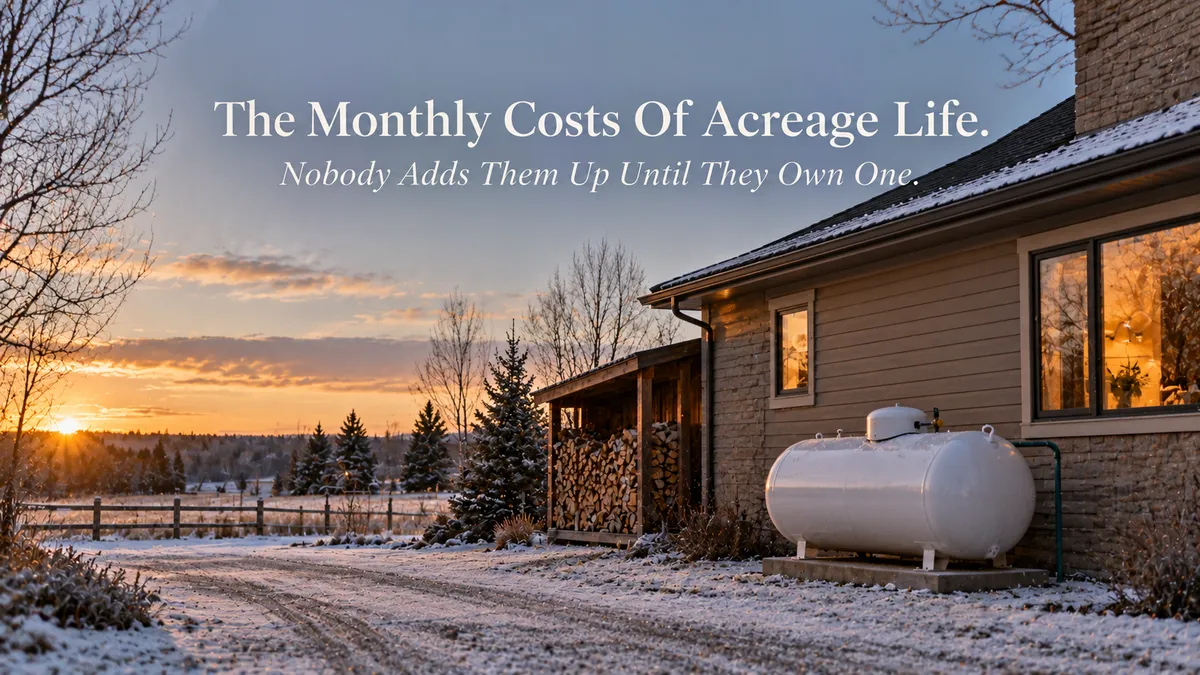
The Monthly Costs of Acreage Life Nobody Adds Up Until They Own One
Most Calgary-area acreage buyers plan carefully for the two big numbers: the purchase price and the mortgage. Almost no one plans as carefully for the third number, which is the actual monthly cost of running an acreage once it is theirs.
That third number is not small. And it is the number most likely to arrive one bill at a time after possession, in a sequence of expenses that add up to a real monthly figure that had never been sitting on the buyer's spreadsheet.
This post walks through the categories that make up that number. It is educational and directional. Every category varies meaningfully by property, by size, by location, and by season. Specific dollars are best worked out for the specific property under consideration, not applied as a fixed rule. What follows is the framework for thinking about it clearly.
Why the third number gets missed
Two things drive the gap.
First, city living hides the cost of most of these categories inside monthly bills that feel unremarkable. Municipal water, sewer, garbage, snow clearing, road maintenance, and stable insurance premiums all get absorbed into a rhythm that becomes background. On an acreage, most of those categories become the buyer's own line items again, and the numbers become visible.
Second, the listing and financing conversation does not naturally raise this number. The listing shows the price. The mortgage broker shows the payment. Neither is set up to walk a buyer through what the property will actually cost to run every month once it is theirs. That work has to happen deliberately, and it has to happen before the offer, not after.
The categories worth building into the picture
1. Heat
Typically the largest ongoing category. Acreage homes are often larger than comparable city homes. They are often less energy-efficient (older construction, more windows, higher ceilings, less insulation than modern city builds). And they are usually heated with propane, natural gas, or wood rather than through a municipal utility.
In an Alberta winter, heating cost matters. It varies by the size of the home, the efficiency of the heating system, the fuel type, and the specific winter. The category is not something to eyeball. It is something to actually estimate for the specific property being considered.
2. Well and septic
Both systems require ongoing upkeep. Water testing. Filter changes. Periodic septic pumping. Occasional service calls when something needs attention.
Neither is expensive on any given month in most cases. Both are meaningful over the course of a year, and both can produce larger unplanned expenses when something needs professional attention. Building a reasonable annual budget for both categories, and understanding what the specific systems on the specific property are likely to need, is part of the real number.
3. Snow removal and driveway or road maintenance
On a city lot, snow removal is a shovel and an hour. On an acreage, snow removal is often a tractor with a blade, or a hired service, or a piece of equipment and enough time to actually clear the driveway and any private road. Driveway maintenance (gravel top-ups, grading, culvert care) is a recurring category.
Whether the access road is county-maintained or private also matters, because private-road cost sharing between neighbours can be a real annual line item.
4. Utility and fuel costs from distance
Rural properties are further from the places most people go for work, school, groceries, and services. That means more driving, more fuel, more vehicle wear, and often a second vehicle where a city household had one. The specific commute pattern and the household's driving habits determine how large this category is, but it is meaningful for almost every acreage buyer.
5. Rural insurance
A rural property insurance policy is structurally different from a city policy. Coverage considerations for outbuildings, distance to a fire hall, water source, heat source, and property type all factor in. The result is typically a higher premium than a comparable city home would carry.
Rural insurance is a category buyers should get an actual quote on during the due-diligence window for the specific property, not assume based on their current city policy.
6. Outbuildings and fencing maintenance
Every outbuilding on the property is a structure that needs occasional attention. Roofs, siding, paint, doors, small repairs. Fencing has a functional life and requires periodic replacement of posts, rails, or wire. On a property with several outbuildings and extensive fencing, this category is not massive in any given month but is meaningful over the course of ownership.
7. Equipment and the time to run it
Land ownership generally requires equipment. A tractor or ATV for snow, grading, and land management. Basic outdoor tools. Sometimes larger equipment depending on the specific property and the specific use.
Equipment has two costs. The purchase cost, which is one-time but real. And the ongoing time and maintenance cost of actually running the equipment, which is easy to underestimate before ownership. Both are part of the honest carrying-cost picture.
Why building the real number before closing matters
The reason to work through this before the offer is straightforward. A buyer who has built the real monthly picture in advance can decide clearly whether the property fits their financial life. A buyer who has not built the picture in advance is going to build it anyway, one bill at a time, in the first year of ownership. That is a more expensive and more stressful version of the same exercise, and it produces the specific version of acreage regret that comes from realizing the property costs more to run than the buyer had assumed.
The exercise is not complicated. It is a specific list of categories, estimated for the specific property, added into a single monthly figure. When that figure sits alongside the mortgage payment, the buyer is looking at the real cost of the property.
Sometimes the number is completely workable, and the buyer moves forward confidently. Sometimes the number changes what property is right for the buyer, and they end up with a better-fit property they can genuinely enjoy without ongoing financial pressure. Sometimes the number changes the timing of the move. All of those outcomes are cleaner than discovering the number after possession.
How I work through this with clients
Building the real monthly picture is part of the pre-viewing work I do with any acreage buyer. It is not detailed enough to replace an accountant, and it is not authoritative on specific service costs or fuel prices, which change. What it is, is a framework applied honestly to the specific property under consideration, with reasonable estimates that get sharpened as due diligence advances.
The buyer walks into the offer already knowing what the property is likely to cost to run. That clarity is what lets the buying decision get made on complete information rather than on the mortgage payment alone.
The bottom line
Acreage life is worth it. The lifestyle, the space, the quiet, the reasons buyers move in the first place are all real. None of that is undermined by naming the monthly cost of running the property honestly. It is strengthened by it, because the buyer who understands the real number before closing is the buyer who enjoys the property afterward without a running discovery of what it actually costs.
If you are considering a Calgary-area acreage in the next 12 months and want the framework for building the real monthly picture for a specific property, comment COST on the video and I will send you my Rural Living Cost Guide.