
The Legacy Property Shift: When Inherited Homes Become Burdens, Not Blessings
![Introduction You've worked hard your entire life. You've paid off your mortgage. You own your home outright. And you assume — like most homeowners — that when you pass away, your home will be a gift to your children. A financial legacy. An asset. Something that provides security and wealth to the next generation. But here's what's actually happening in more and more families: The inherited home isn't a blessing. It's a burden. It comes with deferred maintenance costs of $50,000-$80,000. It creates conflict among siblings who can't agree on what to do with it. It sits empty for months or years, accumulating carrying costs. And it damages family relationships as adult children fight over whether to sell, rent, or keep a property nobody actually wants to live in. This is what I'm calling the Legacy Property Shift — the growing recognition that inherited real estate often becomes a financial and emotional liability instead of the intended asset. And it's forcing families to rethink how they approach property inheritance entirely. This post breaks down why inherited homes so often become burdens, the hidden costs and conflicts that emerge, real examples of legacy property failures, and how to plan proactively so your property actually becomes a legacy instead of a problem your children have to solve. The Traditional Legacy Property Assumption Let's start by understanding the conventional assumption most homeowners make. The Assumption You own your home outright. You've lived there for 30-40 years. You've raised your family there. The mortgage is paid off. The home has appreciated significantly in value. You assume it's an asset. Current market value: $700,000. You paid $150,000 for it decades ago. That's $550,000 in equity — a massive financial asset. You assume your children will inherit wealth. When you pass away, your children inherit the property. They can: Live in it themselves Rent it out for income Sell it and split the proceeds Either way, they receive a valuable asset that provides financial security. You write it into your will. "Our home at [address] shall pass to our children equally upon our death." Done. Legacy secured. Why This Assumption Made Sense (Historically) For previous generations, this assumption often worked: Homes were simpler. Fewer systems. Less expensive to maintain. Easier to keep in good condition. Families were more local. Adult children often lived in the same city. One child might move into the family home. Siblings could easily coordinate. Markets were different. Real estate transactions were simpler. Less regulation. Lower carrying costs. Family dynamics were different. Traditional family structures with clearer hierarchies and decision-making processes. But the reality today is very different. Why Inherited Homes Often Become Burdens Here's what's actually happening when families inherit property in 2025-2026. Problem 1: Deferred Maintenance Creates Immediate Financial Burden The Reality: Most homeowners who age in place defer expensive maintenance as they get older: They stop replacing major systems: 30-year-old roof that needs replacement 20-year-old furnace that's inefficient or failing Original windows from the 1970s-1980s Aging plumbing (galvanized pipes corroding) Outdated electrical (knob-and-tube wiring, 60-100 amp panels) Why they defer: Fixed retirement income makes large expenses difficult Physical inability to coordinate contractors and repairs "It's worked this long, it'll last until we're gone" mentality Cognitive decline makes complex decisions harder What Children Inherit: A house with $50,000-$100,000 in deferred maintenance that must be addressed before the property can be sold or rented. The Financial Burden: Adult children don't have $50,000-$100,000 sitting around. They're dealing with: Their own mortgages Children's education costs Retirement savings Day-to-day expenses Inheriting a property that requires immediate $60,000 investment isn't a gift — it's a financial crisis. Problem 2: Multiple Heirs = Decision Paralysis and Conflict The Reality: Most families have multiple children. When parents leave property "to our children equally," it creates shared ownership among siblings. What Shared Ownership Creates: Different Financial Situations: Sibling 1 is financially secure and wants to keep the property Sibling 2 is struggling and needs cash immediately Sibling 3 is neutral but doesn't want conflict Different Geographic Locations: Sibling 1 lives locally and can manage the property Sibling 2 lives out of province and can't Sibling 3 lives internationally Different Emotional Attachments: Sibling 1 has strong sentimental attachment and doesn't want to sell Sibling 2 has painful memories and wants to sell immediately Sibling 3 is indifferent Different Visions: Sibling 1 wants to renovate and rent for income Sibling 2 wants to sell as-is immediately Sibling 3 wants to move into the property themselves The Result: Decision paralysis. Conflict. Resentment. Legal disputes. Every decision requires unanimous agreement or court involvement. And while siblings argue, the property sits empty, accumulating costs. Problem 3: Carrying Costs Accumulate While Property Sits Empty The Reality: Inherited properties often sit empty for 6-24 months while families figure out what to do. Monthly Carrying Costs: Property Taxes: $300-$500/month Home Insurance: $150-$250/month (higher for vacant properties) Utilities: $100-$200/month (minimal heat, electricity to prevent damage) Lawn Care/Snow Removal: $100-$300/month (seasonal) Security/Monitoring: $50-$100/month (preventing break-ins, vandalism) Total Monthly Carrying Costs: $700-$1,400/month Annual Cost: $8,400-$16,800/year If the property sits for 18 months while siblings negotiate, that's $12,600-$25,200 in carrying costs before anyone receives a dollar from the inheritance. Problem 4: Sentimental Value ≠ Market Value The Reality: Families emotionally overvalue inherited properties. The Family's Perspective: "This house is worth $800,000. It's in a great neighborhood. Mom and Dad loved it. We can't sell it for less than $800,000 — that would dishonor their memory." The Market's Perspective: "This house needs $60,000 in repairs. It's outdated. Comparable updated homes sell for $750,000. This house, as-is, is worth $650,000-$680,000." The Conflict: Family refuses to list below $800,000. Property sits on market for 120+ days. No offers. Family grudgingly reduces to $775,000. Still sits. Reduces to $750,000. Finally accepts $690,000 after 9 months on market. The Cost: 9 months of carrying costs ($8,000-$12,000) plus lost opportunity (market may have softened during those 9 months). All because sentimental attachment prevented realistic pricing from day one. Problem 5: No Clear Plan = Years of Limbo The Reality: Parents assume "the kids will figure it out." They don't provide clear instructions. They don't have difficult conversations about expectations. What Happens: Children inherit property with no clarity on: Whether they should sell immediately or wait What price is acceptable Whether one sibling can buy out the others How to split costs and proceeds Who makes decisions if siblings disagree The Result: Years of indecision, conflict, mounting costs, and damaged relationships while "trying to figure out what Mom and Dad would have wanted." Real Examples: Legacy Property Failures Let me share real scenarios (details changed for privacy) of how legacy property inheritances go wrong. Example 1: The Parkdale House (Three Siblings) Background: Parents lived in Parkdale home for 42 years. Passed away and left house "to our three children equally." Home Condition: Roof: 28 years old, needs replacement ($16,000) Furnace: Original 1982, failing ($8,000) Plumbing: Galvanized pipes, corrosion ($12,000) Electrical: Knob-and-tube wiring ($15,000) Foundation: Cracks, water intrusion ($9,000) Total Deferred Maintenance: $60,000 The Conflict: Sibling 1 (out of province): Wanted to sell immediately as-is Sibling 2 (local): Wanted to renovate and rent Sibling 3 (local): Wanted to buy out others and live there, but couldn't get financing Timeline: Months 1-4: Disagreement and inaction, carrying costs accumulating Month 5: Legal mediation ($8,000 in fees) Months 6-9: Continued conflict Month 10: Agreement to sell as-is Months 11-12: Listed at $620,000, no offers, reduced to $580,000, sold for $565,000 Total Costs: Carrying costs (12 months): $9,000 Legal fees: $8,000 Realtor commission: $28,000 Net proceeds: $520,000 ($173,333 each) Emotional Cost: Two siblings stopped speaking. Family gatherings destroyed. A "legacy" that tore the family apart. Example 2: The Lakeview Condo (Two Siblings) Background: Mother lived in Lakeview condo for 25 years. Passed away and left condo "to my two daughters." Condo Condition: Generally well-maintained Minor updates needed ($8,000) Condo fees: $425/month Property taxes: $2,400/year The Conflict: Daughter 1: Wanted to keep and rent for income Daughter 2: Wanted to sell immediately and split proceeds The Problem: Condo rules required 75% cash down for any tenant-occupied unit. To rent it, they needed a tenant who could put down 75% cash — extremely limiting. Alternatively, one daughter could buy out the other — but neither had the cash for a buyout, and getting financing for a buyout of inherited property proved difficult. Timeline: Months 1-6: Attempted to rent (couldn't find qualified tenant) Months 7-12: Daughter 1 tried to secure financing for buyout (denied) Month 13: Agreed to sell Total Costs: Carrying costs (13 months): $8,125 (condo fees + taxes + insurance) Lost rental income they'd hoped for: $0 (never rented) Emotional toll: Significant Outcome: Sold for $485,000. After costs, each daughter netted $220,000. But relationship strained over year of disagreement. Example 3: The Acreage Property (Four Siblings) Background: Parents lived on 10-acre acreage for 35 years. Passed away and left property to four adult children. Property Condition: Home: Good condition Well: 40 years old, declining yield, needs replacement ($25,000) Septic: 35 years old, nearing failure ($20,000) Outbuildings: Deteriorating barn ($15,000 to repair or remove) The Conflict: Sibling 1: Wanted to keep property, has horses Sibling 2: Wanted to sell, lives in another province Sibling 3: Wanted to subdivide and sell parcels (not permitted by zoning) Sibling 4: Indifferent but didn't want to invest money The Problem: To make the property sellable or usable: New well needed: $25,000 New septic needed: $20,000 Barn repair or demolition: $15,000 Total investment needed: $60,000 ($15,000 per sibling) Sibling 2 and 4 refused to invest. Sibling 1 couldn't afford $60,000 alone. Stalemate. Timeline: Year 1: Property sits empty, carrying costs accumulate Year 2: Legal partition lawsuit filed by Sibling 2 (forcing sale) Year 3: Court-ordered sale, sold at auction below market value Outcome: Property worth $850,000 if properly maintained sold for $720,000 at forced auction. After legal fees ($45,000) and carrying costs ($25,000), siblings netted $162,500 each. A property that could have provided $200,000+ per sibling instead netted $162,500 due to conflict and forced sale circumstances. The Hidden Costs of Legacy Property Inheritance Beyond the obvious financial costs, there are hidden costs that devastate families. Cost 1: Damaged Family Relationships Siblings who were close before inheritance become estranged. Family gatherings are tense or stop entirely. Relationships never fully recover. The Tragedy: Parents intended the property to be a blessing and a way to provide for their children. Instead, it became the source of permanent family fracture. Cost 2: Opportunity Cost While families argue about inherited property for 12-24 months, they miss opportunities: Real estate markets shift (properties lose value in softening markets) Investment opportunities pass (proceeds could have been invested) Personal financial goals delayed (siblings can't access their inheritance to pay down debt, invest, or pursue goals) Cost 3: Emotional and Mental Health Toll The stress of managing inherited property conflict creates: Anxiety and depression Sleep disruption Relationship strain (with siblings, spouses, and other family) Burnout and decision fatigue Many adult children describe inherited property situations as "the most stressful thing I've ever dealt with." The Legacy Property Shift: Proactive Solutions Here's how to ensure your property becomes a true legacy instead of a burden. Solution 1: Sell Before You Pass The Strategy: Downsize while you're still alive. Sell the family home. Distribute the proceeds to your children as gifts or keep it for your own retirement needs. Why This Works: You make the decision (removes burden from children) No deferred maintenance transferred to children No sibling conflict over property decisions Children inherit cash (easily divisible, no carrying costs) You get to see your children benefit from the inheritance When This Makes Sense: You're downsizing anyway (empty nest, mobility issues) The property has significant deferred maintenance You have multiple children who might conflict You want simplicity for your estate Solution 2: Create a Trust with Clear Sale Instructions The Strategy: Place the property in a trust with explicit instructions: "Upon our passing, the property shall be sold within 6 months. Proceeds shall be distributed equally among our children. The executor shall have authority to make all decisions regarding repairs, pricing, and sale terms without requiring heir approval." Why This Works: Removes decision-making burden from children Prevents prolonged conflict and indecision Creates clear timeline (6 months) Empowers executor to act decisively When This Makes Sense: You want children to inherit value but not property management burden You have multiple children who might disagree The property will require updates or repairs before sale You want to prevent carrying costs and delays Solution 3: Leave Funds for Property Transition The Strategy: Set aside $30,000-$60,000 specifically designated for: Property repairs and updates before sale Carrying costs during sale period Legal and realtor fees Why This Works: Children don't face immediate out-of-pocket expenses Property can be properly prepared for sale (maximizing value) Reduces financial stress and conflict How to Implement: Life insurance policy with proceeds earmarked for property transition Savings account designated for estate property costs Instructions in will/trust allocating specific funds Solution 4: Single Heir Designation (If Appropriate) The Strategy: If one child wants the property and can afford it, leave it to that child specifically with cash equalizers to other children. Example: "Our home shall pass to our daughter Sarah. Our son Michael and daughter Jennifer shall each receive $200,000 from our investment accounts to equalize the inheritance." Why This Works: Eliminates shared ownership conflict Child who wants property receives it Other children receive equivalent value in cash Clear and simple When This Makes Sense: One child genuinely wants to live in or manage the property You have sufficient other assets to equalize inheritance All children agree to this arrangement Solution 5: Have the Conversation Now The Strategy: Talk to your adult children NOW about what they actually want. Questions to Ask: Do any of you want to live in our home after we're gone? Would you want to keep it as a rental property? Would you prefer we sell it and distribute cash? How would you handle disagreements about the property? Why This Works: Reveals actual preferences (children might NOT want the property) Allows you to plan based on reality, not assumptions Prevents surprises and conflict after you're gone Opens communication and sets expectations How to Start the Conversation: "We're updating our estate plan and we want to make sure our home is truly a blessing to you, not a burden. Let's talk about what you'd actually want us to do." What to Do If You've Already Inherited a Problem Property If you're currently dealing with an inherited property that's become a burden, here are your options. Option 1: Agree to Sell Immediately The Strategy: All heirs agree to list and sell as quickly as possible, even if it means accepting slightly less than optimal pricing. Why This Works: Stops carrying cost bleeding Prevents further family conflict Allows everyone to move forward Cash proceeds are easily divided How to Implement: Family meeting. Agree on acceptable price range. Hire realtor. List property. Accept first reasonable offer. Option 2: One Heir Buys Out the Others The Strategy: If one heir wants to keep the property, they buy out the other heirs' shares. How to Structure: Get property appraised Calculate each heir's share Buying heir pays cash or secures financing for buyout Property transfers to single ownership Challenges: Buyout amounts can be large ($200,000+ per heir) Financing a buyout can be difficult Requires fair market appraisal (not inflated sentimental value) Option 3: Legal Partition (Last Resort) The Strategy: If heirs cannot agree, any heir can file for legal partition — forcing the sale of the property through court process. How It Works: One heir files partition lawsuit Court orders property sold Proceeds divided among heirs after legal costs Why This Is Last Resort: Legal fees are substantial ($20,000-$50,000+) Court-ordered sales often achieve below-market prices Permanent family relationship damage Takes 1-2 years to resolve When It's Necessary: Heirs are completely unable to agree One heir is blocking all reasonable solutions Property is deteriorating and losing value Planning Your Own Legacy: Action Steps If you're a homeowner thinking about what happens to your property after you're gone, here's what to do. Step 1: Assess Your Property Honestly Questions: What's the realistic current market value? What deferred maintenance exists? What will need replacement in the next 5-10 years? How much would it cost to prepare the property for sale? Be honest. Don't assume it's worth more than it is or that systems will last indefinitely. Step 2: Talk to Your Children Questions for Your Children: Do any of you want to live in our home? Would you want to manage it as a rental? Would you prefer we sell it and leave you cash? How do you think you'd handle decisions if you inherit it together? Their answers might surprise you. Many adult children would prefer NOT to inherit property. Step 3: Consider Your Options Based on the conversation: If children don't want the property: Plan to sell before you pass or create trust with sale instructions. If one child wants it: Structure single-heir inheritance with cash equalizers for others. If multiple children want shared ownership: Create VERY clear operating agreements, decision-making processes, and exit strategies. Step 4: Fund the Transition Set aside money for: Property maintenance and repairs Carrying costs during sale period Legal and transaction fees This can be life insurance, savings, or designated estate funds. Step 5: Document Everything Clearly Work with an estate lawyer to create: Clear will or trust language Explicit instructions for property disposition Executor powers and authority Heir responsibilities and timelines Don't leave it to "the kids will figure it out." FAQ: Legacy Property and Inheritance Should I always sell my home before I die? Not necessarily. But you should have a clear plan that prevents your children from inheriting a burden. If they genuinely want the property and can manage it, inheritance can work. If not, selling and leaving cash is often better. What if my children are fighting over my property while I'm still alive? This is a sign that leaving them shared ownership will create disaster. Consider selling and distributing cash, or leaving property to one child with cash equalizers to others. Can I require my children to keep the family home? You can include such language in your will, but it's not enforceable long-term and may create resentment. If they don't want to keep it, forcing them to will damage relationships and create financial burden. What if I don't have other assets to equalize inheritance if I leave the home to one child? Then shared ownership may be necessary, but create VERY clear operating agreements and consider life insurance to provide cash to non-property-inheriting children. How do I bring this up with my children without it being morbid? Frame it as practical planning: "We want to make sure we handle things in a way that's actually helpful to you, not burdensome. Let's talk about what would work best." What if the property has sentimental value and my children will be hurt if I sell it? Ask them directly. Often children feel obligated to express sentimental attachment even when they'd prefer cash. Give them permission to be honest. Conclusion The Legacy Property Shift is the recognition that inherited real estate often becomes a financial and emotional burden instead of the blessing parents intended. Deferred maintenance creates $50,000-$100,000 immediate expenses. Shared ownership among siblings creates decision paralysis and conflict. Carrying costs accumulate for months or years while families figure out what to do. Sentimental overvaluation prevents realistic pricing and sales. And family relationships are damaged or destroyed. The solution isn't to never leave property to your children. It's to plan proactively: Sell before you pass and distribute cash Create trusts with clear sale instructions and timelines Fund property transition costs Have honest conversations about what your children actually want Create single-heir inheritance with equalizers when appropriate Don't assume your property will be a legacy. Make sure it actually is. If you're planning your estate and wondering how to handle your property, or if you've inherited a property and you're trying to navigate what to do with it — that's exactly the kind of strategic guidance I provide families. Save this and share it with your family. This conversation could save you tens of thousands of dollars and preserve your relationships. Related Reading If you found this useful, these posts go deeper on property planning and strategic decisions: The Anti-Downsize Movement: Why Going Smaller Might Be Your Biggest Mistake Why High-Equity Homeowners Are Choosing Land Over Luxury Condos City Bungalow vs. Rocky View Acreage: The Real Cost Comparison About Kristen Edmunds Kristen Edmunds is a Calgary-area REALTOR® and Associate Broker with KIC Realty, specializing in acreages, luxury homes, and smart buy/sell strategies. With expertise in rural properties (water wells, septic, equestrian facilities) and a client-obsessed approach, Kristen helps buyers and sellers achieve their real estate goals with confidence and ease.](https://assets.cdn.filesafe.space/BMPjZRP0XpDzb2osUSDB/media/69d575d9089870ea2ac25ae0.png "Introduction You've worked hard your entire life. You've paid off your mortgage. You own your home outright. And you assume — like most homeowners — that when you pass away, your home will be a gift to your children. A financial legacy. An asset. Something that provides security and wealth to the next generation. But here's what's actually happening in more and more families: The inherited home isn't a blessing. It's a burden. It comes with deferred maintenance costs of $50,000-$80,000. It creates conflict among siblings who can't agree on what to do with it. It sits empty for months or years, accumulating carrying costs. And it damages family relationships as adult children fight over whether to sell, rent, or keep a property nobody actually wants to live in. This is what I'm calling the Legacy Property Shift — the growing recognition that inherited real estate often becomes a financial and emotional liability instead of the intended asset. And it's forcing families to rethink how they approach property inheritance entirely. This post breaks down why inherited homes so often become burdens, the hidden costs and conflicts that emerge, real examples of legacy property failures, and how to plan proactively so your property actually becomes a legacy instead of a problem your children have to solve. The Traditional Legacy Property Assumption Let's start by understanding the conventional assumption most homeowners make. The Assumption You own your home outright. You've lived there for 30-40 years. You've raised your family there. The mortgage is paid off. The home has appreciated significantly in value. You assume it's an asset. Current market value: $700,000. You paid $150,000 for it decades ago. That's $550,000 in equity — a massive financial asset. You assume your children will inherit wealth. When you pass away, your children inherit the property. They can: Live in it themselves Rent it out for income Sell it and split the proceeds Either way, they receive a valuable asset that provides financial security. You write it into your will. \"Our home at [address] shall pass to our children equally upon our death.\" Done. Legacy secured. Why This Assumption Made Sense (Historically) For previous generations, this assumption often worked: Homes were simpler. Fewer systems. Less expensive to maintain. Easier to keep in good condition. Families were more local. Adult children often lived in the same city. One child might move into the family home. Siblings could easily coordinate. Markets were different. Real estate transactions were simpler. Less regulation. Lower carrying costs. Family dynamics were different. Traditional family structures with clearer hierarchies and decision-making processes. But the reality today is very different. Why Inherited Homes Often Become Burdens Here's what's actually happening when families inherit property in 2025-2026. Problem 1: Deferred Maintenance Creates Immediate Financial Burden The Reality: Most homeowners who age in place defer expensive maintenance as they get older: They stop replacing major systems: 30-year-old roof that needs replacement 20-year-old furnace that's inefficient or failing Original windows from the 1970s-1980s Aging plumbing (galvanized pipes corroding) Outdated electrical (knob-and-tube wiring, 60-100 amp panels) Why they defer: Fixed retirement income makes large expenses difficult Physical inability to coordinate contractors and repairs \"It's worked this long, it'll last until we're gone\" mentality Cognitive decline makes complex decisions harder What Children Inherit: A house with $50,000-$100,000 in deferred maintenance that must be addressed before the property can be sold or rented. The Financial Burden: Adult children don't have $50,000-$100,000 sitting around. They're dealing with: Their own mortgages Children's education costs Retirement savings Day-to-day expenses Inheriting a property that requires immediate $60,000 investment isn't a gift — it's a financial crisis. Problem 2: Multiple Heirs = Decision Paralysis and Conflict The Reality: Most families have multiple children. When parents leave property \"to our children equally,\" it creates shared ownership among siblings. What Shared Ownership Creates: Different Financial Situations: Sibling 1 is financially secure and wants to keep the property Sibling 2 is struggling and needs cash immediately Sibling 3 is neutral but doesn't want conflict Different Geographic Locations: Sibling 1 lives locally and can manage the property Sibling 2 lives out of province and can't Sibling 3 lives internationally Different Emotional Attachments: Sibling 1 has strong sentimental attachment and doesn't want to sell Sibling 2 has painful memories and wants to sell immediately Sibling 3 is indifferent Different Visions: Sibling 1 wants to renovate and rent for income Sibling 2 wants to sell as-is immediately Sibling 3 wants to move into the property themselves The Result: Decision paralysis. Conflict. Resentment. Legal disputes. Every decision requires unanimous agreement or court involvement. And while siblings argue, the property sits empty, accumulating costs. Problem 3: Carrying Costs Accumulate While Property Sits Empty The Reality: Inherited properties often sit empty for 6-24 months while families figure out what to do. Monthly Carrying Costs: Property Taxes: $300-$500/month Home Insurance: $150-$250/month (higher for vacant properties) Utilities: $100-$200/month (minimal heat, electricity to prevent damage) Lawn Care/Snow Removal: $100-$300/month (seasonal) Security/Monitoring: $50-$100/month (preventing break-ins, vandalism) Total Monthly Carrying Costs: $700-$1,400/month Annual Cost: $8,400-$16,800/year If the property sits for 18 months while siblings negotiate, that's $12,600-$25,200 in carrying costs before anyone receives a dollar from the inheritance. Problem 4: Sentimental Value ≠ Market Value The Reality: Families emotionally overvalue inherited properties. The Family's Perspective: \"This house is worth $800,000. It's in a great neighborhood. Mom and Dad loved it. We can't sell it for less than $800,000 — that would dishonor their memory.\" The Market's Perspective: \"This house needs $60,000 in repairs. It's outdated. Comparable updated homes sell for $750,000. This house, as-is, is worth $650,000-$680,000.\" The Conflict: Family refuses to list below $800,000. Property sits on market for 120+ days. No offers. Family grudgingly reduces to $775,000. Still sits. Reduces to $750,000. Finally accepts $690,000 after 9 months on market. The Cost: 9 months of carrying costs ($8,000-$12,000) plus lost opportunity (market may have softened during those 9 months). All because sentimental attachment prevented realistic pricing from day one. Problem 5: No Clear Plan = Years of Limbo The Reality: Parents assume \"the kids will figure it out.\" They don't provide clear instructions. They don't have difficult conversations about expectations. What Happens: Children inherit property with no clarity on: Whether they should sell immediately or wait What price is acceptable Whether one sibling can buy out the others How to split costs and proceeds Who makes decisions if siblings disagree The Result: Years of indecision, conflict, mounting costs, and damaged relationships while \"trying to figure out what Mom and Dad would have wanted.\" Real Examples: Legacy Property Failures Let me share real scenarios (details changed for privacy) of how legacy property inheritances go wrong. Example 1: The Parkdale House (Three Siblings) Background: Parents lived in Parkdale home for 42 years. Passed away and left house \"to our three children equally.\" Home Condition: Roof: 28 years old, needs replacement ($16,000) Furnace: Original 1982, failing ($8,000) Plumbing: Galvanized pipes, corrosion ($12,000) Electrical: Knob-and-tube wiring ($15,000) Foundation: Cracks, water intrusion ($9,000) Total Deferred Maintenance: $60,000 The Conflict: Sibling 1 (out of province): Wanted to sell immediately as-is Sibling 2 (local): Wanted to renovate and rent Sibling 3 (local): Wanted to buy out others and live there, but couldn't get financing Timeline: Months 1-4: Disagreement and inaction, carrying costs accumulating Month 5: Legal mediation ($8,000 in fees) Months 6-9: Continued conflict Month 10: Agreement to sell as-is Months 11-12: Listed at $620,000, no offers, reduced to $580,000, sold for $565,000 Total Costs: Carrying costs (12 months): $9,000 Legal fees: $8,000 Realtor commission: $28,000 Net proceeds: $520,000 ($173,333 each) Emotional Cost: Two siblings stopped speaking. Family gatherings destroyed. A \"legacy\" that tore the family apart. Example 2: The Lakeview Condo (Two Siblings) Background: Mother lived in Lakeview condo for 25 years. Passed away and left condo \"to my two daughters.\" Condo Condition: Generally well-maintained Minor updates needed ($8,000) Condo fees: $425/month Property taxes: $2,400/year The Conflict: Daughter 1: Wanted to keep and rent for income Daughter 2: Wanted to sell immediately and split proceeds The Problem: Condo rules required 75% cash down for any tenant-occupied unit. To rent it, they needed a tenant who could put down 75% cash — extremely limiting. Alternatively, one daughter could buy out the other — but neither had the cash for a buyout, and getting financing for a buyout of inherited property proved difficult. Timeline: Months 1-6: Attempted to rent (couldn't find qualified tenant) Months 7-12: Daughter 1 tried to secure financing for buyout (denied) Month 13: Agreed to sell Total Costs: Carrying costs (13 months): $8,125 (condo fees + taxes + insurance) Lost rental income they'd hoped for: $0 (never rented) Emotional toll: Significant Outcome: Sold for $485,000. After costs, each daughter netted $220,000. But relationship strained over year of disagreement. Example 3: The Acreage Property (Four Siblings) Background: Parents lived on 10-acre acreage for 35 years. Passed away and left property to four adult children. Property Condition: Home: Good condition Well: 40 years old, declining yield, needs replacement ($25,000) Septic: 35 years old, nearing failure ($20,000) Outbuildings: Deteriorating barn ($15,000 to repair or remove) The Conflict: Sibling 1: Wanted to keep property, has horses Sibling 2: Wanted to sell, lives in another province Sibling 3: Wanted to subdivide and sell parcels (not permitted by zoning) Sibling 4: Indifferent but didn't want to invest money The Problem: To make the property sellable or usable: New well needed: $25,000 New septic needed: $20,000 Barn repair or demolition: $15,000 Total investment needed: $60,000 ($15,000 per sibling) Sibling 2 and 4 refused to invest. Sibling 1 couldn't afford $60,000 alone. Stalemate. Timeline: Year 1: Property sits empty, carrying costs accumulate Year 2: Legal partition lawsuit filed by Sibling 2 (forcing sale) Year 3: Court-ordered sale, sold at auction below market value Outcome: Property worth $850,000 if properly maintained sold for $720,000 at forced auction. After legal fees ($45,000) and carrying costs ($25,000), siblings netted $162,500 each. A property that could have provided $200,000+ per sibling instead netted $162,500 due to conflict and forced sale circumstances. The Hidden Costs of Legacy Property Inheritance Beyond the obvious financial costs, there are hidden costs that devastate families. Cost 1: Damaged Family Relationships Siblings who were close before inheritance become estranged. Family gatherings are tense or stop entirely. Relationships never fully recover. The Tragedy: Parents intended the property to be a blessing and a way to provide for their children. Instead, it became the source of permanent family fracture. Cost 2: Opportunity Cost While families argue about inherited property for 12-24 months, they miss opportunities: Real estate markets shift (properties lose value in softening markets) Investment opportunities pass (proceeds could have been invested) Personal financial goals delayed (siblings can't access their inheritance to pay down debt, invest, or pursue goals) Cost 3: Emotional and Mental Health Toll The stress of managing inherited property conflict creates: Anxiety and depression Sleep disruption Relationship strain (with siblings, spouses, and other family) Burnout and decision fatigue Many adult children describe inherited property situations as \"the most stressful thing I've ever dealt with.\" The Legacy Property Shift: Proactive Solutions Here's how to ensure your property becomes a true legacy instead of a burden. Solution 1: Sell Before You Pass The Strategy: Downsize while you're still alive. Sell the family home. Distribute the proceeds to your children as gifts or keep it for your own retirement needs. Why This Works: You make the decision (removes burden from children) No deferred maintenance transferred to children No sibling conflict over property decisions Children inherit cash (easily divisible, no carrying costs) You get to see your children benefit from the inheritance When This Makes Sense: You're downsizing anyway (empty nest, mobility issues) The property has significant deferred maintenance You have multiple children who might conflict You want simplicity for your estate Solution 2: Create a Trust with Clear Sale Instructions The Strategy: Place the property in a trust with explicit instructions: \"Upon our passing, the property shall be sold within 6 months. Proceeds shall be distributed equally among our children. The executor shall have authority to make all decisions regarding repairs, pricing, and sale terms without requiring heir approval.\" Why This Works: Removes decision-making burden from children Prevents prolonged conflict and indecision Creates clear timeline (6 months) Empowers executor to act decisively When This Makes Sense: You want children to inherit value but not property management burden You have multiple children who might disagree The property will require updates or repairs before sale You want to prevent carrying costs and delays Solution 3: Leave Funds for Property Transition The Strategy: Set aside $30,000-$60,000 specifically designated for: Property repairs and updates before sale Carrying costs during sale period Legal and realtor fees Why This Works: Children don't face immediate out-of-pocket expenses Property can be properly prepared for sale (maximizing value) Reduces financial stress and conflict How to Implement: Life insurance policy with proceeds earmarked for property transition Savings account designated for estate property costs Instructions in will/trust allocating specific funds Solution 4: Single Heir Designation (If Appropriate) The Strategy: If one child wants the property and can afford it, leave it to that child specifically with cash equalizers to other children. Example: \"Our home shall pass to our daughter Sarah. Our son Michael and daughter Jennifer shall each receive $200,000 from our investment accounts to equalize the inheritance.\" Why This Works: Eliminates shared ownership conflict Child who wants property receives it Other children receive equivalent value in cash Clear and simple When This Makes Sense: One child genuinely wants to live in or manage the property You have sufficient other assets to equalize inheritance All children agree to this arrangement Solution 5: Have the Conversation Now The Strategy: Talk to your adult children NOW about what they actually want. Questions to Ask: Do any of you want to live in our home after we're gone? Would you want to keep it as a rental property? Would you prefer we sell it and distribute cash? How would you handle disagreements about the property? Why This Works: Reveals actual preferences (children might NOT want the property) Allows you to plan based on reality, not assumptions Prevents surprises and conflict after you're gone Opens communication and sets expectations How to Start the Conversation: \"We're updating our estate plan and we want to make sure our home is truly a blessing to you, not a burden. Let's talk about what you'd actually want us to do.\" What to Do If You've Already Inherited a Problem Property If you're currently dealing with an inherited property that's become a burden, here are your options. Option 1: Agree to Sell Immediately The Strategy: All heirs agree to list and sell as quickly as possible, even if it means accepting slightly less than optimal pricing. Why This Works: Stops carrying cost bleeding Prevents further family conflict Allows everyone to move forward Cash proceeds are easily divided How to Implement: Family meeting. Agree on acceptable price range. Hire realtor. List property. Accept first reasonable offer. Option 2: One Heir Buys Out the Others The Strategy: If one heir wants to keep the property, they buy out the other heirs' shares. How to Structure: Get property appraised Calculate each heir's share Buying heir pays cash or secures financing for buyout Property transfers to single ownership Challenges: Buyout amounts can be large ($200,000+ per heir) Financing a buyout can be difficult Requires fair market appraisal (not inflated sentimental value) Option 3: Legal Partition (Last Resort) The Strategy: If heirs cannot agree, any heir can file for legal partition — forcing the sale of the property through court process. How It Works: One heir files partition lawsuit Court orders property sold Proceeds divided among heirs after legal costs Why This Is Last Resort: Legal fees are substantial ($20,000-$50,000+) Court-ordered sales often achieve below-market prices Permanent family relationship damage Takes 1-2 years to resolve When It's Necessary: Heirs are completely unable to agree One heir is blocking all reasonable solutions Property is deteriorating and losing value Planning Your Own Legacy: Action Steps If you're a homeowner thinking about what happens to your property after you're gone, here's what to do. Step 1: Assess Your Property Honestly Questions: What's the realistic current market value? What deferred maintenance exists? What will need replacement in the next 5-10 years? How much would it cost to prepare the property for sale? Be honest. Don't assume it's worth more than it is or that systems will last indefinitely. Step 2: Talk to Your Children Questions for Your Children: Do any of you want to live in our home? Would you want to manage it as a rental? Would you prefer we sell it and leave you cash? How do you think you'd handle decisions if you inherit it together? Their answers might surprise you. Many adult children would prefer NOT to inherit property. Step 3: Consider Your Options Based on the conversation: If children don't want the property: Plan to sell before you pass or create trust with sale instructions. If one child wants it: Structure single-heir inheritance with cash equalizers for others. If multiple children want shared ownership: Create VERY clear operating agreements, decision-making processes, and exit strategies. Step 4: Fund the Transition Set aside money for: Property maintenance and repairs Carrying costs during sale period Legal and transaction fees This can be life insurance, savings, or designated estate funds. Step 5: Document Everything Clearly Work with an estate lawyer to create: Clear will or trust language Explicit instructions for property disposition Executor powers and authority Heir responsibilities and timelines Don't leave it to \"the kids will figure it out.\" FAQ: Legacy Property and Inheritance Should I always sell my home before I die? Not necessarily. But you should have a clear plan that prevents your children from inheriting a burden. If they genuinely want the property and can manage it, inheritance can work. If not, selling and leaving cash is often better. What if my children are fighting over my property while I'm still alive? This is a sign that leaving them shared ownership will create disaster. Consider selling and distributing cash, or leaving property to one child with cash equalizers to others. Can I require my children to keep the family home? You can include such language in your will, but it's not enforceable long-term and may create resentment. If they don't want to keep it, forcing them to will damage relationships and create financial burden. What if I don't have other assets to equalize inheritance if I leave the home to one child? Then shared ownership may be necessary, but create VERY clear operating agreements and consider life insurance to provide cash to non-property-inheriting children. How do I bring this up with my children without it being morbid? Frame it as practical planning: \"We want to make sure we handle things in a way that's actually helpful to you, not burdensome. Let's talk about what would work best.\" What if the property has sentimental value and my children will be hurt if I sell it? Ask them directly. Often children feel obligated to express sentimental attachment even when they'd prefer cash. Give them permission to be honest. Conclusion The Legacy Property Shift is the recognition that inherited real estate often becomes a financial and emotional burden instead of the blessing parents intended. Deferred maintenance creates $50,000-$100,000 immediate expenses. Shared ownership among siblings creates decision paralysis and conflict. Carrying costs accumulate for months or years while families figure out what to do. Sentimental overvaluation prevents realistic pricing and sales. And family relationships are damaged or destroyed. The solution isn't to never leave property to your children. It's to plan proactively: Sell before you pass and distribute cash Create trusts with clear sale instructions and timelines Fund property transition costs Have honest conversations about what your children actually want Create single-heir inheritance with equalizers when appropriate Don't assume your property will be a legacy. Make sure it actually is. If you're planning your estate and wondering how to handle your property, or if you've inherited a property and you're trying to navigate what to do with it — that's exactly the kind of strategic guidance I provide families. Save this and share it with your family. This conversation could save you tens of thousands of dollars and preserve your relationships. Related Reading If you found this useful, these posts go deeper on property planning and strategic decisions: The Anti-Downsize Movement: Why Going Smaller Might Be Your Biggest Mistake Why High-Equity Homeowners Are Choosing Land Over Luxury Condos City Bungalow vs. Rocky View Acreage: The Real Cost Comparison About Kristen Edmunds Kristen Edmunds is a Calgary-area REALTOR® and Associate Broker with KIC Realty, specializing in acreages, luxury homes, and smart buy/sell strategies. With expertise in rural properties (water wells, septic, equestrian facilities) and a client-obsessed approach, Kristen helps buyers and sellers achieve their real estate goals with confidence and ease.")
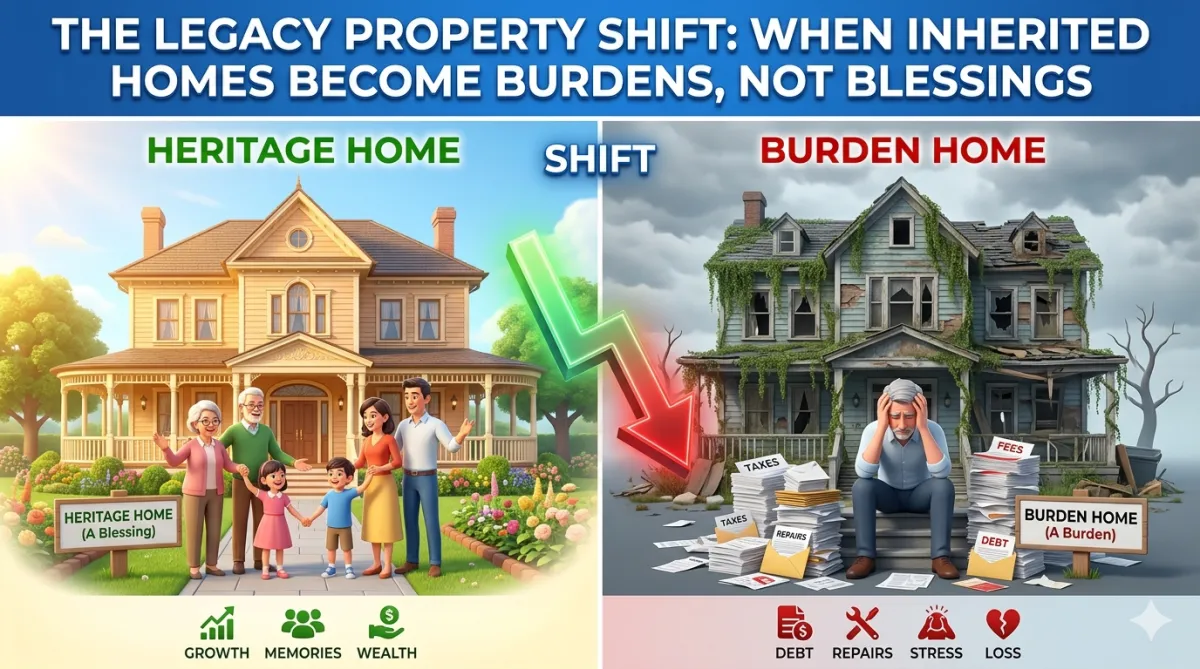
The Legacy Property Shift: When Inherited Homes Become Burdens, Not Blessings
Introduction
You've worked hard your entire life. You've paid off your mortgage. You own your home outright. And you assume — like most homeowners — that when you pass away, your home will be a gift to your children.
A financial legacy. An asset. Something that provides security and wealth to the next generation.
But here's what's actually happening in more and more families:
The inherited home isn't a blessing. It's a burden.
It comes with deferred maintenance costs of $50,000-$80,000. It creates conflict among siblings who can't agree on what to do with it. It sits empty for months or years, accumulating carrying costs. And it damages family relationships as adult children fight over whether to sell, rent, or keep a property nobody actually wants to live in.
This is what I'm calling the Legacy Property Shift — the growing recognition that inherited real estate often becomes a financial and emotional liability instead of the intended asset.
And it's forcing families to rethink how they approach property inheritance entirely.
This post breaks down why inherited homes so often become burdens, the hidden costs and conflicts that emerge, real examples of legacy property failures, and how to plan proactively so your property actually becomes a legacy instead of a problem your children have to solve.
The Traditional Legacy Property Assumption
Let's start by understanding the conventional assumption most homeowners make.
The Assumption
You own your home outright.
You've lived there for 30-40 years. You've raised your family there. The mortgage is paid off. The home has appreciated significantly in value.
You assume it's an asset.
Current market value: $700,000. You paid $150,000 for it decades ago. That's $550,000 in equity — a massive financial asset.
You assume your children will inherit wealth.
When you pass away, your children inherit the property. They can:
Live in it themselves
Rent it out for income
Sell it and split the proceeds
Either way, they receive a valuable asset that provides financial security.
You write it into your will.
"Our home at [address] shall pass to our children equally upon our death."
Done. Legacy secured.
Why This Assumption Made Sense (Historically)
For previous generations, this assumption often worked:
Homes were simpler. Fewer systems. Less expensive to maintain. Easier to keep in good condition.
Families were more local. Adult children often lived in the same city. One child might move into the family home. Siblings could easily coordinate.
Markets were different. Real estate transactions were simpler. Less regulation. Lower carrying costs.
Family dynamics were different. Traditional family structures with clearer hierarchies and decision-making processes.
But the reality today is very different.
Why Inherited Homes Often Become Burdens
Here's what's actually happening when families inherit property in 2025-2026.
Problem 1: Deferred Maintenance Creates Immediate Financial Burden
The Reality:
Most homeowners who age in place defer expensive maintenance as they get older:
They stop replacing major systems:
30-year-old roof that needs replacement
20-year-old furnace that's inefficient or failing
Original windows from the 1970s-1980s
Aging plumbing (galvanized pipes corroding)
Outdated electrical (knob-and-tube wiring, 60-100 amp panels)
Why they defer:
Fixed retirement income makes large expenses difficult
Physical inability to coordinate contractors and repairs
"It's worked this long, it'll last until we're gone" mentality
Cognitive decline makes complex decisions harder
What Children Inherit:
A house with $50,000-$100,000 in deferred maintenance that must be addressed before the property can be sold or rented.
The Financial Burden:
Adult children don't have $50,000-$100,000 sitting around. They're dealing with:
Their own mortgages
Children's education costs
Retirement savings
Day-to-day expenses
Inheriting a property that requires immediate $60,000 investment isn't a gift — it's a financial crisis.
Problem 2: Multiple Heirs = Decision Paralysis and Conflict
The Reality:
Most families have multiple children. When parents leave property "to our children equally," it creates shared ownership among siblings.
What Shared Ownership Creates:
Different Financial Situations:
Sibling 1 is financially secure and wants to keep the property
Sibling 2 is struggling and needs cash immediately
Sibling 3 is neutral but doesn't want conflict
Different Geographic Locations:
Sibling 1 lives locally and can manage the property
Sibling 2 lives out of province and can't
Sibling 3 lives internationally
Different Emotional Attachments:
Sibling 1 has strong sentimental attachment and doesn't want to sell
Sibling 2 has painful memories and wants to sell immediately
Sibling 3 is indifferent
Different Visions:
Sibling 1 wants to renovate and rent for income
Sibling 2 wants to sell as-is immediately
Sibling 3 wants to move into the property themselves
The Result:
Decision paralysis. Conflict. Resentment. Legal disputes.
Every decision requires unanimous agreement or court involvement. And while siblings argue, the property sits empty, accumulating costs.
Problem 3: Carrying Costs Accumulate While Property Sits Empty
The Reality:
Inherited properties often sit empty for 6-24 months while families figure out what to do.
Monthly Carrying Costs:
Property Taxes: $300-$500/month Home Insurance: $150-$250/month (higher for vacant properties) Utilities: $100-$200/month (minimal heat, electricity to prevent damage) Lawn Care/Snow Removal: $100-$300/month (seasonal) Security/Monitoring: $50-$100/month (preventing break-ins, vandalism)
Total Monthly Carrying Costs: $700-$1,400/month
Annual Cost: $8,400-$16,800/year
If the property sits for 18 months while siblings negotiate, that's $12,600-$25,200 in carrying costs before anyone receives a dollar from the inheritance.
Problem 4: Sentimental Value ≠ Market Value
The Reality:
Families emotionally overvalue inherited properties.
The Family's Perspective:
"This house is worth $800,000. It's in a great neighborhood. Mom and Dad loved it. We can't sell it for less than $800,000 — that would dishonor their memory."
The Market's Perspective:
"This house needs $60,000 in repairs. It's outdated. Comparable updated homes sell for $750,000. This house, as-is, is worth $650,000-$680,000."
The Conflict:
Family refuses to list below $800,000. Property sits on market for 120+ days. No offers. Family grudgingly reduces to $775,000. Still sits. Reduces to $750,000. Finally accepts $690,000 after 9 months on market.
The Cost:
9 months of carrying costs ($8,000-$12,000) plus lost opportunity (market may have softened during those 9 months).
All because sentimental attachment prevented realistic pricing from day one.
Problem 5: No Clear Plan = Years of Limbo
The Reality:
Parents assume "the kids will figure it out." They don't provide clear instructions. They don't have difficult conversations about expectations.
What Happens:
Children inherit property with no clarity on:
Whether they should sell immediately or wait
What price is acceptable
Whether one sibling can buy out the others
How to split costs and proceeds
Who makes decisions if siblings disagree
The Result:
Years of indecision, conflict, mounting costs, and damaged relationships while "trying to figure out what Mom and Dad would have wanted."
Real Examples: Legacy Property Failures
Let me share real scenarios (details changed for privacy) of how legacy property inheritances go wrong.
Example 1: The Parkdale House (Three Siblings)
Background:
Parents lived in Parkdale home for 42 years. Passed away and left house "to our three children equally."
Home Condition:
Roof: 28 years old, needs replacement ($16,000)
Furnace: Original 1982, failing ($8,000)
Plumbing: Galvanized pipes, corrosion ($12,000)
Electrical: Knob-and-tube wiring ($15,000)
Foundation: Cracks, water intrusion ($9,000)
Total Deferred Maintenance: $60,000
The Conflict:
Sibling 1 (out of province): Wanted to sell immediately as-is
Sibling 2 (local): Wanted to renovate and rent
Sibling 3 (local): Wanted to buy out others and live there, but couldn't get financing
Timeline:
Months 1-4: Disagreement and inaction, carrying costs accumulating
Month 5: Legal mediation ($8,000 in fees)
Months 6-9: Continued conflict
Month 10: Agreement to sell as-is
Months 11-12: Listed at $620,000, no offers, reduced to $580,000, sold for $565,000
Total Costs:
Carrying costs (12 months): $9,000
Legal fees: $8,000
Realtor commission: $28,000
Net proceeds: $520,000 ($173,333 each)
Emotional Cost:
Two siblings stopped speaking. Family gatherings destroyed. A "legacy" that tore the family apart.
Example 2: The Lakeview Condo (Two Siblings)
Background:
Mother lived in Lakeview condo for 25 years. Passed away and left condo "to my two daughters."
Condo Condition:
Generally well-maintained
Minor updates needed ($8,000)
Condo fees: $425/month
Property taxes: $2,400/year
The Conflict:
Daughter 1: Wanted to keep and rent for income
Daughter 2: Wanted to sell immediately and split proceeds
The Problem:
Condo rules required 75% cash down for any tenant-occupied unit. To rent it, they needed a tenant who could put down 75% cash — extremely limiting.
Alternatively, one daughter could buy out the other — but neither had the cash for a buyout, and getting financing for a buyout of inherited property proved difficult.
Timeline:
Months 1-6: Attempted to rent (couldn't find qualified tenant)
Months 7-12: Daughter 1 tried to secure financing for buyout (denied)
Month 13: Agreed to sell
Total Costs:
Carrying costs (13 months): $8,125 (condo fees + taxes + insurance)
Lost rental income they'd hoped for: $0 (never rented)
Emotional toll: Significant
Outcome:
Sold for $485,000. After costs, each daughter netted $220,000. But relationship strained over year of disagreement.
Example 3: The Acreage Property (Four Siblings)
Background:
Parents lived on 10-acre acreage for 35 years. Passed away and left property to four adult children.
Property Condition:
Home: Good condition
Well: 40 years old, declining yield, needs replacement ($25,000)
Septic: 35 years old, nearing failure ($20,000)
Outbuildings: Deteriorating barn ($15,000 to repair or remove)
The Conflict:
Sibling 1: Wanted to keep property, has horses
Sibling 2: Wanted to sell, lives in another province
Sibling 3: Wanted to subdivide and sell parcels (not permitted by zoning)
Sibling 4: Indifferent but didn't want to invest money
The Problem:
To make the property sellable or usable:
New well needed: $25,000
New septic needed: $20,000
Barn repair or demolition: $15,000
Total investment needed: $60,000 ($15,000 per sibling)
Sibling 2 and 4 refused to invest. Sibling 1 couldn't afford $60,000 alone. Stalemate.
Timeline:
Year 1: Property sits empty, carrying costs accumulate
Year 2: Legal partition lawsuit filed by Sibling 2 (forcing sale)
Year 3: Court-ordered sale, sold at auction below market value
Outcome:
Property worth $850,000 if properly maintained sold for $720,000 at forced auction. After legal fees ($45,000) and carrying costs ($25,000), siblings netted $162,500 each.
A property that could have provided $200,000+ per sibling instead netted $162,500 due to conflict and forced sale circumstances.
The Hidden Costs of Legacy Property Inheritance
Beyond the obvious financial costs, there are hidden costs that devastate families.
Cost 1: Damaged Family Relationships
Siblings who were close before inheritance become estranged. Family gatherings are tense or stop entirely. Relationships never fully recover.
The Tragedy:
Parents intended the property to be a blessing and a way to provide for their children. Instead, it became the source of permanent family fracture.
Cost 2: Opportunity Cost
While families argue about inherited property for 12-24 months, they miss opportunities:
Real estate markets shift (properties lose value in softening markets)
Investment opportunities pass (proceeds could have been invested)
Personal financial goals delayed (siblings can't access their inheritance to pay down debt, invest, or pursue goals)
Cost 3: Emotional and Mental Health Toll
The stress of managing inherited property conflict creates:
Anxiety and depression
Sleep disruption
Relationship strain (with siblings, spouses, and other family)
Burnout and decision fatigue
Many adult children describe inherited property situations as "the most stressful thing I've ever dealt with."
The Legacy Property Shift: Proactive Solutions
Here's how to ensure your property becomes a true legacy instead of a burden.
Solution 1: Sell Before You Pass
The Strategy:
Downsize while you're still alive. Sell the family home. Distribute the proceeds to your children as gifts or keep it for your own retirement needs.
Why This Works:
You make the decision (removes burden from children)
No deferred maintenance transferred to children
No sibling conflict over property decisions
Children inherit cash (easily divisible, no carrying costs)
You get to see your children benefit from the inheritance
When This Makes Sense:
You're downsizing anyway (empty nest, mobility issues)
The property has significant deferred maintenance
You have multiple children who might conflict
You want simplicity for your estate
Solution 2: Create a Trust with Clear Sale Instructions
The Strategy:
Place the property in a trust with explicit instructions:
"Upon our passing, the property shall be sold within 6 months. Proceeds shall be distributed equally among our children. The executor shall have authority to make all decisions regarding repairs, pricing, and sale terms without requiring heir approval."
Why This Works:
Removes decision-making burden from children
Prevents prolonged conflict and indecision
Creates clear timeline (6 months)
Empowers executor to act decisively
When This Makes Sense:
You want children to inherit value but not property management burden
You have multiple children who might disagree
The property will require updates or repairs before sale
You want to prevent carrying costs and delays
Solution 3: Leave Funds for Property Transition
The Strategy:
Set aside $30,000-$60,000 specifically designated for:
Property repairs and updates before sale
Carrying costs during sale period
Legal and realtor fees
Why This Works:
Children don't face immediate out-of-pocket expenses
Property can be properly prepared for sale (maximizing value)
Reduces financial stress and conflict
How to Implement:
Life insurance policy with proceeds earmarked for property transition
Savings account designated for estate property costs
Instructions in will/trust allocating specific funds
Solution 4: Single Heir Designation (If Appropriate)
The Strategy:
If one child wants the property and can afford it, leave it to that child specifically with cash equalizers to other children.
Example:
"Our home shall pass to our daughter Sarah. Our son Michael and daughter Jennifer shall each receive $200,000 from our investment accounts to equalize the inheritance."
Why This Works:
Eliminates shared ownership conflict
Child who wants property receives it
Other children receive equivalent value in cash
Clear and simple
When This Makes Sense:
One child genuinely wants to live in or manage the property
You have sufficient other assets to equalize inheritance
All children agree to this arrangement
Solution 5: Have the Conversation Now
The Strategy:
Talk to your adult children NOW about what they actually want.
Questions to Ask:
Do any of you want to live in our home after we're gone?
Would you want to keep it as a rental property?
Would you prefer we sell it and distribute cash?
How would you handle disagreements about the property?
Why This Works:
Reveals actual preferences (children might NOT want the property)
Allows you to plan based on reality, not assumptions
Prevents surprises and conflict after you're gone
Opens communication and sets expectations
How to Start the Conversation:
"We're updating our estate plan and we want to make sure our home is truly a blessing to you, not a burden. Let's talk about what you'd actually want us to do."
What to Do If You've Already Inherited a Problem Property
If you're currently dealing with an inherited property that's become a burden, here are your options.
Option 1: Agree to Sell Immediately
The Strategy:
All heirs agree to list and sell as quickly as possible, even if it means accepting slightly less than optimal pricing.
Why This Works:
Stops carrying cost bleeding
Prevents further family conflict
Allows everyone to move forward
Cash proceeds are easily divided
How to Implement:
Family meeting. Agree on acceptable price range. Hire realtor. List property. Accept first reasonable offer.
Option 2: One Heir Buys Out the Others
The Strategy:
If one heir wants to keep the property, they buy out the other heirs' shares.
How to Structure:
Get property appraised
Calculate each heir's share
Buying heir pays cash or secures financing for buyout
Property transfers to single ownership
Challenges:
Buyout amounts can be large ($200,000+ per heir)
Financing a buyout can be difficult
Requires fair market appraisal (not inflated sentimental value)
Option 3: Legal Partition (Last Resort)
The Strategy:
If heirs cannot agree, any heir can file for legal partition — forcing the sale of the property through court process.
How It Works:
One heir files partition lawsuit
Court orders property sold
Proceeds divided among heirs after legal costs
Why This Is Last Resort:
Legal fees are substantial ($20,000-$50,000+)
Court-ordered sales often achieve below-market prices
Permanent family relationship damage
Takes 1-2 years to resolve
When It's Necessary:
Heirs are completely unable to agree
One heir is blocking all reasonable solutions
Property is deteriorating and losing value
Planning Your Own Legacy: Action Steps
If you're a homeowner thinking about what happens to your property after you're gone, here's what to do.
Step 1: Assess Your Property Honestly
Questions:
What's the realistic current market value?
What deferred maintenance exists?
What will need replacement in the next 5-10 years?
How much would it cost to prepare the property for sale?
Be honest. Don't assume it's worth more than it is or that systems will last indefinitely.
Step 2: Talk to Your Children
Questions for Your Children:
Do any of you want to live in our home?
Would you want to manage it as a rental?
Would you prefer we sell it and leave you cash?
How do you think you'd handle decisions if you inherit it together?
Their answers might surprise you. Many adult children would prefer NOT to inherit property.
Step 3: Consider Your Options
Based on the conversation:
If children don't want the property: Plan to sell before you pass or create trust with sale instructions.
If one child wants it: Structure single-heir inheritance with cash equalizers for others.
If multiple children want shared ownership: Create VERY clear operating agreements, decision-making processes, and exit strategies.
Step 4: Fund the Transition
Set aside money for:
Property maintenance and repairs
Carrying costs during sale period
Legal and transaction fees
This can be life insurance, savings, or designated estate funds.
Step 5: Document Everything Clearly
Work with an estate lawyer to create:
Clear will or trust language
Explicit instructions for property disposition
Executor powers and authority
Heir responsibilities and timelines
Don't leave it to "the kids will figure it out."
FAQ: Legacy Property and Inheritance
Should I always sell my home before I die?
Not necessarily. But you should have a clear plan that prevents your children from inheriting a burden. If they genuinely want the property and can manage it, inheritance can work. If not, selling and leaving cash is often better.
What if my children are fighting over my property while I'm still alive?
This is a sign that leaving them shared ownership will create disaster. Consider selling and distributing cash, or leaving property to one child with cash equalizers to others.
Can I require my children to keep the family home?
You can include such language in your will, but it's not enforceable long-term and may create resentment. If they don't want to keep it, forcing them to will damage relationships and create financial burden.
What if I don't have other assets to equalize inheritance if I leave the home to one child?
Then shared ownership may be necessary, but create VERY clear operating agreements and consider life insurance to provide cash to non-property-inheriting children.
How do I bring this up with my children without it being morbid?
Frame it as practical planning: "We want to make sure we handle things in a way that's actually helpful to you, not burdensome. Let's talk about what would work best."
What if the property has sentimental value and my children will be hurt if I sell it?
Ask them directly. Often children feel obligated to express sentimental attachment even when they'd prefer cash. Give them permission to be honest.
Conclusion
The Legacy Property Shift is the recognition that inherited real estate often becomes a financial and emotional burden instead of the blessing parents intended.
Deferred maintenance creates $50,000-$100,000 immediate expenses. Shared ownership among siblings creates decision paralysis and conflict. Carrying costs accumulate for months or years while families figure out what to do. Sentimental overvaluation prevents realistic pricing and sales. And family relationships are damaged or destroyed.
The solution isn't to never leave property to your children. It's to plan proactively:
Sell before you pass and distribute cash
Create trusts with clear sale instructions and timelines
Fund property transition costs
Have honest conversations about what your children actually want
Create single-heir inheritance with equalizers when appropriate
Don't assume your property will be a legacy. Make sure it actually is.
If you're planning your estate and wondering how to handle your property, or if you've inherited a property and you're trying to navigate what to do with it — that's exactly the kind of strategic guidance I provide families.
Save this and share it with your family. This conversation could save you tens of thousands of dollars and preserve your relationships.
Related Reading
If you found this useful, these posts go deeper on property planning and strategic decisions:
The Anti-Downsize Movement: Why Going Smaller Might Be Your Biggest Mistake
Why High-Equity Homeowners Are Choosing Land Over Luxury Condos
City Bungalow vs. Rocky View Acreage: The Real Cost Comparison
About Kristen Edmunds
Kristen Edmunds is a Calgary-area REALTOR® and Associate Broker with KIC Realty, specializing in acreages, luxury homes, and smart buy/sell strategies. With expertise in rural properties (water wells, septic, equestrian facilities) and a client-obsessed approach, Kristen helps buyers and sellers achieve their real estate goals with confidence and ease.