
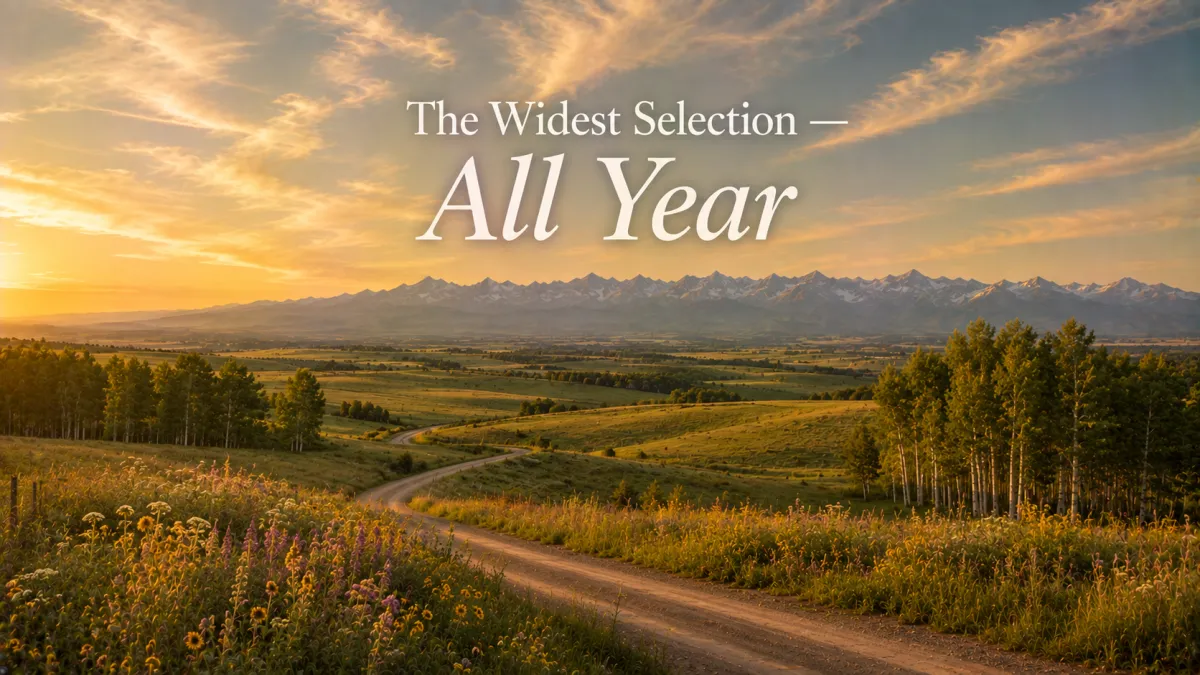
Why Late Summer Is the Widest Acreage Selection You'll See All Year in Rocky View
If you have been thinking about buying an acreage in Rocky View County — even loosely, even just circling the decision without a firm timeline — here is something worth understanding right now about how the rural market actually works. It is different from the city market most Calgary buyers are used to, and the difference matters for your timing.
Rural acreage inventory follows a season. City listings run year-round with relatively steady flow, but rural listings do not. They build through spring, peak in late summer, and thin dramatically through fall and winter. Right now — late August — Rocky View County acreage inventory is at or near its seasonal high. Which means, for buyers, this is the widest selection window of the calendar year.
This post is about why that pattern exists, what it looks like in practice, and why understanding it changes how a smart buyer plans their search. None of this is about pressure. It is about smart planning.
Why rural markets are seasonal
Rural acreage listings concentrate in mid-to-late summer for reasons that make complete sense once you think about them from the seller's side.
The first and biggest driver is presentation. Rural sellers list when the land looks its best — green pasture, leaves fully out on the aspens and poplars, wildflowers along the fence lines, the specific late-August-early-September look that makes rural Alberta genuinely beautiful. A property that photographs stunning in July looks flat and grey in November. Rural sellers know this, and they time their listings to catch the window when the visuals do the work.
The second driver is showings. Walking an acreage in July or August is a different experience from walking one in mid-November. You can actually see the parcel, walk the boundaries, notice the drainage, get a real sense of the land. Showings in warmer months land differently, produce better offers, and generally result in cleaner transactions. Sellers respond to that reality by concentrating listings in the season when buyers want to be outdoors on the property.
The third driver is what I call the "list in spring" convention. City real estate has a strong March-through-May listing tradition. Rural listing timing shifts a few weeks later than that, because rural photos and showings actually benefit from the more mature summer landscape rather than the still-brown early spring one. So while city inventory peaks in April-May, rural inventory peaks in July-September.
What the peak window actually looks like
In practice, "the peak" for Rocky View County acreage runs from about mid-August through early September, with a broader ramp-up from June and a gradual thinning through October. The specific weeks shift slightly year to year based on weather, growing season timing, and general market conditions, but the shape is consistent.
What that means for a buyer actively looking: right now, you are seeing more parcels on the market simultaneously than you will see at any other point in the year. That includes more range across parcel sizes, more range across price points, more range across geographic pockets within Rocky View, and more range across specific property characteristics — treed vs open, closer to services vs more remote, existing infrastructure vs raw, and so on.
For a buyer with specific criteria — you want a certain acreage size, a certain distance from Calgary, a certain type of well and septic setup, a certain zoning that supports your specific plans — this is the window where the odds of finding a match are highest.
What happens after the peak
The seasonal shape does not reverse instantly. What happens is a gradual thinning through fall, followed by a much sharper drop-off into winter.
Through October, you typically see the pace of new listings slow while previously-listed properties continue to work their way through the market. Inventory begins to narrow, but selection is still reasonable. Some rural buyers time their search for October specifically, because the pressure of the peak season has come off and sellers who have been listed for a couple of months are often more open to negotiation.
By November, the drop-off is meaningful. New rural listings slow substantially as sellers pull back — the land no longer photographs at its best, showings are less pleasant, and most rural sellers who were going to list this year have already listed. Inventory available to shop is materially narrower than it was in August.
By January and February, corridor acreage inventory typically sits at a fraction of what was available in the peak. The specific fraction varies by year, but the direction is consistent — this is the thinnest inventory window of the year. Buyers who wait until winter to shop are looking at a much smaller selection with much fewer options that match specific criteria.
None of this means winter buyers cannot find good properties. Some do — often with less competition. But the trade-off is real: you are choosing from a much narrower set.
Why this matters — choice as leverage
The reason the seasonal rhythm matters for you as a buyer is not urgency. It is leverage.
Choice is leverage. When you have more properties to compare, you can be more selective. You can hold out for the specific parcel that actually fits your plans instead of settling for the one that's available. You can walk away from a property that has a well flow rate concern, knowing there are three other comparable listings to consider. You can negotiate from a position of "we have alternatives" rather than "this is the only option this year."
Peak-inventory season gives you that leverage. It is when a strategic, prepared buyer is at their strongest position — not because prices are meaningfully different than at other times of year (they are not, for acreage), but because the range of what you can actually choose from is at its widest.
The specific practical implications for a Rocky View acreage buyer right now:
You have more parcels to compare against your criteria
You have more range of price points to consider without compromising on other must-haves
You have more room to be picky about the specific well, septic, zoning, and infrastructure characteristics that fit your plans
You have more negotiating leverage because your walk-away option is real
You have more time to do proper due diligence because you are not scrambling to shop a two-listing market
How to shop this window smartly
If you are actively considering an acreage move in the next 6-12 months, the practical way to use this window is not to rush. It is to prepare.
Peak-inventory season rewards the buyer who has already done the pre-work — clear on their criteria, clear on their financing, clear on their buy-sell sequencing if they are also selling a city home, clear on the specific due diligence that matters for the property type they are targeting. That buyer walks into peak season able to move confidently when the right property appears, because the preparation is done and the decision is now just about property fit.
The buyer who is still figuring out criteria, financing, and process during peak season is the buyer who watches the right property come and go without being ready to write on it. Peak season is not the time to start preparing. It is the time to have already prepared.
That is what the City to Acreage Reality Check is designed to walk through — the specific way the rural market operates, the pre-work that separates ready buyers from not-yet-ready buyers, and the practical framework for using the seasonal rhythm to your advantage.
Frequently asked questions
Does this same seasonal pattern apply to Foothills County and other corridor counties?
Yes, broadly. The late-summer inventory peak is a corridor-wide rural pattern, not just Rocky View. Specific timing varies slightly by county — some pockets peak a week or two earlier or later, some have different secondary micro-peaks — but the overall shape is consistent across the Calgary rural corridor.
If I miss this window, is it worth waiting for next August?
Not necessarily. Fall and winter both have properties on the market, and some buyers do very well shopping in the shoulder seasons because they face less competition. The right question is not "when is the market best" but "when is right for my situation." Peak selection is one factor. Your financing, life timing, and property-fit criteria are others.
Are acreage prices different in peak season vs off-season?
Broadly, no. Rural acreage pricing does not follow the same seasonal cycle as inventory volume. What changes seasonally is selection — the number and range of properties available to choose from — not the underlying price levels. You are not paying more in August than you would in November. You are just choosing from a wider set.
What if I am not ready to move immediately but want to be ready for a future peak season?
The pre-work — criteria, financing, due-diligence framework, corridor community knowledge — is exactly what a buyer 6-12 months out from their move should be working on. When your peak season arrives, you want to be the buyer who is ready, not the one still preparing.
The bottom line
Rural acreage inventory in Rocky View County follows a seasonal rhythm that peaks in late summer and thins dramatically through fall and winter. Right now, you are at the peak — the widest selection window of the calendar year. That is not a reason to rush. It is a reason to understand the rhythm and plan your search intelligently.
Choice is leverage. Peak-inventory season gives you the widest range to compare, the most room to be selective about the specific property that fits your plans, and the strongest negotiating position because your alternatives are real.
Comment REALITY on the video and I will send you my City to Acreage Reality Check — how the rural market actually works before you shop it.