
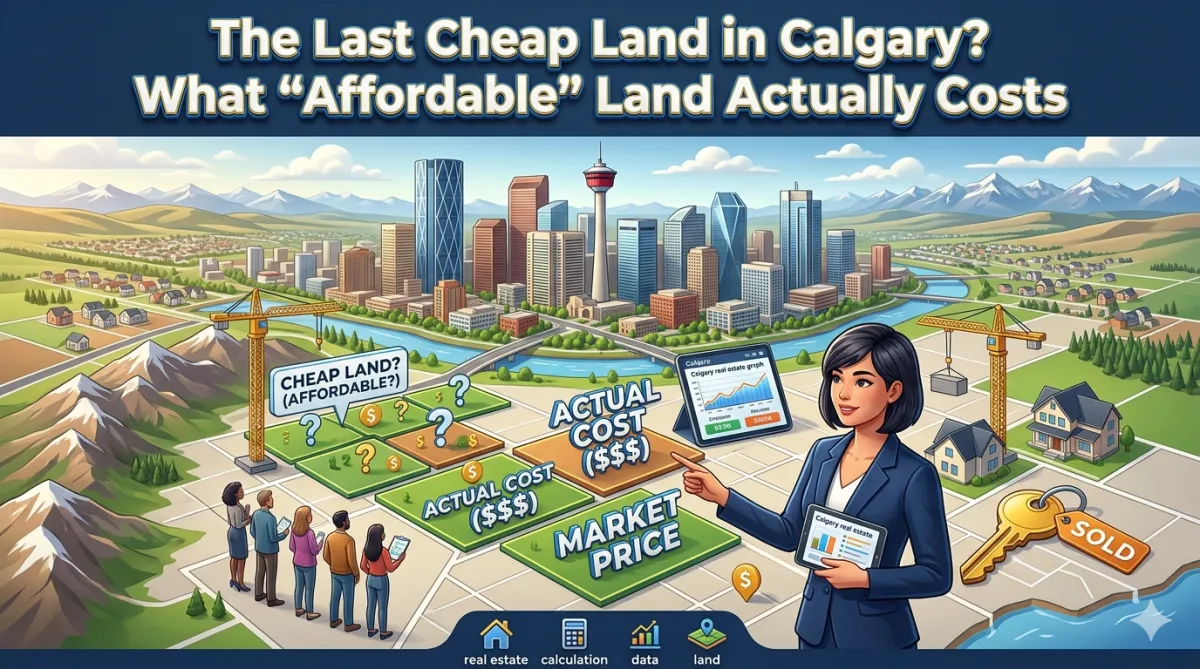
The Last Cheap Land in Calgary? What "Affordable" Land Actually Costs
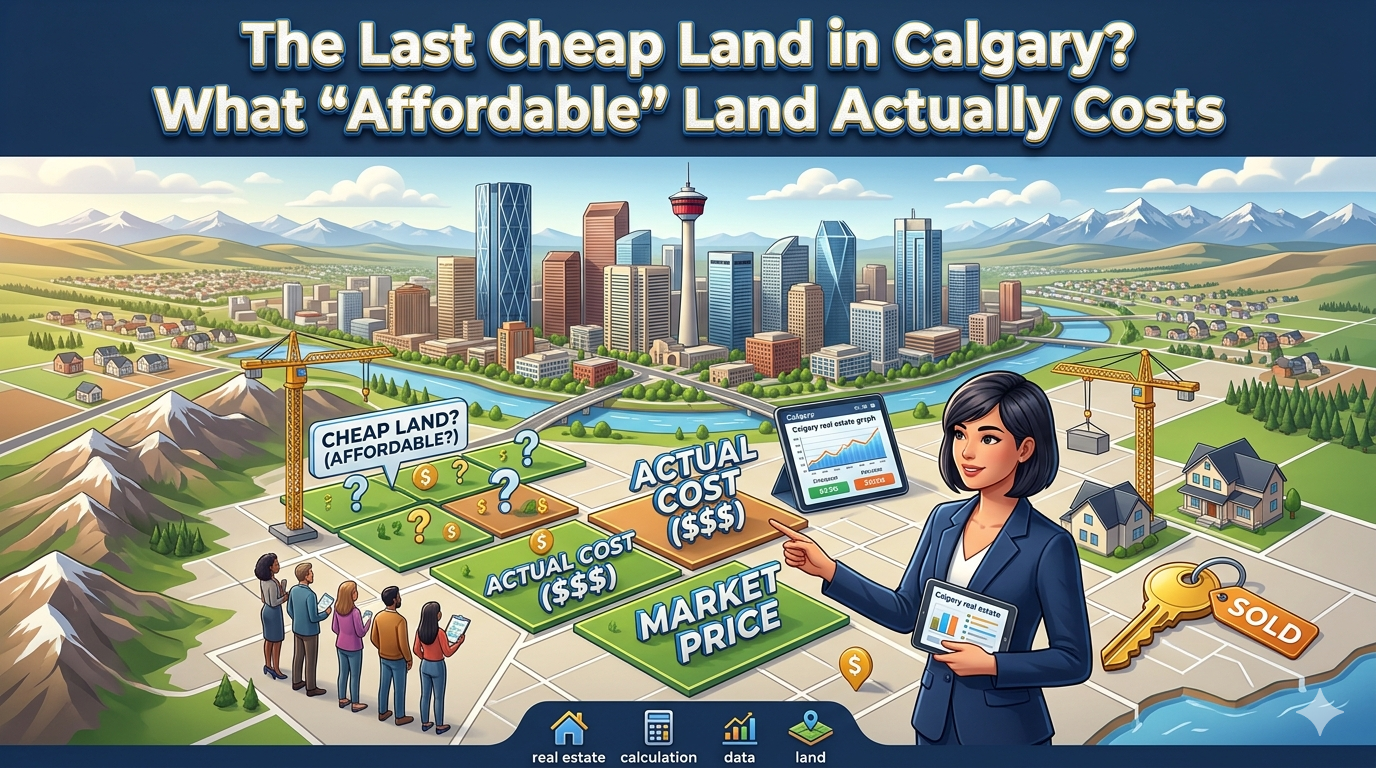
The Last Cheap Land in Calgary? What "Affordable" Land Actually Costs
Introduction
You're scrolling through land listings in Calgary. And you see it:
"1 Acre Parcel - Only $175,000!"
Your heart races. You've been looking at serviced city lots for $450,000-$500,000. This is less than half the price.
You could buy land. Build your dream home. All for a fraction of what you'd pay for a finished lot in an established neighborhood.
It seems too good to be true.
And it is.
Because that $175,000 "cheap land" isn't actually cheap once you understand what it takes to make it buildable.
No water service. No sewer. No electrical connection. No road access. Agricultural zoning that doesn't permit residential building.
By the time you pay for infrastructure extensions, rezoning applications, engineering studies, and development permits, your $175,000 "cheap land" has cost you $500,000-$600,000 — and you haven't even started building yet.
This is the reality of "cheap land" in Calgary: it exists, but it's not a shortcut to affordable homeownership. It's an investment strategy for people with deep pockets, long timelines, and tolerance for risk and uncertainty.
This post breaks down where Calgary's "cheap land" actually is, what it costs to develop it, why the total cost often exceeds serviced lot prices, who this strategy works for, and how to evaluate whether raw land makes sense for your situation.
Where Calgary's "Cheap Land" Actually Is
Let's start by understanding what we mean by "cheap land" and where it exists.
What "Cheap Land" Means
Price Range: $100,000-$300,000 per acre (sometimes less for larger parcels)
Characteristics:
Unserviced or partially serviced (no water, sewer, power, roads)
Agricultural or future development zoning (not currently residential)
Located on Calgary's fringe or just outside city limits
Designated growth corridors or future annexation areas
Not:
Finished, serviced, ready-to-build residential lots ($400,000-$600,000+)
Established neighborhood infill lots ($500,000-$1,000,000+)
Location 1: Far Northeast Calgary (Growth Corridor)
Areas:
East of Stoney Trail beyond Cityscape, Cornerstone, Redstone
Future growth areas designated in Calgary's Municipal Development Plan
Typical Pricing: $150,000-$250,000 per acre for unserviced agricultural land
Status:
Agricultural zoning
No services
Designated for future residential development (10-20+ year timeline)
What You're Buying: Raw land that might be developed for residential use eventually, but requires rezoning and full infrastructure installation now if you want to build.
Location 2: Far North Calgary (Symons Valley / Glacier Ridge Area)
Areas:
North of Stoney Trail beyond current development
Future annexation areas
Typical Pricing: $200,000-$350,000 per acre
Status:
Agricultural or future development zoning
Minimal or no services
Long-term growth area
What You're Buying: Land on the edge of Calgary's expansion, decades away from typical suburban development.
Location 3: Far Southeast (Shepard / 114th Avenue Area)
Areas:
Industrial fringe areas
Future mixed-use development zones
Typical Pricing: $250,000-$400,000 per acre
Status:
Industrial or future development zoning
Partial services in some areas
Environmental and noise considerations (proximity to industry, Deerfoot Trail)
What You're Buying: Land that may eventually transition to residential but currently faces zoning and environmental challenges.
Location 4: Just Outside City Limits (Rocky View County)
Areas:
Fringe areas adjacent to Calgary city limits
Lands likely to be annexed by Calgary in future decades
Typical Pricing: $100,000-$300,000 per acre depending on location and services
Status:
Rocky View County jurisdiction (different zoning and development processes than Calgary)
Agricultural zoning typically
May have well/septic rather than municipal services
What You're Buying: Rural land that operates under county rules but may eventually become part of Calgary.
The Hidden Costs: What "Cheap Land" Actually Requires
Here's why that $175,000 acre isn't actually cheap.
Cost 1: Infrastructure Installation ($150,000-$400,000+)
Raw land has no services. You pay to bring them in.
Water Service
Option A: Municipal Water Extension
If municipal water exists within reasonable distance (rare for "cheap land"), you pay to extend it to your property.
Cost: $150-$300 per linear meter
Example: Water line is 800 meters from your parcel. 800 meters × $200/meter = $160,000
Option B: Private Well
More common for fringe land without nearby municipal infrastructure.
Cost: $20,000-$50,000 depending on depth and geology
Sewer Service
Option A: Municipal Sewer Extension
If municipal sewer exists nearby (rare), you pay to connect.
Cost: $200-$400 per linear meter
Example: Sewer line is 1,000 meters away. 1,000 meters × $300/meter = $300,000 (often prohibitively expensive)
Option B: Septic System
More common for fringe land.
Cost: $20,000-$50,000 depending on system type and soil conditions
Electrical Service Extension
Your parcel is far from existing electrical infrastructure.
Components:
Transformer installation: $15,000-$30,000
Pole installation: $3,000-$5,000 per pole (need 5-15 poles typically)
Underground trenching (if preferred): $40-$80 per meter
Service connection: $10,000-$20,000
Total Electrical Extension: $50,000-$150,000
Natural Gas (If Available)
Most "cheap land" areas don't have natural gas service.
Alternative: Propane installation ($5,000-$10,000)
Road Access
Your parcel doesn't have road frontage or has unmaintained road access.
Components:
Road construction to property: $30,000-$100,000 depending on distance
Driveway construction: $20,000-$50,000
Total Access Costs: $50,000-$150,000
Storm Drainage
Required by the city for new development.
Cost: $20,000-$60,000 depending on property size and grading
Total Infrastructure Cost: $200,000-$500,000+
Low End (well, septic, minimal services): $150,000-$200,000 Mid Range (partial municipal services): $250,000-$350,000 High End (full municipal extensions): $400,000-$600,000+
Cost 2: Rezoning and Development Approvals ($20,000-$100,000+)
If your "cheap land" is zoned agricultural or future development, you cannot build a house without rezoning.
Rezoning Application Process
Step 1: Pre-Application Consultation Meeting with city planners to discuss feasibility. Cost: $500-$2,000
Step 2: Rezoning Application Formal application to change zoning from agricultural to residential. City fees: $10,000-$25,000
Step 3: Required Studies
Land Use Study: Analyzing compatibility with surrounding area, impact on services, traffic, etc. Cost: $5,000-$15,000
Environmental Site Assessment: Identifying environmental constraints (wetlands, contamination, endangered species). Cost: $5,000-$15,000
Traffic Impact Assessment: Required for larger developments or busy areas. Cost: $8,000-$20,000
Geotechnical Study: Soil analysis for foundation and septic suitability. Cost: $3,000-$8,000
Total Study Costs: $20,000-$60,000
Community Consultation
The city requires you to notify neighboring property owners and hold community meetings.
Costs:
Signage: $1,000-$3,000
Mailing/notification: $500-$2,000
Meeting space: $500-$1,500
Professional facilitators (if needed): $2,000-$5,000
Total Consultation Costs: $4,000-$12,000
Legal and Professional Fees
You'll need land use lawyers and planning consultants.
Costs:
Land use lawyer: $10,000-$30,000
Planning consultant: $8,000-$20,000
Total Legal/Professional: $18,000-$50,000
Timeline and Uncertainty
Timeline: 18-36 months from application to approval (if approved)
Approval Risk: Rezoning is discretionary — the city can deny your application.
If Denied: You've spent $40,000-$80,000+ on applications and studies and cannot build. You own agricultural land you can't use for your intended purpose.
Total Rezoning Cost: $40,000-$100,000+ (with no guarantee of approval)
Cost 3: Carrying Costs During Development ($10,000-$30,000+)
While you navigate infrastructure and rezoning (1-3 years), you're paying carrying costs.
Annual Costs:
Property Taxes: $1,500-$3,000/year (agricultural rate, lower than residential) Insurance: $800-$1,500/year Legal/Administrative: $1,000-$2,000/year
Total Annual Carrying Costs: $3,300-$6,500
Over 2-3 Years: $6,600-$19,500
The Real Total Cost: Example Scenarios
Let's calculate what "cheap land" actually costs.
Scenario 1: Far Northeast Calgary Parcel
Land Purchase: $180,000 (1 acre, agricultural zoning, unserviced)
Infrastructure Costs:
Well drilling: $28,000
Septic system: $35,000
Electrical extension (600m): $75,000
Road access to property: $40,000
Driveway construction: $25,000
Storm drainage: $30,000
Infrastructure Total: $233,000
Rezoning Costs:
Application fees: $15,000
Required studies: $35,000
Legal/professional fees: $25,000
Rezoning Total: $75,000
Carrying Costs (2 years): $10,000
Total Cost Before Construction: $498,000
Comparable Alternative: Serviced residential lot in Cityscape or Cornerstone: $450,000-$500,000, ready to build immediately.
Conclusion: The "cheap land" at $180,000 actually costs $498,000 and takes 2-3 years to become buildable — comparable to or exceeding serviced lot prices with significantly more risk and delay.
Scenario 2: Far North Symons Valley Area
Land Purchase: $250,000 (1.5 acres, future development zoning, partial services)
Infrastructure Costs:
Municipal water extension (400m): $80,000
Municipal sewer extension (600m): $180,000
Electrical extension (300m): $45,000
Road improvements: $30,000
Storm drainage: $40,000
Infrastructure Total: $375,000
Rezoning Costs:
Application fees: $18,000
Required studies: $40,000
Legal/professional fees: $30,000
Rezoning Total: $88,000
Carrying Costs (3 years): $15,000
Total Cost Before Construction: $728,000
Comparable Alternative: Serviced residential lot in established north Calgary community: $500,000-$550,000.
Conclusion: The "cheap land" at $250,000 actually costs $728,000 — $200,000+ MORE than serviced alternatives, with 3+ years of development time and approval uncertainty.
Scenario 3: Rocky View County Fringe
Land Purchase: $150,000 (2 acres, agricultural zoning, Rocky View County)
Infrastructure Costs:
Well drilling: $32,000
Septic system (advanced treatment): $38,000
Electrical extension (800m): $95,000
Driveway (500m): $45,000
Infrastructure Total: $210,000
Development Costs (Rocky View County):
Development permit: $8,000
Environmental assessments: $12,000
Professional fees: $10,000
Development Total: $30,000
Carrying Costs (18 months): $6,000
Total Cost Before Construction: $396,000
Comparable Alternative: Acreage property with existing home near Calgary (older home, but livable while you plan rebuild): $500,000-$600,000.
OR
Serviced city lot: $450,000-$500,000.
Conclusion: Rocky View "cheap land" at $150,000 costs $396,000 total — comparable to serviced city lots but with rural location, longer timeline, and execution complexity.
Why "Cheap Land" Usually Isn't a Good Deal for Homebuyers
Reason 1: Total Cost Exceeds Serviced Lot Prices
As shown above, once you add infrastructure and development costs, "cheap land" often costs MORE than serviced lots — with significantly more risk and delay.
Reason 2: Timeline Is Years, Not Months
Serviced Lot: Purchase today, start building next month.
Raw Land: Purchase today, spend 18-36 months on rezoning and infrastructure, then start building.
During those 2-3 years, you're paying rent elsewhere, paying carrying costs on the land, and dealing with construction delays that push your move-in date years into the future.
Reason 3: Approval Isn't Guaranteed
Rezoning applications can be denied. Environmental assessments can identify constraints. Community opposition can block approvals.
You can spend $50,000-$100,000 on applications and studies and end up with land you can't build on.
Reason 4: Financing Is Complex
Serviced Lot: Straightforward lot mortgage or construction financing.
Raw Land: Lenders are reluctant to finance unserviced land or provide construction mortgages for properties requiring rezoning and infrastructure development.
You often need to pay cash for land and development costs, then seek construction financing once the land is buildable.
Reason 5: You Need Expertise
Navigating rezoning, infrastructure installation, utility company coordination, engineering studies, and municipal approvals requires expertise most homebuyers don't have.
You'll need:
Land use lawyers
Planning consultants
Engineers
Environmental consultants
Contractors for infrastructure
Professional Fees Alone: $30,000-$80,000+
Who "Cheap Land" Actually Works For
Despite the challenges, buying raw land and developing it can make sense for specific buyers.
Profile 1: Experienced Developers
Who: Professional developers or builders who develop land as a business.
Why It Works:
Experience navigating approvals and infrastructure
Relationships with utility companies, contractors, and municipalities
Access to capital for multi-year development timelines
Ability to spread costs across multiple lots (buying larger parcels and subdividing)
Example: Developer buys 20-acre parcel for $2,000,000, rezones for residential subdivision, installs infrastructure, subdivides into 40 lots, sells lots for $400,000 each = $16,000,000 gross revenue.
Profile 2: High-Net-Worth Individuals with Long-Term Vision
Who: Wealthy buyers who can afford 3-5 year timelines and $500,000-$1,000,000+ total investment before construction.
Why It Works:
Can pay cash for land and development costs
Not in a rush (can wait years for approvals)
Want specific location or property characteristics only available in undeveloped areas
Willing to take approval risk as part of investment strategy
Example: High-net-worth buyer wants 5-acre estate property in specific location. Buys raw land for $300,000, spends $400,000 on infrastructure and approvals over 3 years, builds $1,500,000 custom home. Total investment: $2,200,000 for property they couldn't find otherwise.
Profile 3: Investors Speculating on Future Growth
Who: Investors buying land in growth corridors, betting on future annexation or development by the city.
Why It Works:
Not building immediately
Holding land for 10-20+ years
Expecting land values to increase as Calgary expands
Willing to carry costs and risk for potential long-term appreciation
Example: Investor buys 10 acres in far northeast for $200,000 in 2025. Holds for 15 years. By 2040, Calgary has expanded, rezoned area for residential, and land is now worth $2,000,000. Investor sells for 10x return (minus carrying costs and taxes).
Who "Cheap Land" Doesn't Work For
Profile 1: First-Time Homebuyers
Why It Doesn't Work:
Limited capital (can't afford $400,000-$600,000 in land + development costs before even starting construction)
Need to move in within 6-12 months (can't wait 2-3 years for development)
Lack expertise to navigate complex approvals
Financing challenges (lenders reluctant to finance raw land for first-time buyers)
Profile 2: Average Homebuyers on Tight Budgets
Why It Doesn't Work:
"Cheap land" total costs exceed serviced lot prices once development is included
Carrying costs for years while developing are unaffordable
Risk of approval denial or cost overruns is too high
Profile 3: Buyers Who Need Certainty
Why It Doesn't Work:
Rezoning and approvals are uncertain (can be denied)
Infrastructure costs can exceed estimates
Timelines can extend beyond projections
Too much risk for buyers who need predictable outcomes
How to Evaluate Raw Land: Questions to Ask
If you're considering buying "cheap land," here's how to evaluate it.
Question 1: What Is the Current Zoning?
Agricultural or Future Development Zoning: Requires rezoning before you can build residential. Expensive, time-consuming, uncertain.
Already Residential: Much better — you can likely build without rezoning.
Question 2: What Services Are Available?
At Property Line: Best case — minimal extension costs.
Within 500 Meters: Moderate costs — extensions feasible but expensive.
1+ Kilometers Away: High costs — may be prohibitively expensive to extend services.
Not Available: You'll need well, septic, propane — feasible but adds costs and complexity.
Question 3: What Are Total Development Costs?
Get quotes from:
Utility companies (electrical, water, sewer extension costs)
Well drillers (if needed)
Septic designers (if needed)
Excavators (road access, driveway)
Land use consultants (rezoning cost and timeline estimate)
Total Estimated Development Cost = Infrastructure + Rezoning + Professional Fees
Question 4: What Is Total Cost Before Construction?
Formula:
Land Purchase + Development Costs + Carrying Costs (2-3 years) = Total Pre-Construction Cost
Compare to:
Serviced residential lot price in desirable area.
If raw land total exceeds serviced lot price: Raw land is NOT a good deal.
Question 5: What Is the Approval Timeline and Risk?
Questions:
How long does rezoning take in this municipality? (18-36 months typical)
What's the approval success rate for similar applications?
Are there community opposition concerns?
Are there environmental constraints (wetlands, endangered species)?
If approval is uncertain or timeline exceeds 2 years: Significant risk.
Question 6: Can I Finance This?
Questions:
Will lenders provide a mortgage for raw land?
Can I qualify for construction financing on unserviced land?
Do I have cash reserves to cover development costs while waiting for approvals?
If financing is uncertain: You may need to pay cash for everything, which limits this strategy to high-net-worth buyers.
The Better Alternatives for Most Buyers
Alternative 1: Buy a Serviced Lot in an Established Area
Cost: $450,000-$550,000
Benefits:
Ready to build immediately
No rezoning risk
Predictable costs
Easy financing
Best For: Buyers who want to build within 6-12 months with cost certainty.
Alternative 2: Buy an Acreage with Existing Infrastructure
Cost: $500,000-$700,000 (land + older home)
Benefits:
Infrastructure already in place (well, septic, power, driveway)
Can live in existing home while planning rebuild or renovation
No rezoning needed
Lower risk
Best For: Buyers who want acreage lifestyle without raw land development complexity.
Alternative 3: Buy in a New Suburban Development
Cost: $400,000-$500,000 for serviced lot
Benefits:
Fully serviced and ready to build
Established community amenities planned
No approval uncertainty
Standard financing
Best For: Buyers who want new construction in a planned community.
FAQ: Cheap Land in Calgary
Is there any truly affordable land left in Calgary?
"Affordable" in purchase price, yes — you can find raw land for $150,000-$300,000. But once you add development costs, it's rarely affordable in total cost compared to serviced alternatives.
Can I buy land now and develop it later when I have more money?
Yes, but you'll pay carrying costs (taxes, insurance) for years, and land values may not appreciate enough to offset those costs and inflation.
What if I do all the infrastructure work myself to save money?
You can't. Electrical, water, sewer, and septic work require licensed professionals and permits. You might save money on clearing or driveway work, but major infrastructure must be professionally installed.
Are there any shortcuts to avoid rezoning costs?
No. If the land isn't zoned residential, you must rezone. There's no workaround.
What if I find land that's already zoned residential?
That's better — you eliminate rezoning risk and cost. But make sure to verify services are available and calculate infrastructure costs.
Should I just wait for Calgary to annex and develop these areas?
If you're investing long-term (10-20+ years), maybe. But there's no guarantee when or if Calgary will annex and develop specific areas.
Conclusion
The Last Cheap Land in Calgary exists — unserviced parcels on the city's fringe priced at $150,000-$300,000 per acre.
But "cheap land" isn't cheap once you factor in infrastructure installation ($150,000-$400,000), rezoning and approvals ($40,000-$100,000), professional fees ($30,000-$80,000), and carrying costs over 2-3 years ($10,000-$30,000).
Total cost before construction: $400,000-$700,000+ — often exceeding serviced residential lot prices with significantly more risk, complexity, and delay.
This strategy works for experienced developers, high-net-worth individuals with long timelines, and investors speculating on future growth. It doesn't work for first-time buyers, average homebuyers on budgets, or anyone who needs cost certainty and quick timelines.
If you're dreaming of building your custom home in Calgary, understand the true costs before you buy "cheap land." In most cases, a serviced lot in an established area or a property with existing infrastructure is a better investment.
If you're considering land purchase and want help evaluating total costs and feasibility — that's exactly the kind of strategic analysis I provide buyers.
Let's connect and make sure you understand what you're actually buying before you commit.
Related Reading
If you found this useful, these posts go deeper on land buying and development:
The Acreage Rebuild Reality Check: Hidden Costs That Add 20-30% to Your Budget
5 Things Nobody Tells You Before Buying an Acreage Outside Calgary
City Bungalow vs. Rocky View Acreage: The Real Cost Comparison
About Kristen Edmunds
Kristen Edmunds is a Calgary-area REALTOR® and Associate Broker with KIC Realty, specializing in acreages, luxury homes, and smart buy/sell strategies. With expertise in rural properties (water wells, septic, equestrian facilities) and a client-obsessed approach, Kristen helps buyers and sellers achieve their real estate goals with confidence and ease.