
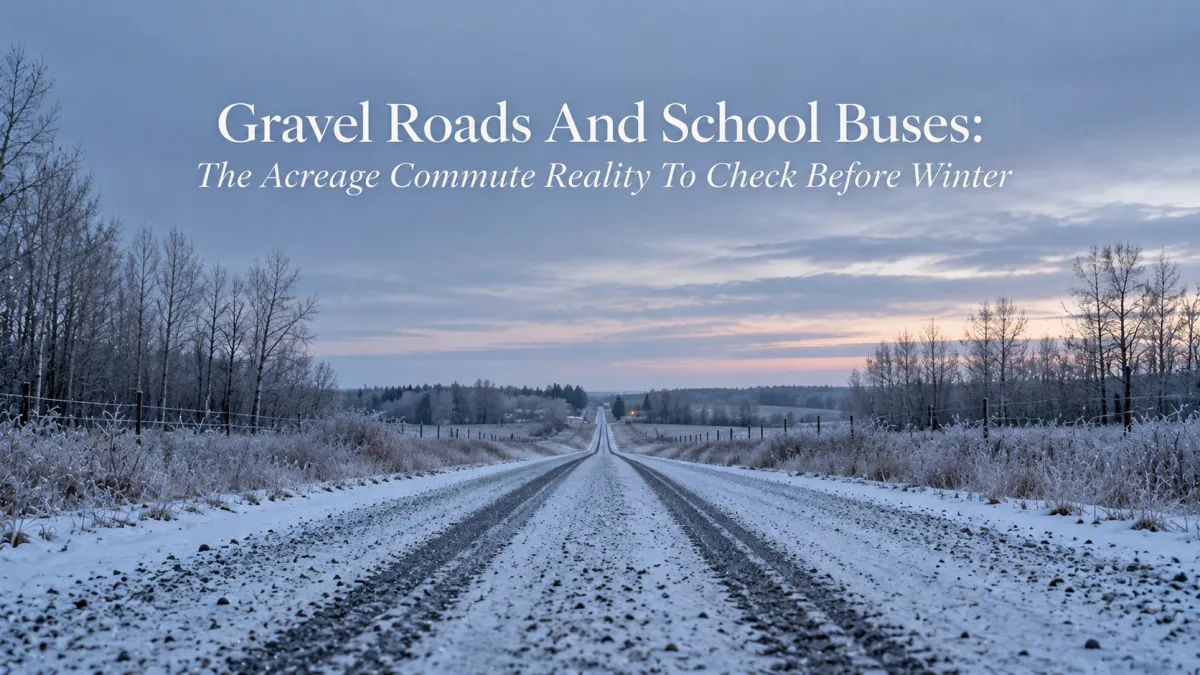
Gravel Roads and School Buses. The Acreage Commute Reality to Check Before Winter
One of the most common gaps in how Calgary-area acreage buyers prepare for the move is a simple but consequential one. They see the property in summer. It looks stunning. The drive out feels manageable. The road is dry, the sun is up until 10 p.m., the garden is thriving, the driveway is clean. The property makes an emotional case for itself that is almost impossible to argue with, and the buyer starts imagining life on the acreage from the version of it they are standing in.
What they usually do not do, and what fall is the last practical window to do, is check what the same property looks and functions like the rest of the year.
The acreage lifestyle is worth it. I say that as someone who spends her career helping people make the move. But it is only worth it when buyers go in with clear eyes about the year-round realities, because a property that works beautifully in July can present very differently in January if the year-round logistics were not investigated before the offer. This post walks through the four practical categories worth looking at now, before first snowfall, on any specific acreage a buyer is seriously considering.
1. Road access and maintenance
The single most consequential year-round factor on a Calgary-area acreage is the access road, and it is also the factor buyers most consistently underestimate.
The specific questions that need to be answered on any given property are these. Is the access road paved or gravel? Who is responsible for maintaining it, in both summer and winter? Is it a county-maintained road, a privately maintained road, or a shared arrangement between a group of properties? Who plows it, on what schedule, and after what depth of snowfall?
Every one of those answers is property-specific. Two acreages on nearby roads can have very different access situations. A gravel road maintained by the county on a set schedule is a materially different experience from a private road maintained by an informal arrangement between the property owners on it, which is different again from a paved road with municipal-level snow removal.
None of these are inherently good or bad. Plenty of acreage owners are perfectly happy on gravel-and-private-plow arrangements. The point is that the buyer needs to know which arrangement they are actually buying into and what it means for their day-to-day life in the months when access matters most.
2. The real commute, in real winter conditions
Almost every acreage buyer times the commute at least once during their initial viewings. Almost none of them time it the way it actually needs to be timed to be useful.
The useful commute is the winter commute. In snow. In cold. In low light. On the shortest days of the year, when the road might be slick, visibility might be reduced, and the driving speed on the rural section of the route might be substantially slower than the summer version.
If a buyer is only ever going to commute to the city in perfect conditions, the summer test drive is fine. If a buyer is going to commute five days a week year-round, the summer test drive is not enough. Fall is the window to think honestly about what the real commute is going to look like across the calendar, and to make the decision on the year-round version rather than the July version.
Practical suggestion: drive the commute at the actual hour it will happen, in weather that is closer to the harder end of the range. It changes the read.
3. School bus routes and pickup realities for families
For buyers with school-age children, or buyers who are planning to have them, the school bus route and pickup situation is worth investigating carefully as part of the due-diligence process.
The questions worth answering on any specific property: does the school bus actually service this specific property? Where does it stop? How far is the stop from the house? What time does it stop in the morning, and what does the pickup routine look like when the temperature is well below zero and it is dark? What is the ride time to the school on the bus itself, and does that fit the family's rhythm?
These are not deal-breaker questions. They are informed-decision questions. The family that knows the bus stop is at the end of a quarter-mile driveway, that the pickup is at 7:10 a.m., and that the ride is 40 minutes, is a family that is buying the property with real information. The family that finds out these things on the first Monday of the school year after possession is a family that is adjusting on the fly.
School bus policies and routes are set by local school districts and vary by area. This is one of the specific things to investigate for the specific property in the specific district.
4. Spring runoff and mud season
The final category is the one buyers rarely think about at all, because it is not visible in summer or fall.
Spring runoff and mud season on a Calgary-area acreage can meaningfully affect driveway condition, road access, low-lying areas of the property, and general day-to-day livability during a specific window each year. Some driveways handle spring beautifully. Others turn to mud in ways that make daily access genuinely difficult for a stretch of weeks. Some low-lying yards drain well. Others hold water in ways that surprise city buyers who have never dealt with rural drainage.
This one is harder to fully assess in fall, because the property is not currently in its spring state. But there are things a buyer can do. Ask the current owner directly what the spring looks like. Look at the driveway grade, the property drainage, and any obvious signs of past water accumulation. Talk to neighbours if possible, because they know the road and the area's spring pattern from experience.
How this fits into the full picture
None of these four categories are deal-breakers on their own. Plenty of acreage buyers investigate each of them, get answers that are workable for their specific situation, and move forward confidently. That is how it should go.
The problem is not any single one of the four. The problem is skipping all four because the summer walkthrough felt so obviously right. That is the specific gap that leads to the "why didn't anyone tell me this" moment after the first snowfall, and it is entirely preventable with the due diligence done at the right time.
This is why my Acreage Protection Protocol treats year-round access as a core category alongside water, septic, zoning, outbuildings, and everything else on the checklist. The systems side of the property matters. The year-round livability side of the property matters too. Both need to be checked before the offer goes firm.
The bottom line
The acreage lifestyle is genuinely worth it, and I would not spend my career helping people make the move if I did not believe that. But the lifestyle is only worth it when the day-to-day logistics of the specific property are known going in, not discovered after possession.
If you are seriously considering a Calgary-area acreage and fall is the season you are viewing in, use the window before winter to check the year-round realities properly. Comment REALITY on the video and I will send you my City to Acreage Reality Check guide, which is the framework I use with clients to investigate these categories for a specific property before the offer goes firm.