
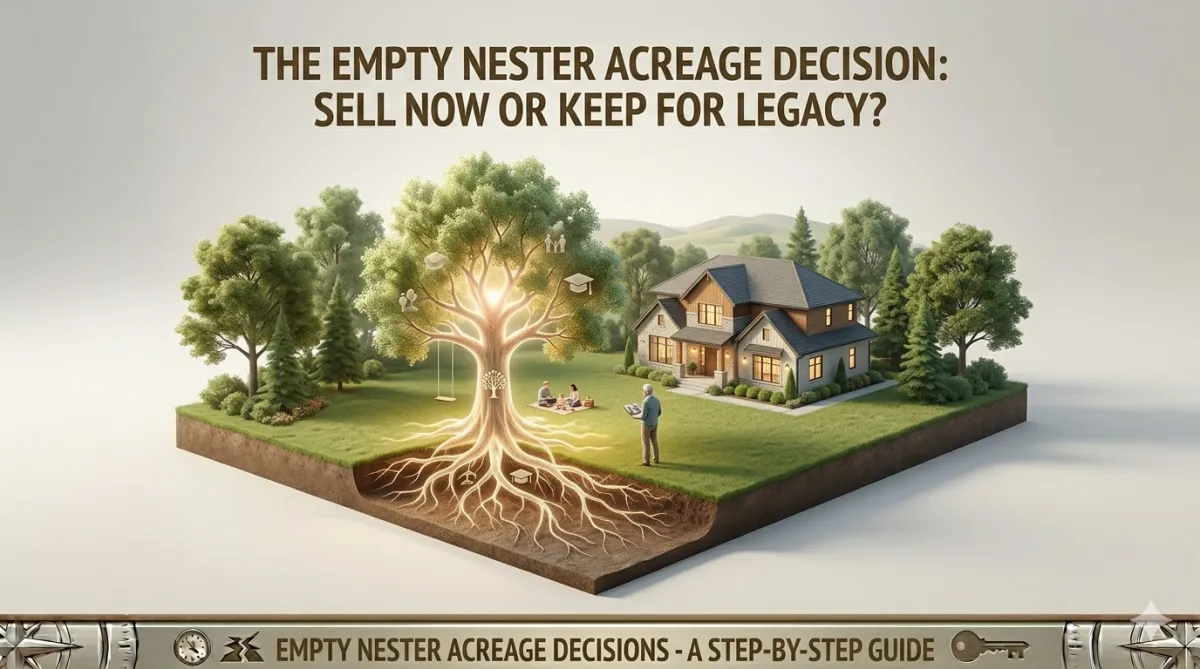
The Empty Nester Acreage Decision: Sell Now or Keep for Legacy?
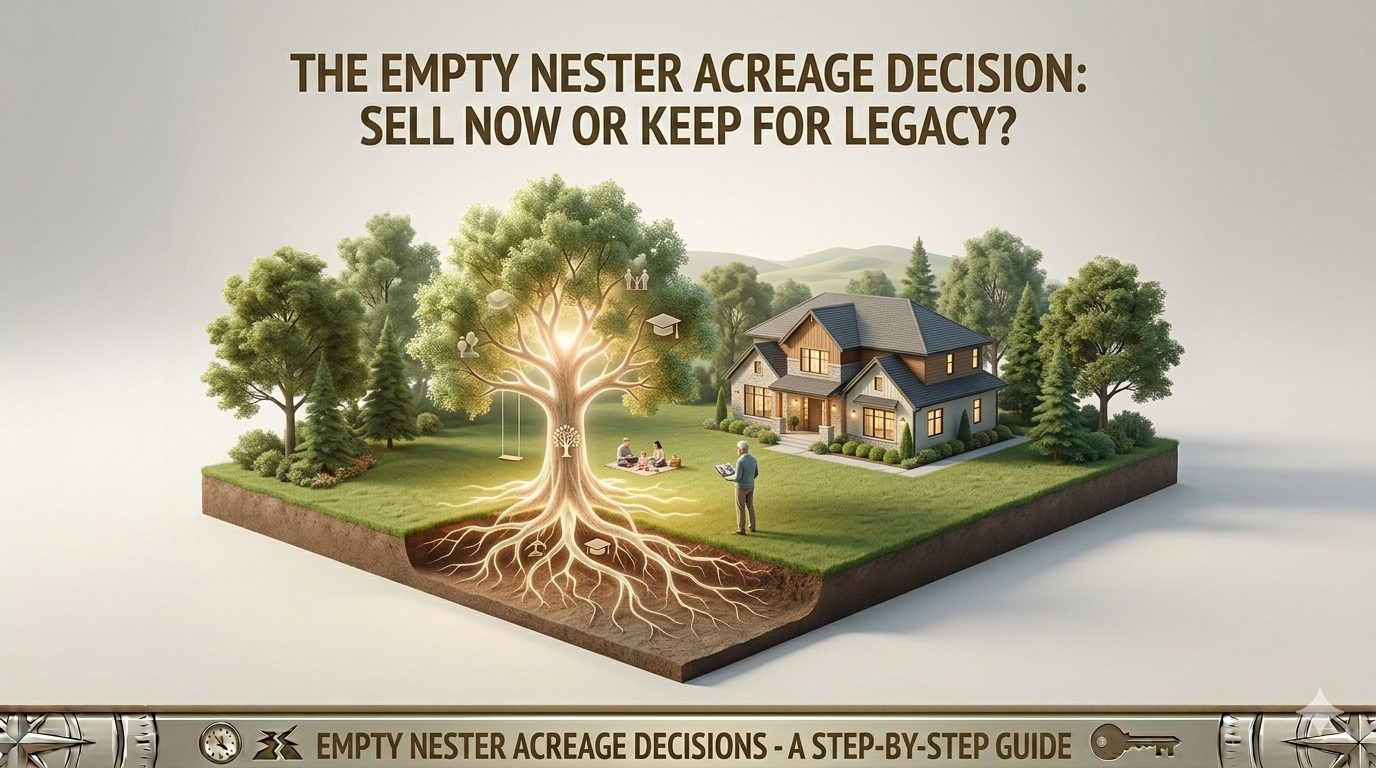
The Empty Nester Acreage Decision: Sell Now or Keep for Legacy?
Introduction
You're sitting on your deck, looking out over 10 acres of property you've owned for 30 years.
The kids grew up here. They learned to ride bikes on the long driveway. They built forts in the woods. They had bonfires with friends. This land holds three decades of memories.
But now?
The kids are gone. Moved to the city. Busy with careers, partners, their own lives.
It's just you and your spouse. Two people on 10 acres.
The lawn takes 3 hours to mow. The snow clearing is exhausting. The septic needs maintenance. The well pump failed last month ($4,500 to replace). The roof needs work ($18,000).
You're 68 years old. You want to travel. Simplify. Enjoy retirement without the constant maintenance.
But every time you think about selling, you hesitate:
"This is the kids' childhood home. This is their legacy. We should keep it for them."
So you keep paying the property taxes ($8,000/year). The utilities ($4,000/year). The maintenance ($5,000-$10,000/year). The insurance ($3,000/year).
Year after year, you spend $20,000-$25,000 carrying this property — for kids you haven't actually asked if they want it.
Meanwhile, your neighbor (same age, same situation) sold their acreage 5 years ago.
They downsized to a condo downtown. Invested the sale proceeds.
Today:
They travel 4 months per year
Zero property maintenance stress
Their investment portfolio has grown $200,000+ in 5 years
Their kids are grateful (not burdened with unwanted property)
You're still mowing 10 acres and wondering when your kids will move back (they won't).
This is The Empty Nester Acreage Decision — one of the most significant financial and lifestyle choices you'll make in retirement.
Keep the acreage? Or sell and simplify?
The financial difference over 20 years of retirement: $300,000-$600,000 in net worth plus $200,000-$400,000 in reduced carrying costs.
This post breaks down the complete financial analysis of both options, the non-financial factors that matter, how to have the conversation with your kids, and the decision framework that helps empty nesters make the right choice for their retirement and their family's future.
The Two Options: Financial Analysis
Let's run the numbers on both scenarios over a 20-year retirement period.
Scenario Setup
You (Empty Nesters):
Ages: 65-70
Property: 10-acre acreage outside Calgary
Current value: $1.2 million
Mortgage: Paid off (owned free and clear)
Annual income (retirement): $80,000-$100,000 (pensions, CPP, OAS, investments)
The Decision:
Option A: Sell acreage, downsize to smaller home or condo, invest proceeds
Option B: Keep acreage for family legacy
Option A: Sell Now, Downsize, Invest Proceeds
The Transaction
Sell Acreage:
Sale price: $1,200,000
Selling costs (realtor fees, legal, etc.): $60,000 (5%)
Net proceeds: $1,140,000
Purchase Smaller Home:
Condo or smaller home (1,200-1,500 sq ft): $500,000
Purchase costs (legal, land transfer tax, etc.): $10,000
Total purchase cost: $510,000
Remaining Cash:
$1,140,000 - $510,000 = $630,000 available to invest
Annual Carrying Costs (Smaller Home/Condo)
Property Taxes: $2,500-$3,500/year (smaller property, lower assessment)
Utilities: $2,000-$2,500/year (smaller space, more efficient)
Maintenance: $1,500-$2,500/year (condo fees cover exterior maintenance, or smaller home = less upkeep)
Insurance: $1,200-$1,800/year
Total Annual Carrying Costs: $7,200-$10,300/year
Average: $8,750/year
Investment Returns
Initial Investment: $630,000
Conservative Portfolio Allocation (Retirement-Appropriate):
60% bonds/fixed income (3-4% return)
40% equities (7-9% return)
Blended average return: 5-6% annually
Moderate Portfolio:
50% bonds, 50% equities
Blended average return: 6-7% annually
For This Analysis: 6% annual return (conservative-to-moderate)
Year 1: $630,000 × 1.06 = $667,800
Year 5: $630,000 × (1.06)^5 = $842,700
Year 10: $630,000 × (1.06)^10 = $1,128,000
Year 15: $630,000 × (1.06)^15 = $1,509,000
Year 20: $630,000 × (1.06)^20 = $2,019,000
Option A: 20-Year Summary
Assets After 20 Years:
Smaller home value (assuming 3% appreciation): $500,000 → $903,000
Investment portfolio: $2,019,000
Total Net Worth: $2,922,000
Total Carrying Costs Over 20 Years:
$8,750/year × 20 years = $175,000
Option B: Keep Acreage for Legacy
Annual Carrying Costs (10-Acre Acreage)
Property Taxes: $7,000-$9,000/year (large rural property)
Utilities:
Well pump electricity and maintenance: $600-$1,000/year
Septic maintenance (pump every 3-5 years): $500-$800/year average
Propane or natural gas (heating large home): $2,500-$4,000/year
Total utilities: $3,600-$5,800/year
Maintenance and Upkeep:
Lawn care (professional or DIY time/equipment): $2,000-$4,000/year
Snow clearing (professional or DIY time/equipment): $1,500-$3,000/year
General repairs (roof, siding, fence, driveway, etc.): $3,000-$6,000/year
Total maintenance: $6,500-$13,000/year
Insurance: $2,500-$4,000/year (larger property, rural location)
Total Annual Carrying Costs: $19,600-$31,800/year
Average: $25,700/year
Acreage Appreciation
Current Value: $1,200,000
Appreciation Rate: 3-4% annually (rural acreage appreciation typically slower than urban real estate)
For This Analysis: 3.5% annual appreciation
Year 5: $1,200,000 × (1.035)^5 = $1,426,000
Year 10: $1,200,000 × (1.035)^10 = $1,694,000
Year 15: $1,200,000 × (1.035)^15 = $2,012,000
Year 20: $1,200,000 × (1.035)^20 = $2,390,000
Option B: 20-Year Summary
Assets After 20 Years:
Acreage value: $2,390,000
Total Net Worth: $2,390,000
Total Carrying Costs Over 20 Years:
$25,700/year × 20 years = $514,000
The Financial Comparison
Net Worth After 20 Years
Option A (Sell, Downsize, Invest): $2,922,000
Option B (Keep Acreage): $2,390,000
Difference: $532,000 higher net worth by selling and downsizing
Total Carrying Costs Over 20 Years
Option A: $175,000
Option B: $514,000
Difference: $339,000 less in carrying costs by selling and downsizing
Combined Financial Advantage
Higher net worth: +$532,000
Lower carrying costs: +$339,000
Total financial advantage of Option A: $871,000
What This Means Practically
By selling the acreage and downsizing, you:
Build $532,000 more wealth over 20 years (available for retirement spending or inheritance)
Spend $339,000 less on carrying costs (freed up for travel, hobbies, grandkids, quality of life)
Have $871,000 more cumulative financial advantage compared to keeping the acreage
The Non-Financial Factors
Financial analysis is critical, but it's not the only consideration.
Factor 1: Emotional Attachment vs. Practical Reality
The Emotion:
"This is our home. We raised our kids here. Every tree, every corner of this property holds memories. How can we leave?"
The Reality:
Memories live in your heart, not in the land. Your kids' childhood doesn't disappear when you sell the property.
Questions to Ask:
Do we actively use and enjoy this property today, or are we keeping it for memories of the past?
Does maintaining this property enhance our current quality of life, or create stress and burden?
Are we living for now or living for what was?
Factor 2: Will Your Kids Actually Want This Property?
The Assumption:
"Our kids love this place. They'll want to keep it when we're gone."
The Reality (Often):
Your kids:
Live in the city (1+ hour from the acreage)
Have careers, families, busy lives
Can't afford $25,000/year carrying costs
Don't want rural property maintenance responsibilities
Will inherit the property and immediately sell it (incurring selling costs and stress during grieving period)
The Conversation You Need to Have:
Sit down with your kids. Ask directly:
"We're thinking about the future of this property. If we keep it and you inherit it, would you want to own and maintain it, or would you sell it?"
Possible Responses:
Response 1: "Honestly, we'd sell it. We love visiting, but we don't want to own it."
Your Decision: Sell now. Invest proceeds. Leave your kids liquid inheritance they actually want.
Response 2: "We'd love to keep it! We'd use it as a family retreat and can afford the carrying costs."
Your Decision: Consider keeping it — but verify they understand the actual costs and responsibilities.
Response 3: "We're not sure. Maybe one of us would want it?"
Your Decision: Get clarity. Vague "maybe" isn't a plan. Pin down who would actually take it on and whether they can afford it.
Factor 3: Active Use vs. Sentimental Storage
Active Use:
You're on the property daily or weekly. You:
Garden extensively
Keep animals (horses, chickens, etc.)
Host family gatherings regularly
Have hobbies that require space (woodworking, workshops, etc.)
The property actively enhances your life today.
Sentimental Storage:
You're on the property because you live there, but you:
Don't use most of the land
Don't host gatherings regularly (kids visit 2-3 times/year)
Spend weekends maintaining it (not enjoying it)
Would be happier in a smaller, easier-to-maintain space
The property is a burden you're keeping out of guilt or nostalgia.
Question:
If you could snap your fingers and live in a beautiful, maintenance-free condo downtown with zero yard work, would you?
If the answer is "yes" (even hesitantly), you're likely keeping the acreage for the wrong reasons.
Factor 4: Health and Mobility Considerations
Reality Check:
You're 65-70 now. Healthy, active, capable.
In 10-15 years (ages 75-85):
Snow clearing becomes dangerous (risk of falls, heart attack)
Lawn mowing becomes exhausting
General maintenance becomes difficult
Driving to town for groceries/medical appointments becomes harder
Isolation increases (far from services, friends, healthcare)
The Question:
Is this property sustainable for you for the next 15-20 years, or will you eventually be forced to sell when you're older and the market might be less favorable?
Better to sell proactively (on your terms, at a good time) than reactively (when health forces it and you have less control).
The Decision Framework
Here's how to decide which option is right for you.
Keep the Acreage If:
✅ Your kids genuinely want it (you've asked directly, they've confirmed, they understand costs and can afford them)
✅ You actively use and enjoy the property (not just maintaining it, but living a lifestyle that requires the space)
✅ You can comfortably afford the carrying costs ($20,000-$30,000/year doesn't strain your retirement budget)
✅ The emotional value outweighs the financial cost (you're willing to accept $300,000-$600,000 less net worth and $300,000+ in carrying costs in exchange for staying)
✅ You're healthy and capable of maintaining the property for the foreseeable future (next 10-15 years minimum)
Sell the Acreage If:
✅ Your kids don't want it (or you haven't asked, which likely means they don't)
✅ The property sits mostly unused (you're maintaining it, not enjoying it)
✅ Carrying costs strain your retirement budget ($20,000-$30,000/year is significant portion of income)
✅ You want simplified retirement (travel, hobbies, less stress, more time)
✅ You want to maximize wealth for yourself (retirement security) or your kids (inheritance)
✅ Health or mobility concerns make long-term maintenance uncertain
How to Have "The Conversation" with Your Kids
Most empty nesters avoid this conversation because:
They assume they know what the kids want
They're afraid of seeming like they don't care about family legacy
They don't want to burden kids with this decision
But avoiding the conversation is the real burden.
How to Start
Set Up a Family Meeting (In-Person or Video Call):
"Your mom/dad and I want to talk about the future of the acreage. We're getting older, and we need to make some decisions. We want your input."
The Questions to Ask
Question 1:
"If we keep this property and you eventually inherit it, would you want to own and maintain it, or would you sell it?"
Listen without judgment. Let them answer honestly.
Question 2:
"Do you understand the carrying costs? Property taxes, utilities, maintenance, insurance run about $20,000-$25,000 per year. Could you afford that?"
Most adult children have no idea what acreage ownership actually costs.
Laying out the numbers helps them understand the reality.
Question 3:
"Would you rather inherit this property, or would you prefer we sell it, simplify our retirement, and leave you a financial inheritance instead?"
Give them permission to be honest.
Many kids feel guilty saying "I don't want the property" because they think it will hurt you.
Reassure them: "We want to make the decision that's best for everyone. There's no wrong answer."
Common Responses (And What They Mean)
Response: "We'd sell it."
Meaning: Don't keep it for them. Sell now, enjoy retirement, invest proceeds.
Response: "I'd love to keep it, but I can't afford the upkeep."
Meaning: Emotional attachment exists, but practical reality prevents ownership. Sell now. Leave them financial inheritance they can use.
Response: "Maybe one of us would want it eventually."
Meaning: Vague, non-committal. Press for clarity. Who specifically? Can they afford it? When would they take it over?
"Maybe" isn't a plan. Get concrete answers.
Response: "We'd love to keep it as a family retreat. We'd share the costs."
Meaning: Genuine interest. But verify:
How would cost-sharing work?
Who handles maintenance?
What happens if one sibling can't afford their share?
Put it in writing (informal family agreement) so expectations are clear.
Real Example: The Johnsons' Decision
Background
The Johnsons:
Ages: 67 and 69
Property: 10 acres, Springbank area
Value: $1.3 million
Owned 28 years
Three adult children (ages 35, 38, 42)
Their Situation:
Mr. Johnson had a minor health scare (heart issue, fully recovered). It made them realize: "We're not getting younger. What do we do with this property?"
They assumed the kids would want it. "It's their childhood home."
The Conversation
They invited the kids for Sunday dinner. Brought up the topic.
Question: "If we keep the acreage and you inherit it someday, would you want to own it?"
Kid 1 (42, lives in Calgary, corporate job, two kids):
"Dad, I love this place. But honestly? I'd sell it. I'm in the city. My kids are in city schools. I can't afford $25,000/year to keep it. And I don't have time to maintain it."
Kid 2 (38, lives in Vancouver, tech job, single):
"Same. I'm in Vancouver. I visit maybe once a year. I can't take this on."
Kid 3 (35, lives in Calgary, teacher, married with one kid):
"I'd love to keep it... but I couldn't afford it on a teacher's salary. I'd have to sell too."
Mr. and Mrs. Johnson were stunned.
"We've been keeping this property thinking you kids wanted it. None of you do."
Kid 1 responded:
"Mom, Dad... we appreciate everything you've done. But we'd rather you enjoy retirement, travel, live comfortably — and leave us money we can actually use for our own families. Not a property we'll just sell anyway."
Their Decision
The Johnsons listed the property.
Sold for $1.35 million.
Bought a $600,000 condo in downtown Calgary (walkable to restaurants, theater, river pathways).
Invested $700,000 in a balanced portfolio.
Five Years Later
Their Life:
Travel 3-4 months per year (Mexico, Europe, visiting grandkids in Vancouver)
Walk to dinner, shows, coffee shops
Zero property maintenance (condo fees cover everything)
Social life improved (closer to friends, easier to host)
Health and mobility excellent (elevators, no snow clearing, accessible)
Their Finances:
Condo value: $600,000 → $720,000 (3.5% appreciation)
Investment portfolio: $700,000 → $980,000 (7% annual returns)
Net worth: $1.7 million (up from $1.35 million five years ago)
Their Kids:
Visit them in the condo regularly (easier access, downtown location)
Relieved parents are happy and financially secure
Grateful they'll inherit liquid assets, not a property to manage and sell during grief
The Johnsons' Reflection:
"We should have done this 10 years ago. We wasted a decade maintaining a property 'for the kids' who didn't want it. Best decision we ever made."
What About Subdivision or Development?
Question: "What if we subdivide the 10 acres and keep part, sell part?"
The Reality of Subdivision
Pros:
Monetize part of the property while keeping some land
Reduce carrying costs (smaller parcel = lower taxes, less maintenance)
Create liquidity without selling entirely
Cons:
Cost: $50,000-$150,000+ (surveying, engineering, legal, municipal fees, servicing)
Time: 12-24 months (municipal approvals, development permits, servicing installation)
Complexity: Zoning restrictions, setbacks, environmental constraints, access requirements
Uncertainty: Approval not guaranteed. Market conditions may change during process.
Risk: You invest $100,000+ and 18 months, and subdivision might not be approved or financially viable.
When Subdivision Makes Sense
✅ Property is in growth area with strong demand for smaller rural parcels
✅ Zoning allows subdivision (check minimum lot sizes for your municipality)
✅ You can afford the upfront costs and time
✅ You genuinely want to keep part of the property long-term (not just delaying the inevitable sale)
When Subdivision Doesn't Make Sense
❌ You're subdividing just to avoid making the "sell or keep" decision
❌ Market for subdivided rural parcels is soft (slow sales, low demand)
❌ Zoning restrictions make subdivision difficult or impossible
❌ You'll spend $100,000+ subdividing, then sell both parcels anyway (wasted cost)
For most empty nesters, subdivision is a distraction from the core decision: Do you want to continue rural property ownership, or simplify and downsize?
The Estate Planning Perspective
Question: "What if we keep the property and structure it as part of our estate plan?"
Option 1: Leave Property to Kids in Will
What Happens:
You pass away. Property transfers to kids (equally, or to one child, depending on your will).
Challenges:
Challenge 1: Probate and Transfer Costs
Property must go through probate. Legal fees, executor fees, taxes.
Challenge 2: Disagreement Among Siblings
One kid wants to keep it. Two want to sell. Conflict arises.
Challenge 3: Forced Sale During Grief
Kids are grieving. They're also forced to list, market, and sell a property. Stressful timing.
Challenge 4: Market Timing
You die in 2035. Market is soft. Property sells for less than optimal value. Kids lose $100,000-$200,000 compared to selling in a stronger market.
Option 2: Transfer Property to Kids Now (Living Trust or Gift)
What Happens:
You transfer ownership to kids while you're alive. They own it. You might retain life estate (right to live there until death).
Challenges:
Capital Gains Tax:
If property has appreciated significantly since you bought it, transferring to kids triggers capital gains tax.
Example:
Purchase price (1995): $300,000
Current value: $1,300,000
Capital gain: $1,000,000
Taxable capital gain (50%): $500,000
Tax owed (at 40% marginal rate): $200,000
You'd owe $200,000 in taxes to transfer property to kids.
Better Alternative: Keep property until death. Transfer via estate. Principal residence exemption may apply (consult tax advisor).
Option 3: Sell Now, Create Inheritance Fund
What Happens:
You sell property. Invest proceeds in trust or investment account earmarked for kids' inheritance.
Advantages:
Advantage 1: Liquidity
Kids inherit cash/investments, not property. Easy to divide equally. No forced sale.
Advantage 2: Growth
Investments grow 5-7% annually. By the time you pass (15-20 years), inheritance has compounded significantly.
Example:
$700,000 invested today at 6% annual return.
20 years later: $2.2 million inheritance (vs. $2.4 million property value if kept).
Nearly equivalent, but liquid and divisible.
Advantage 3: No Carrying Costs
You're not spending $25,000/year maintaining property. That $500,000 saved over 20 years is also part of inheritance (or retirement spending).
FAQ: The Empty Nester Acreage Decision
What if we sell and then regret it?
Regret is possible. But ask: Are you more likely to regret selling and enjoying a simplified, financially secure retirement? Or regret keeping a property that drains $500,000 over 20 years while your kids don't want it?
Most empty nesters who sell report relief and happiness, not regret.
Can we sell to one of our kids at below-market price?
Legally, yes. But consider:
Tax implications (deemed disposition rules)
Fairness to other siblings (are they compensated equally?)
Can that child actually afford ongoing carrying costs?
Consult estate lawyer and tax advisor before discounted family sales.
What if the market drops after we sell?
Market timing risk exists. But:
If you're selling to downsize and invest proceeds, you're still building wealth through investments.
If you hold acreage hoping for market peak, you might wait years while spending $25,000/year carrying costs.
Better to sell when it makes sense for your life than try to time the market perfectly.
Should we wait until the market improves?
If the market is currently soft, waiting 1-2 years for recovery might make sense.
But don't wait indefinitely. Every year you wait = another $25,000 in carrying costs.
What if we want to downsize but stay rural (smaller acreage)?
Great option. Sell 10 acres, buy 2-3 acres.
Reduces carrying costs while maintaining rural lifestyle.
Conclusion
The Empty Nester Acreage Decision: Sell now or keep for legacy?
The Financial Reality:
Keeping 10 acres for 20 years of retirement:
Carrying costs: $500,000+
Appreciation: $1.2M → $2.4M
Net worth: $2.4M
Selling, downsizing, investing proceeds:
Carrying costs: $175,000
Net worth: $2.9M+ (smaller home + investments)
$500,000-$600,000 higher net worth
$325,000 less in carrying costs
The Non-Financial Reality:
Will your kids actually want the property? (Ask them directly)
Do you actively use and enjoy it today? (Or just maintain it)
Does keeping it enhance your retirement? (Or create stress and burden)
The Decision Framework:
Keep if: Kids want it, you use it actively, you can afford it, emotional value outweighs financial cost.
Sell if: Kids don't want it (or you haven't asked), property sits mostly unused, you want simplified retirement and maximized wealth.
Most empty nesters keep acreages "for the kids" who would rather inherit $800,000 in liquid assets than a $1.2 million property they'll immediately sell.
Talk to your kids. Run the numbers. Make the decision that serves your retirement AND their future.
Facing this decision yourself? Comment 'LEGACY' below and I'll send you my Empty Nester Acreage Decision Calculator that models both scenarios financially — or DM me for personalized analysis.
Related Reading
If you found this useful, these posts go deeper on strategic retirement real estate decisions:
The Anti-Downsize Movement: Why Some Empty Nesters Refuse to Leave
The Legacy Property Shift: When Family Homes Become Multi-Generational Assets
How I Sequence a Buy-Sell So You Never Own Two Homes at Once
About Kristen Edmunds
Kristen Edmunds is a Calgary-area REALTOR® and Associate Broker with KIC Realty, specializing in acreages, luxury homes, and smart buy/sell strategies. With expertise in rural properties (water wells, septic, equestrian facilities) and a client-obsessed approach, Kristen helps buyers and sellers achieve their real estate goals with confidence and ease.