
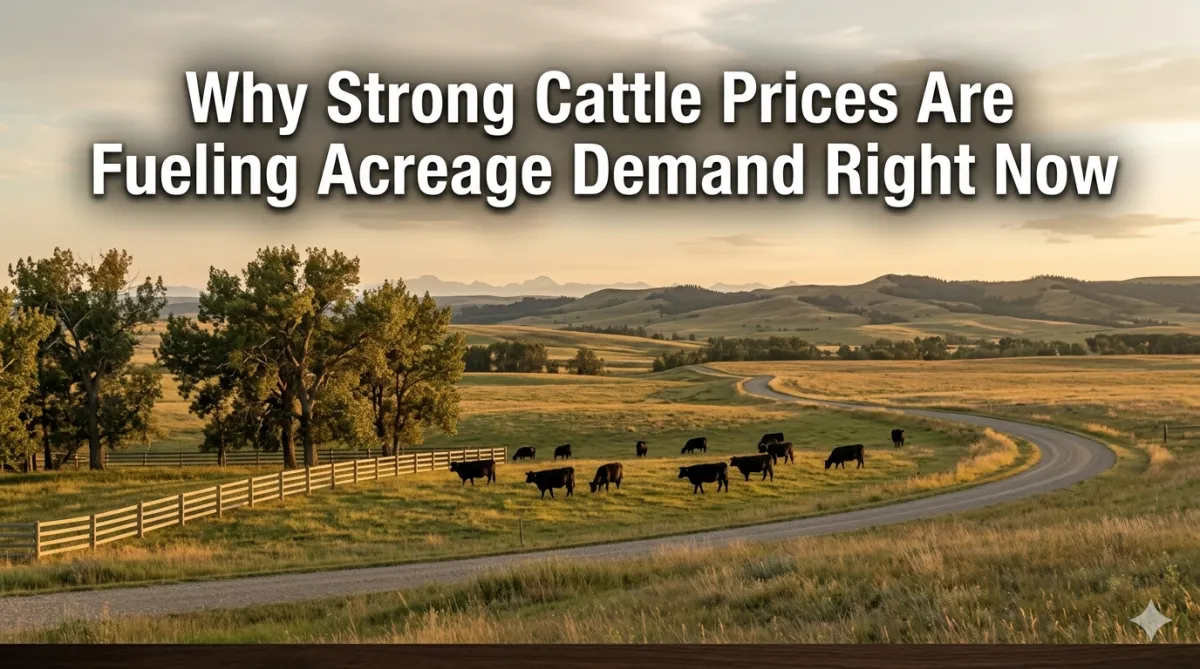
Cattle Prices Are Fueling Alberta Acreage Demand
Most of the commentary about acreage demand in the Calgary rural corridor over the past two years has focused on Calgary's population growth, high-equity homeowners, and out-of-province inflow. Those forces are real, and I've written about them. They are also not the whole picture.
There is a quieter piece of the demand puzzle that deserves more attention: cattle prices. Through 2024–2026, North American cattle markets have stayed at multi-year highs, and that cash is moving into rural Alberta land in ways the broader real estate commentary has not fully reflected. What follows is a calm walk-through of how the cattle cycle is shaping the corridor market right now, where the pressure is concentrated, and what it means for buyers and sellers across Foothills, Mountain View, Wheatland County, and the surrounding rural geography.
The Cattle Price Story, Briefly
The North American beef sector entered a herd reduction cycle in 2021–2023, driven by widespread drought conditions, high feed costs, and producers culling cows to manage operations. The result was a contracted continental herd by 2024 — the smallest in decades by some measures.
Tight supply met steady demand. Calf prices, replacement heifer prices, fed cattle prices, and feeder cattle prices have all stayed at or near multi-year highs through 2024–2026. Producers who held through the down cycle are now seeing the strongest cash flow in over a decade.
That cash flow does what cash flow has always done in agricultural communities: it goes back into land.
Three Buyer Types, One Inventory Pool
The Calgary rural corridor has three distinct buyer types competing for similar acreage parcels right now, and the cattle cycle is intensifying the pressure on the inventory pool.
Operating producers expanding herds. Producers across Foothills, eastern Mountain View, and southern Wheatland County are using elevated cash flow to expand cow-calf operations, which requires more grazing and hay land. The 40–160 acre range is particularly active for this buyer type — large enough to add meaningful capacity, small enough to be financeable through ag-credit programs.
Lifestyle acreage buyers. The buyer who wants 20 to 80 acres, a few cows for tax structure or visual appeal, a horse or two, and a primary lifestyle reason for the move. This buyer type often comes from Calgary equity, has done their reading on agricultural depreciation and ranchland tax treatment, and is competing for similar parcels to the operating producer — though usually at slightly different price points.
Out-of-province acreage seekers. Buyers from Ontario, British Columbia, and increasingly Saskatchewan, drawn by Alberta's relative affordability, lifestyle, and the shift toward rural living that began through the pandemic and has not reversed. Many of these buyers are entering the corridor with significant capital from urban property sales and are looking at parcels comparable to the operating-producer and lifestyle-buyer pools.
Three buyer types. One inventory pool. The mathematical result is exactly what you'd expect — pressure concentrating on the most contested parcels.
Where the Pressure Concentrates
The competition is not uniform across the rural corridor. The most pressured sub-segments share specific characteristics:
Geography. Eastern Rocky View County, northwestern Foothills County, eastern Mountain View County, and southern Wheatland County are the most active cattle-pressure zones. These areas combine grazing-suitable land, reasonable proximity to feedlots and processing infrastructure, and traditionally active producer communities.
Parcel size. 20 to 160 acres is the bullseye. Larger parcels (320+ acres) tend to be held by established operators not selling. Smaller parcels (under 10 acres) are not workable for cattle expansion. The middle segment is where all three buyer types overlap.
Infrastructure. Working perimeter fencing, reliable water source (well, dugout, or stream rights), at least one functional outbuilding, and road access that handles cattle truck loads. Properties without one or more of these characteristics see less competition.
Properties that hit all three are the most contested in the entire corridor right now. They sell quickly, often with multiple offers, and prices are firming year-over-year in a way that would surprise observers who haven't been tracking the cattle market.
What This Means for Sellers
For owners of qualifying parcels in the cattle-pressure zones, the timing window is favourable but specific. The most-contested segment will not stay contested forever — cattle cycles turn, and the cash-flow tailwind eventually weakens. Selling into the current cycle is materially different from selling into the next one.
Two practical implications. First, presentation matters more than usual. The producer-buyer is not buying lifestyle; they are evaluating the land's actual carrying capacity, water reliability, fence condition, and proximity to operations. Documentation of these (water test results, animal unit assessments, fence inspections) will materially affect the sale price. Second, terms can be more flexible than buyers expect. Producers and lifestyle buyers often want different timelines, and creative possession structures, vendor financing, or partial-acreage subdivisions can unlock additional value.
What This Means for Buyers
For acreage buyers — operating, lifestyle, or out-of-province — the strategic posture has shifted. Three things matter more in this market than they did even 18 months ago.
The first is being ready. Financing pre-approved, conditions framework understood, walk-away thresholds defined. Buyers who arrive ready capture the better properties. Buyers waiting for "the right one" often watch the right ones go to others.
The second is understanding what you're competing against. A lifestyle buyer competing for a parcel against an operating producer is not in a fair fight on price-per-acre — the producer can extract real cash flow from the land that the lifestyle buyer cannot. Understanding the buyer pool for a specific property changes the bidding strategy.
The third is patience on specifics. The cattle pressure is concentrated on certain parcel types. Buyers willing to flex on geography (looking slightly farther east), parcel size (slightly smaller or slightly larger than the bullseye), or infrastructure (willing to invest post-purchase) often find better value with less competition.
The Risk: Cattle Cycles Turn
Cattle markets are cyclical. The current cycle is unusually strong, but it is still a cycle. When prices soften — and they will, eventually — the producer demand component of acreage pressure weakens. The lifestyle and out-of-province pillars are more durable, but the producer pressure on specific sub-segments is the most cycle-sensitive part of the picture.
For sellers, this argues against indefinite delay. The current pricing on highly contested parcels reflects three buyer types competing simultaneously. If the producer pillar weakens, the contested premium in that sub-segment narrows.
For buyers, it argues against assuming current pricing is a permanent floor. There may be a window in 2 to 4 years where producer demand softens and parcels that are unaffordable today become reachable. The trade-off is uncertainty about whether that window will arrive at all.
Frequently Asked Questions
Do producer-buyers usually overpay compared to lifestyle buyers?
Not typically. Operating producers are disciplined buyers who run land economics in their head — they know what carrying capacity, hay yield, and water reliability translate to in dollar terms. They will pay strong prices for the right land but they are not emotional buyers. Lifestyle buyers are more often the source of price-overshoots in the corridor.
What's an "animal unit" and why do producers care?
An animal unit is the standard agricultural measure of how many cattle a parcel can support sustainably. Foothills County and other rural municipalities have specific animal-unit-per-acre guidelines based on land class, water, and grazing infrastructure. For producers, this is a foundational input to any purchase decision. For lifestyle buyers, understanding it helps avoid overpaying for parcels with limited carrying capacity.
Is this the right time to enter ranching as a lifestyle move?
"Lifestyle ranching" is a more demanding undertaking than the marketing usually suggests. Cattle work, infrastructure maintenance, water management, and the daily reality of livestock are not optional once cows are on the property. The right time to enter is when the buyer is genuinely committed to the lifestyle — not when the prices look attractive. The right property pencils both ways.
Where can I track Alberta cattle prices?
Alberta Beef Producers, Canfax, and the daily reports out of Calgary Stockyards are all reliable sources. For real estate buyers, the relevant signal is direction and magnitude — sustained strong prices over 18+ months tell you the producer-buyer pool is active. Specific weekly numbers matter less for property decisions than the broad cycle picture.
Closing Thought
The acreage market across the Calgary rural corridor in 2026 is being shaped by forces that don't all show up in the headline real estate reports. Calgary equity is one. Out-of-province inflow is another. The cattle cycle is the quiet third — and on certain parcels in certain sub-segments, it is the dominant pressure right now.
If you're a seller in a contested parcel type, or a buyer trying to understand why the right property keeps getting taken before you can move, the cattle factor deserves a place in the analysis. The work I do at this stage is structured, market-specific, and built around understanding the actual demand pool for your specific situation — not the generic "warming market" narrative the broader commentary is still circulating.