
857 Wildfires Are Burning in Canada Right Now — Here Are 3 Things Every Acreage Buyer Needs to Ask
As of mid-July 2026, there are 857 active wildfires burning across Canada, with more than 700 currently out of control. The Government of Canada is reporting 3,137 fires so far this 2026 season and 1.4 million hectares burned. Above-average temperatures and dry conditions are forecast to continue through July and August. Smoke from the Canadian fires has crossed the US border and is affecting air quality in 18 states, including New York City.
This piece is not fear content. It is practical due-diligence content — the three specific questions every acreage buyer touring properties in the Calgary rural corridor this summer needs to ask about every property they walk through, and why most buyers never think to ask them. It is what my Acreage Protection Protocol looks like on a live wildfire-season week.
Where the Fires Are Concentrated Right Now
The 2026 fires are concentrated in Ontario, Manitoba, and Saskatchewan, with Alberta and British Columbia under close monitoring. Alberta is not currently at the epicentre, but the province is exposed to the same underlying dry-and-hot conditions and the same insurer-side pressure that is being felt across all Canadian rural markets.
Wildfire risk for a specific Alberta acreage property is not primarily about whether there is an active fire nearby right now. It is about the underlying structural exposure of the property — its position relative to forested land, its defensible-space maintenance, and its insurance profile — over the whole ownership horizon.
Question 1: Where Does This Property Sit Relative to the Wildfire Interface Zone?
The wildfire interface zone is the boundary between wildland vegetation (forest, dense bush, tall grassland) and developed structures. Properties on that boundary — edge-of-forest acreages, heavily-treed properties, acreages that back onto Crown land or protected forest — carry measurably higher wildfire exposure than properties in open grassland with clean sightlines in every direction.
The distinction is often visible from the driveway if you know what to look for. Ask yourself:
Does the property back onto or border continuous forest or dense bush?
Is there a clear separation between the property boundary and any wildland vegetation, or does the wildland press right up to the fence line?
How would a wind-driven fire approach this property — from which direction, and across what fuel load?
What is the terrain? Fires climb slopes fast — properties on a slope with wildland vegetation below are at higher risk than properties on a flat.
Corridor acreages vary significantly on this question. A ten-acre parcel with open pasture on all four sides in Wheatland County has a very different risk profile than a five-acre parcel backing onto forest in the Foothills. Both can be beautiful properties. They just carry different underlying wildfire exposure.
Question 2: What Does the Defensible Space Situation Look Like?
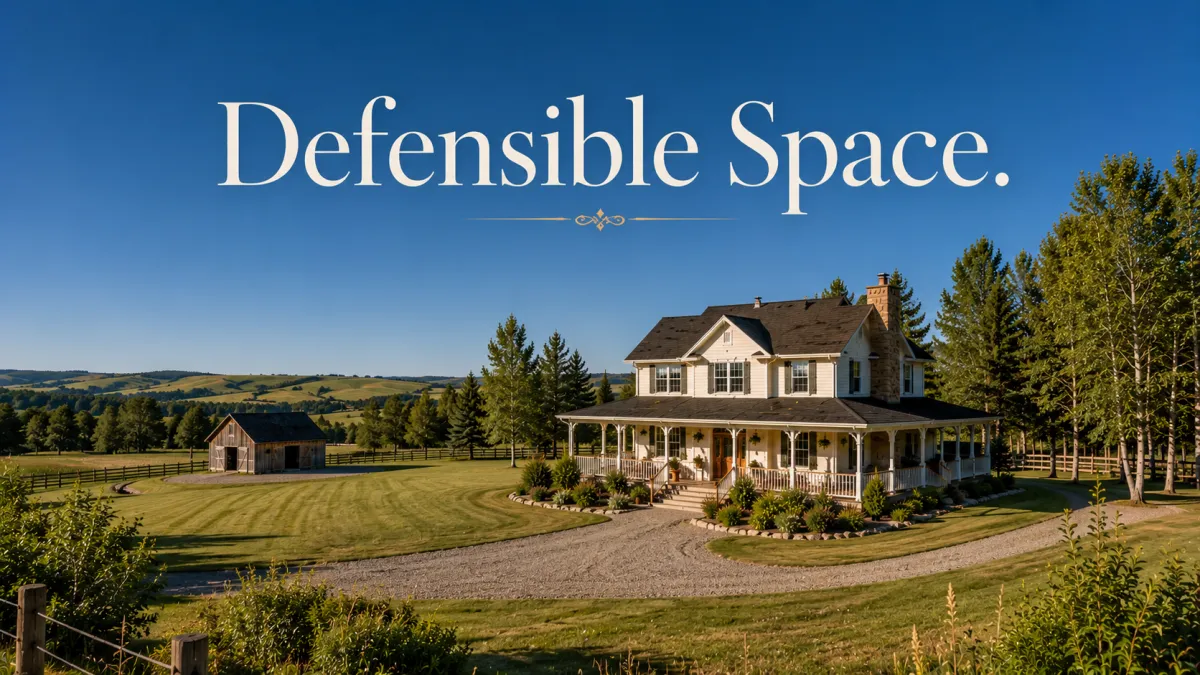
Defensible space is the maintained buffer between the home and outbuildings and the surrounding vegetation. It is the single most cost-effective wildfire protection an acreage owner can maintain — and it is the first thing insurers look at when they price a policy.
The framework most fire authorities use is a zoned approach around the structure:
Zone 1 (0-10 metres from the home): No flammable vegetation, well-watered lawn or gravel, no wood piles, no propane tanks close to structures
Zone 2 (10-30 metres from the home): Thinned vegetation, tree branches pruned up from the ground, no ladder fuels connecting ground vegetation to tree canopies
Zone 3 (30-100 metres from the home): Managed forest or pasture with reduced fuel loads
When you walk a property, look at what is actually there:
Is there a clear buffer of mown lawn, gravel driveway, or maintained pasture immediately around the home and outbuildings?
Or does dense shrub or long grass press right up against the walls, decks, and fences?
Are trees held at a respectful setback distance, or do branches actually overhang the roof line?
Are outbuildings (barns, shops, sheds) receiving the same defensible-space treatment as the main house?
A well-maintained defensible space visibly transforms the wildfire-risk profile of a property. It also transforms what an insurer will quote. Which brings us to the third question.
Question 3: What Does the Rural Insurance Cost, and What Is the Owner's Claim/Coverage History?
Rural property insurance is structurally different from urban home insurance, and wildfire exposure is one of the specific factors insurers are pricing more aggressively in 2026 than they were even two years ago.
Two due-diligence questions to ask the current owner directly, before you write an offer:
What does the rural insurance actually cost right now for this specific property? Not what the seller paid five years ago. What is the current premium under current market conditions?
Has the current owner had any claims or coverage changes in the last five years? Any wildfire-related claim, any smoke-damage claim, any coverage restriction imposed by the insurer, or any non-renewal notice. These are all material facts that carry forward to a new owner.
Wildfire interface properties across Alberta are seeing premium increases and, in some cases, coverage restrictions from insurers — either higher deductibles specifically for wildfire, exclusions on certain outbuildings, or non-renewal notices for the most exposed properties. That is a real cost of ownership and a real timing consideration that belongs in the offer conversation.
A twenty-minute call with a broker who specializes in rural coverage, quoting the specific property you are considering, is one of the highest-leverage due-diligence moves an acreage buyer can make. Do that before you write the offer, not after.
Why These Are Not Scary Questions
The reason I am writing this is not to add wildfire fear to what is already a headline-heavy summer. It is to name that these three questions are the questions a protected buyer asks, and that most acreage buyers never think to ask them.
Understanding a property's wildfire interface position, defensible space setup, and insurance profile does not scare a serious buyer away from acreage life. It ensures the buyer enters acreage life with eyes open — knowing what they own, knowing what maintenance obligations come with it, and knowing what the insurance realities will look like over the ownership horizon.
That is what my Acreage Protection Protocol is built around. Not preventing acreage purchases. Making sure the acreage purchase happens on the buyer's real information base — not on the buyer's hope.
What Corridor Buyers Should Actually Do This Summer
For a serious acreage buyer active in the Calgary corridor this summer, the practical steps are simple.
On every property tour: Assess the three questions above visually. Ask the listing agent for the current insurance information. Note what you see about defensible space and interface position.
Before any offer: Get a rural-specialist insurance quote on the specific property. Ask directly about the owner's claim and coverage history. Include a condition on satisfactory insurance in your offer where appropriate.
After possession: Maintain the defensible space actively. It is the single most cost-effective wildfire protection you will ever invest in.
Why the 857 Number Matters Right Now Specifically
Acreage buyers currently touring have a specific advantage over buyers who tour in a quieter wildfire year. The current news cycle is making sellers, insurers, and listing agents all more receptive to wildfire-due-diligence questions than they would be in a quieter year. Asking these questions now does not read as unusual — it reads as prudent. Which means the friction on getting real answers is lower than usual.
That is a practical, tactical advantage a prepared buyer can use this summer.
What This Doesn't Mean
A few things this piece is not arguing. It is not arguing that acreage buying is dangerous — most acreage properties in the corridor have manageable wildfire risk with appropriate defensible space maintenance. It is not arguing that only open-grassland acreages are worth considering — treed acreages have real lifestyle appeal and can be protected effectively with the right setup. It is not arguing that insurance is impossible to obtain for wildfire-exposed properties — it is arguing that pricing and coverage are meaningfully different in 2026 than five years ago, and the buyer should know what they are getting into. What it is arguing is narrow: three specific questions belong in every acreage buyer's tour and offer conversation this summer, and most buyers do not think to ask them.
Frequently Asked Questions
Where can I read the Government of Canada wildfire update myself?
The Government of Canada Public Safety wildfire update page publishes ongoing situation reports through the season. The July update covers the 857-active, 3,137-season, 1.4M-hectare figures referenced above.
Is my specific property in a wildfire interface zone?
The Alberta government publishes wildfire hazard mapping that identifies interface zones by area. County-specific FireSmart resources are also available for Rocky View, Foothills, Mountain View, and Wheatland Counties. For a specific parcel read, combining the mapping with a walk-around by someone who knows what to look for is the right approach.
Who should I call for a rural insurance quote before writing an offer?
Ask specifically for a broker who does substantial rural and acreage business in Alberta. Not every insurance broker handles rural well — the ones who do can price wildfire exposure, outbuilding coverage, livestock liability, and other rural specifics correctly.
What is the single most important defensible-space maintenance action?
Keeping the immediate 0-10 metre zone around the home and outbuildings clear of flammable vegetation and stored fuel (wood piles, propane tanks close to structures). That single zone does more to reduce wildfire risk than anything else an owner can do.
Closing Thought
857 active wildfires. 700+ out of control. 1.4 million hectares burned this season. Above-average temperatures and dry conditions through August. If you are touring acreages this summer, three questions belong in every conversation: wildfire interface zone position, defensible space, and rural insurance cost plus claim history. Not scary questions. Protected-buyer questions. I ask them for my clients every day — it is exactly what my Acreage Protection Protocol is built around.
If you want to walk through proper acreage due diligence before you make an offer this summer, book a free call: https://bit.ly/4bNDnJ5. This is exactly what I do for every buyer I work with.