
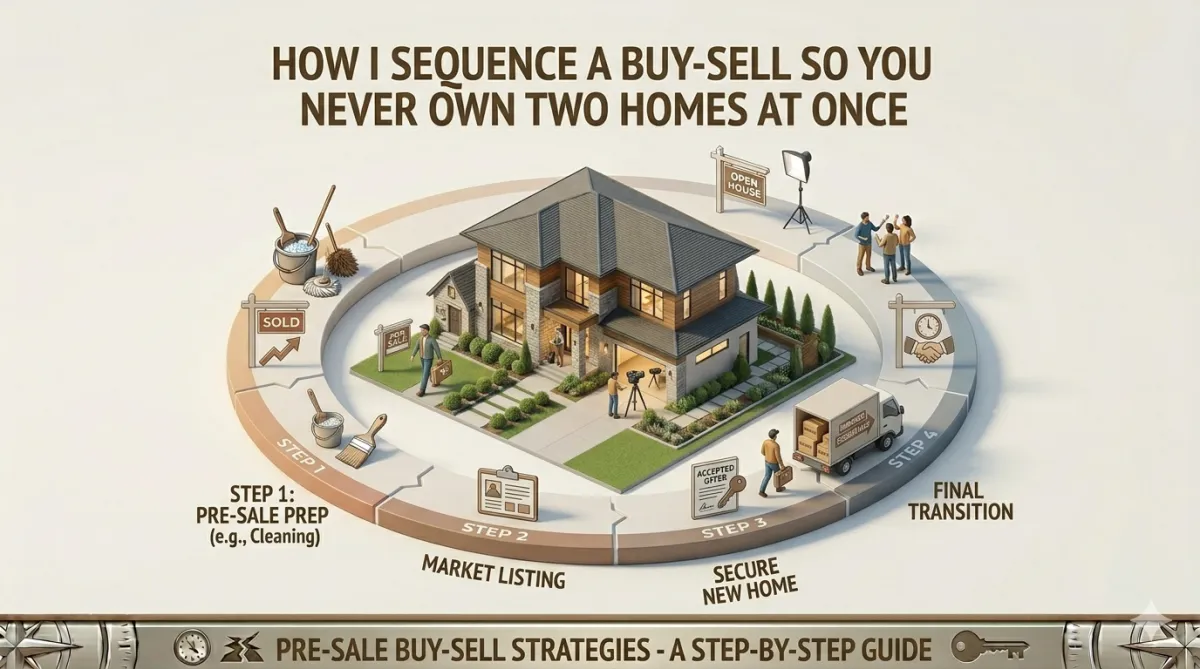
How I Sequence a Buy-Sell So You Never Own Two Homes at Once
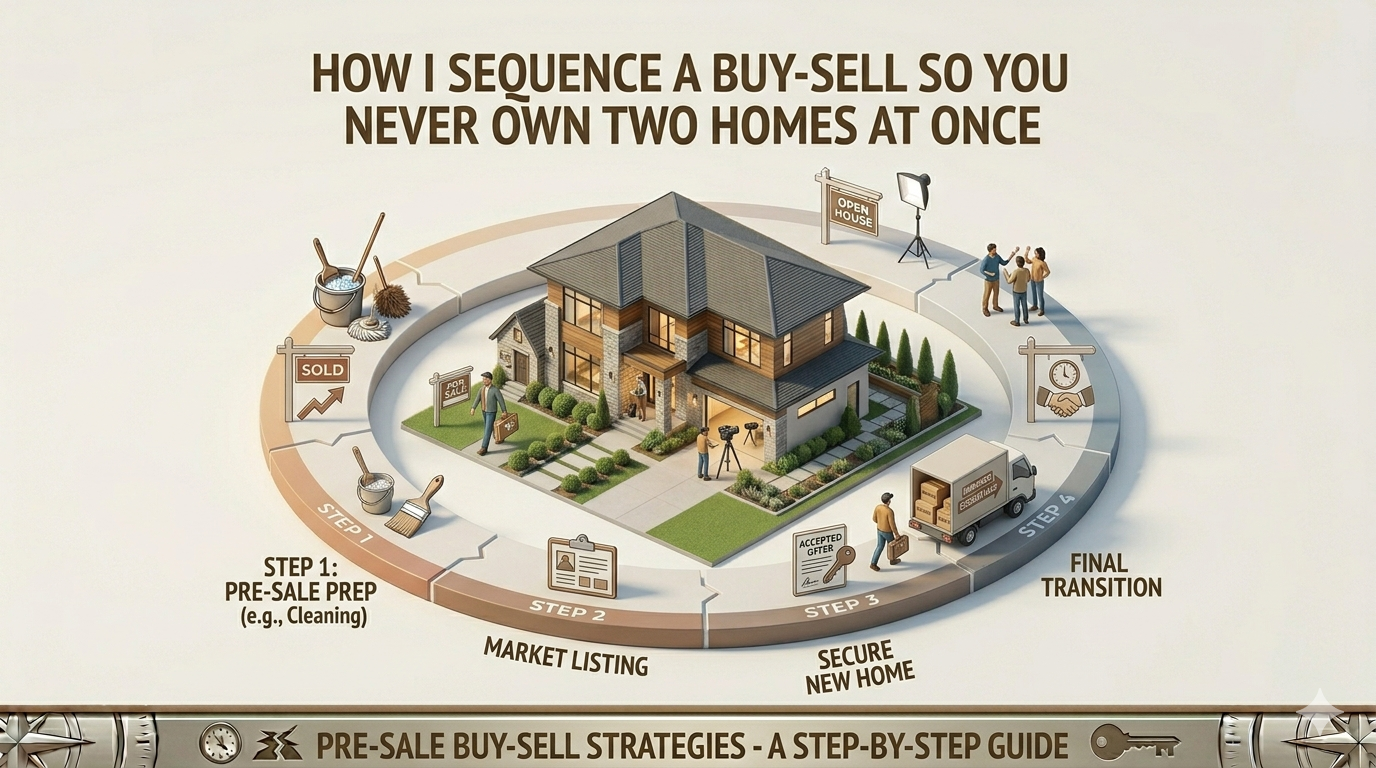
How I Sequence a Buy-Sell So You Never Own Two Homes at Once
Introduction
You're ready to upgrade.
You've outgrown your starter home. The kids need more space. You want a bigger yard. Better neighborhood. Newer finishes.
You start house hunting.
And you find it. The perfect home. Everything you've been looking for.
You're excited. You want to make an offer.
But then reality hits: "Wait... we still own our current home. What do we do?"
Your realtor says: "You have two options."
Option 1: Make your offer conditional on selling your current home.
"But," the realtor warns, "in a competitive market, sellers don't like conditional offers. You might lose the house."
Option 2: Make an unconditional offer and sell your current home after.
"But," the realtor warns, "if your current home doesn't sell quickly, you'll own two homes and have two mortgages."
You panic. You don't want to lose your dream home. So you choose Option 2.
You make an unconditional offer. It's accepted.
Now you have 60 days to close on your new home — and you haven't even listed your current home yet.
You rush to list. Quick clean, basic photos, onto the market.
Week 1: No offers.
Week 2: One lowball offer. You reject it.
Week 3: Another lowball offer. You're getting nervous.
Week 4: Still no acceptable offers. Your new home closes in 30 days.
Week 5: Panic. You accept an offer $35,000 below your original asking price just to close the deal before your new home purchase completes.
Week 6: You coordinate closings. Your current home closes. Three days later, your new home closes.
You made it. Barely.
But here's what it cost you:
$35,000 less on sale price (accepted lowball offer out of desperation)
$8,000 in bridge financing fees (short-term loan to cover down payment gap between closings)
Months of stress and anxiety (Will it sell in time? What if we own two homes?)
Total cost of poor timing: $43,000
Meanwhile, your neighbor did the same upgrade move.
But they used a strategic buy-sell sequence.
Their process:
Month 1: Started pre-listing prep on current home (updates, staging, photos) while house hunting.
Month 2: Found dream home. Made offer conditional on selling current home within 45 days.
Month 2 (same week as offer): Listed current home (already prepped, professional photos ready).
Week 2 after listing: Accepted offer on current home.
Week 3: Conditional clause on new home purchase satisfied. Offer became firm.
Month 3: Coordinated closings. Current home closed Day 1. New home closed Day 5.
One move. No overlap. No bridge financing. No double mortgage.
Their cost: $0 in bridge financing. $0 in double carrying costs. Sold current home for full asking price (not desperate, had time to negotiate).
Net advantage over you: $43,000
This is the buy-sell sequence — the strategic coordination that prevents you from ever owning two homes at once and saves you $30,000-$50,000+ in unnecessary costs and lost sale price.
Most buyers don't know this strategy exists. They panic-buy and hope their current home sells quickly.
That's a $30,000-$50,000 gamble.
This post breaks down the exact buy-sell sequence I use with clients to eliminate double-mortgage risk, avoid bridge financing, coordinate closings seamlessly, and save tens of thousands in the process.
The Problem: Why Most Buyers End Up Owning Two Homes
Scenario 1: The Unconditional Offer Gamble
What Happens:
You find your dream home. You make an unconditional offer (no conditions, firm commitment).
Offer accepted. You have 30-60 days to close.
Problem: You still own your current home.
Now you're racing the clock:
List current home immediately (rushed prep, poor photos, not market-ready)
Accept whatever offers come in (desperate to close before new home purchase completes)
If it doesn't sell in time → bridge financing or double mortgage
Risks:
Risk 1: Desperate Sale
You accept a lowball offer because you're running out of time.
Loss: $20,000-$50,000 below market value.
Risk 2: Bridge Financing
Your current home doesn't sell before new home closes. You need a bridge loan to cover down payment gap.
Cost: $5,000-$12,000 in fees and interest for 30-90 days.
Risk 3: Double Mortgage
Your current home doesn't sell for months. You own two homes simultaneously.
Monthly carrying costs:
Two mortgages: $5,000-$10,000/month
Two property tax payments: $500-$1,000/month
Two utility bills: $400-$800/month
Two insurance premiums: $300-$600/month
Total: $6,200-$12,400/month
For 3 months: $18,600-$37,200
Total potential cost of unconditional offer gamble: $25,000-$75,000+
Scenario 2: The "Sell First" Conservative Approach
What Happens:
You list and sell your current home first. Then you start house hunting.
Problem: You're now homeless (or living in temporary housing) while searching for your next home.
Risks:
Risk 1: Temporary Housing Costs
You need somewhere to live between selling current home and buying new home.
Options:
Rent apartment: $2,000-$3,500/month
Extended stay hotel: $3,000-$5,000/month
Stay with family/friends: Free but inconvenient
For 2-3 months: $4,000-$15,000
Risk 2: Storage Costs
Your furniture and belongings need storage while you're in temporary housing.
Cost: $200-$500/month × 2-3 months = $400-$1,500
Risk 3: Two Moves Instead of One
Move 1: Current home → Temporary housing
Move 2: Temporary housing → New home
Cost: $2,000-$4,000 (professional movers for two moves, or time/stress of DIY twice)
Risk 4: Buying Pressure
Your equity is sitting in the bank. You're in temporary housing. You feel pressure to buy quickly — even if it's not the perfect home.
Potential cost: Settling for suboptimal home = years of regret
Total cost of "sell first" approach: $6,400-$20,500 (plus stress and inconvenience)
The Solution: The Strategic Buy-Sell Sequence
Here's the step-by-step sequence I use to coordinate buy-sell transitions so clients never own two homes at once and avoid all the costs/risks above.
The 3-Step Sequence
Step 1: Pre-List Prep During House Hunting (Months 1-2)
Step 2: Sale-Conditional Purchase Offer (Month 2)
Step 3: Coordinated Closings (Month 3)
Let's break down each step.
Step 1: Pre-List Prep During House Hunting
The Parallel Timeline Strategy
Most buyers think sequentially:
Find new home
Make offer
Then start prepping current home to sell
Problem: This creates time pressure and rushed preparation (poor photos, minimal updates, desperate timeline).
Strategic approach: Do Steps 1 and 3 simultaneously.
While you're house hunting for your next home, you're simultaneously preparing your current home for sale.
What "Pre-List Prep" Means
Phase 1: Strategic Updates (30-60 Days Before Listing)
Based on the 90-Day Pre-Sale Prep Timeline, you're doing:
Paint (if needed)
Minor repairs
Landscaping refresh
Updating fixtures
Goal: When you find your dream home and make an offer, your current home is ready to list immediately (not 30-60 days later).
Phase 2: Staging and Photography (2-4 Weeks Before Expected Listing)
Once you're actively house hunting and getting close to making an offer:
Professional staging (or staging consultation)
Decluttering and deep cleaning
Professional photography
Why This Timing:
Photos stay fresh for 4-6 weeks. You want them ready to go the moment you make an offer on a new home.
Phase 3: Pre-Listing Inspection (Optional But Recommended)
Hire inspector to review your current home before listing.
Identify issues buyers will find. Fix them proactively.
Cost: $400-$700
Benefit: Negotiate from strength, not weakness. No surprises during buyer's inspection.
The Timeline Advantage
Scenario A: No Pre-Prep (Most Buyers)
Day 1: Find dream home, make offer, accepted
Day 2-30: Rush to prep current home (updates, photos, staging)
Day 30: List current home
Day 60: Closing on new home (current home may or may not have sold)
Scenario B: Pre-Prep Strategy
Day -60 to Day -30: Pre-list prep on current home while house hunting
Day -14: Staging and professional photos completed
Day 1: Find dream home, make offer (conditional on sale)
Day 1: List current home (already prepped, photos ready)
Day 14-30: Accept offer on current home
Day 60: Coordinated closings (current home Day 60, new home Day 63-67)
Difference:
Pre-prep gives you 30-45 extra days of marketing time for your current home + professional presentation from Day 1 = higher sale price, faster sale, stronger negotiating position.
Step 2: Sale-Conditional Purchase Offer
What Is a Sale-Conditional Offer?
Structure:
Your offer to purchase the new home includes a condition:
"This offer is conditional upon the buyer selling their current property located at [address] by [date, typically 30-60 days from offer date]."
What This Means:
Your offer is not firm until your current home sells.
If your current home sells within the condition period → your offer becomes firm, and you proceed to purchase the new home.
If your current home does not sell within the condition period → you can walk away from the purchase with no penalty.
Why Sellers Accept Sale-Conditional Offers
Seller's Perspective:
"This buyer's offer is conditional. They might not be able to complete the purchase if their home doesn't sell. Should I accept this, or wait for an unconditional offer?"
When Sellers Accept Conditional Offers:
1. Reasonable Condition Period (30-45 Days)
Sellers are more likely to accept if the condition period is short and realistic.
60-90 day conditions feel too long and uncertain.
30-45 days = reasonable timeline for a well-priced, well-prepped home to sell.
2. Buyer's Current Home Is Already Listed
If your current home is already on the market (because you did pre-listing prep), sellers see this as lower risk.
"Their home is already listed and showing activity. They're serious and capable."
3. Strong Offer Price
If your offer price is competitive (at or near asking), sellers are more willing to accept conditions.
4. Backup Offer Protection
Include clause: "Seller retains the right to continue marketing the property and accept backup offers. If seller receives an acceptable backup offer, buyer has 72 hours to remove the sale condition or the offer is null and void."
This protects the seller (they can continue showing the home) while giving you time to sell your current home.
Sale-Conditional Offer in Competitive Markets
Objection: "But won't I lose out to unconditional offers in a hot market?"
Reality:
Sometimes, yes. If there are multiple offers and one is unconditional, sellers often choose the unconditional offer.
But:
Not all markets/properties are ultra-competitive. Many homes receive only 1-2 offers. Your conditional offer may be the only strong offer.
Conditional offers with backup clause protect sellers. They can accept your offer and keep marketing. Low risk for them.
Strong price + short condition period + already-listed current home = competitive offer even with condition.
Risk-reward calculation: Is losing your dream home worse than risking $30,000-$50,000 in double mortgage/bridge financing costs? For most buyers, the answer is no.
Alternative: The "Escape Clause" Strategy
If the market is too competitive for a standard sale-conditional offer, consider:
The Firm Offer with Financing Escape Clause
Make a firm offer (no sale condition), but structure your financing so that if your current home doesn't sell, your mortgage approval falls through.
How:
Your mortgage pre-approval is contingent on selling your current home (lender requires this if your debt-to-income ratio can't support two mortgages).
If your current home doesn't sell, financing falls through, and you can't complete the purchase.
Risk:
You lose your deposit (typically $5,000-$20,000).
Benefit:
Your offer appears "firm" to sellers (more competitive), but you have a realistic exit if your current home doesn't sell.
Use this only if:
You're confident your current home will sell quickly (well-prepped, strong market, good price)
You're willing to risk your deposit
Step 3: Coordinated Closings
The Ideal Timeline
Day 1: Your current home closes
Buyer takes possession. You receive sale proceeds (equity).
Day 1-7: Gap period
You're temporarily without a home (but only for a few days).
Day 3-7: Your new home closes
You take possession of new home.
How to Coordinate Closings
Strategy 1: Build Flexibility Into Closing Dates
When you make your offer on the new home:
Possession date: "To be mutually agreed upon, approximately [60-90 days from offer date], with flexibility of +/- 7 days."
This gives you wiggle room to align closings.
Once your current home sells and you have a firm closing date, you finalize the possession date on your new home purchase to be 3-7 days later.
Strategy 2: Negotiate Rent-Back on Your Current Home (If Needed)
If your new home closing happens before your current home closing:
Rent-back agreement:
You sell your current home but negotiate to rent it back from the buyer for 7-30 days.
Cost: $100-$200/day (roughly equivalent to buyer's carrying costs)
For 7 days: $700-$1,400
Benefit: You avoid moving twice and avoid temporary housing.
When buyers accept rent-backs:
If they're investors or not moving in immediately
If you offer fair market rent
If purchase agreement includes rent-back clause from the start
Strategy 3: Short-Term Temporary Housing (Last Resort)
If closings can't be coordinated within 7 days and rent-back isn't possible:
Options:
Extended stay hotel: $150-$250/night
Short-term rental (Airbnb): $100-$200/night
Stay with family/friends: Free
For 7-14 days: $700-$3,500
Still cheaper than:
Bridge financing: $5,000-$12,000
Double mortgage for months: $18,000-$37,000
What Happens to Your Equity During the Gap?
The Mechanics:
Day 1 (Current Home Closes):
Sale proceeds deposited into your bank account.
Equity available: $200,000 (example)
Day 5 (New Home Closes):
You wire down payment ($250,000) to lawyer for new home purchase.
Source of funds:
$200,000 from sale of current home
$50,000 from savings (or other sources)
No bridge loan needed because your current home closed before your new home purchase, and proceeds are available.
The Numbers: Cost Comparison
Let's compare the costs of different buy-sell strategies.
Scenario: Upgrading from $650,000 Home to $900,000 Home
Current Home:
Sale price: $650,000
Mortgage balance: $350,000
Equity: $300,000
New Home:
Purchase price: $900,000
Down payment required: 20% = $180,000
Mortgage: $720,000
Strategy 1: Unconditional Offer, Hope Current Home Sells Fast
Timeline:
Day 1: Make unconditional offer on new home, accepted
Day 1-30: Rush to list current home
Day 45: Accept lowball offer on current home (desperate to close before Day 60)
Day 55: Current home closes
Day 60: New home closes
Costs:
Lost sale price (accepted $625,000 instead of $650,000): -$25,000
Bridge financing (needed $180,000 down payment before current home closed, borrowed for 30 days): -$3,500
Rushed listing (poor photos, no staging, minimal prep): -$10,000 in lost sale price
Total cost: -$38,500
Strategy 2: Sell Current Home First, Then Buy
Timeline:
Day 1: List current home
Day 30: Accept offer, close 45 days later
Day 75: Current home closes, move to temporary housing
Day 75-120: House hunt (45 days)
Day 120: Make offer on new home
Day 180: New home closes, move in
Costs:
Temporary housing (2 months × $2,500): -$5,000
Storage (2 months × $300): -$600
Two moves (instead of one): -$3,000
Total cost: -$8,600
Plus: Inconvenience, stress, pressure to buy quickly
Strategy 3: Strategic Buy-Sell Sequence (Sale-Conditional Offer + Coordinated Closings)
Timeline:
Day -60 to Day 1: Pre-list prep on current home while house hunting
Day 1: Find new home, make sale-conditional offer (45-day condition)
Day 1: List current home (already prepped)
Day 21: Accept offer on current home
Day 25: Sale condition on new home purchase satisfied (offer becomes firm)
Day 75: Current home closes
Day 80: New home closes (5-day gap, stay with family)
Costs:
Pre-listing prep investment (staging, updates, photos): -$8,000
Return from better sale price (sold for full asking $650,000): +$25,000
No bridge financing needed: $0
No temporary housing (5-day gap, stayed with family): $0
Single move: $0 extra cost
Net: +$17,000 (compared to Strategy 1)
Savings vs. Strategy 1: $55,500
Savings vs. Strategy 2: $25,600 (plus avoided stress and inconvenience)
When Bridge Financing Makes Sense
Sometimes bridge financing is necessary or strategic.
Scenario 1: You Found the Perfect Home and Can't Risk Losing It
Situation:
Dream home. Multiple offers expected. Seller won't accept conditional offer.
You're confident your current home will sell within 60 days, but you can't make your offer conditional.
Strategy:
Make unconditional offer. Use bridge financing to cover down payment gap. List current home immediately.
Bridge Loan Details:
Amount: $180,000 (down payment for new home)
Term: 30-90 days (until current home sells)
Interest Rate: 7-10% annually
Fees: 1-2% of loan amount ($1,800-$3,600)
Total Cost:
For 60 days:
Interest: $180,000 × 8.5% ÷ 12 × 2 = $2,550
Fees: $2,700
Total: $5,250
When this makes sense:
Your current home is well-prepped and will sell quickly
The new home is truly your dream home and worth the cost
You can afford the bridge loan fees and temporary double carrying costs
Scenario 2: Your Current Home Sold Faster Than Expected
Situation:
You listed your current home. It sold in 10 days (faster than expected).
Your new home purchase doesn't close for 45 days.
You don't want to rent-back or move twice.
Strategy:
Close on current home sale. Use bridge financing for 45 days to carry costs of new home until it closes.
Cost: $3,000-$6,000 for 45-day bridge loan
Benefit: Avoid moving twice, avoid rent-back negotiations
Common Mistakes in Buy-Sell Coordination
Mistake 1: Waiting Until After You Find Your New Home to Prep Your Current Home
Problem:
You find your dream home. You want to make an offer now.
But your current home isn't ready to list (needs paint, staging, photos).
You make an unconditional offer and then rush to list your current home. Poor presentation = lower sale price.
Solution:
Pre-list prep while house hunting. When you find your dream home, your current home is ready to list immediately.
Mistake 2: Over-Conditioning Your Offer
Problem:
You make your offer conditional on:
Sale of current home (90 days)
Financing approval (14 days)
Home inspection (10 days)
Appraisal (7 days)
Sellers see this as too uncertain and too long. They reject your offer or accept a cleaner offer.
Solution:
Keep conditions minimal and timelines short:
Sale of current home: 30-45 days max
Financing + inspection: Combined 10-14 days
Mistake 3: Pricing Your Current Home Too High
Problem:
You want to maximize sale price, so you list $30,000 above market value.
Your home sits on market for 60 days with no offers.
Meanwhile, your conditional offer on new home expires. You lose the new home.
Solution:
Price your current home competitively from Day 1. Goal is quick sale at market value, not overpriced slow sale.
Use professional pricing analysis (comparative market analysis) to price correctly.
Mistake 4: Not Communicating Timeline Clearly to All Parties
Problem:
Your current home sells. Closing in 45 days.
Your new home purchase has flexible closing ("approximately 60 days").
You assume it will all work out.
Closing dates don't align. You end up owning both homes for 15 days = $4,000-$8,000 in double carrying costs.
Solution:
Coordinate actively. Once your current home has a firm closing date, finalize your new home closing date to be 3-7 days later.
Communicate with both lawyers, both realtors, lender to ensure alignment.
FAQ: Buy-Sell Sequencing
What if I make a sale-conditional offer and my current home doesn't sell in time?
Your offer becomes void. You walk away with no penalty. You continue house hunting.
Can I make multiple sale-conditional offers on different homes?
Technically yes, but ethically questionable and practically complicated. Focus on one home at a time.
What if the seller receives a backup offer while my sale condition is active?
If your offer includes a "backup offer clause," the seller can accept a backup offer and give you 72 hours to remove your sale condition or walk away.
If you remove the condition, your offer becomes firm (risky if your current home hasn't sold yet).
How do I convince sellers to accept my sale-conditional offer?
Short condition period (30-45 days, not 60-90)
Current home already listed with activity
Competitive offer price
Include backup offer clause (seller can continue marketing)
What if closings can't be coordinated within 7 days?
Options:
Negotiate rent-back on current home (stay 7-30 days after closing)
Temporary housing (hotel, Airbnb, family) for gap period
Bridge financing to cover gap
Is bridge financing expensive?
Moderate cost. $3,000-$8,000 for 30-60 days. Worth it in some scenarios (dream home, can't risk losing it). But avoidable with proper sequencing.
Conclusion
How I Sequence a Buy-Sell So You Never Own Two Homes at Once:
The Strategic 3-Step Sequence:
Step 1: Pre-List Prep During House Hunting
Updates, staging, photos completed while you're searching for your next home
When you find it, your current home is ready to list immediately
Step 2: Sale-Conditional Purchase Offer
Offer on new home conditional on selling current home within 30-45 days
Zero risk — if current home doesn't sell, you walk away penalty-free
Already-listed current home + short condition period + competitive price = sellers often accept
Step 3: Coordinated Closings
Current home closes Day 1
New home closes Day 3-7
One move, minimal gap, zero bridge financing
The Result:
Never own two homes simultaneously
Avoid $18,000-$37,000 in double mortgage carrying costs
Avoid $5,000-$12,000 in bridge financing fees
Avoid desperate sale of current home at $20,000-$50,000 below market
Total savings: $30,000-$75,000+
The Alternative (Most Buyers):
Unconditional offer on new home → rushed listing of current home → desperate sale or bridge financing or double mortgage → $30,000-$75,000 in unnecessary costs.
Planning to upgrade or move? Comment 'SEQUENCE' below and I'll send you my buy-sell coordination checklist that prevents double-mortgage disasters — or DM me for personalized buy-sell strategy consultation.
Related Reading
If you found this useful, these posts go deeper on strategic home transitions:
The Appreciation Play: How to Buy Homes That Build Wealth (Not Just Shelter)
The $1.2M Calgary Reality Check: What Your Budget Actually Buys
About Kristen Edmunds
Kristen Edmunds is a Calgary-area REALTOR® and Associate Broker with KIC Realty, specializing in acreages, luxury homes, and smart buy/sell strategies. With expertise in rural properties (water wells, septic, equestrian facilities) and a client-obsessed approach, Kristen helps buyers and sellers achieve their real estate goals with confidence and ease.