

The Appreciation Play: How to Buy Homes That Build Wealth (Not Just Shelter)
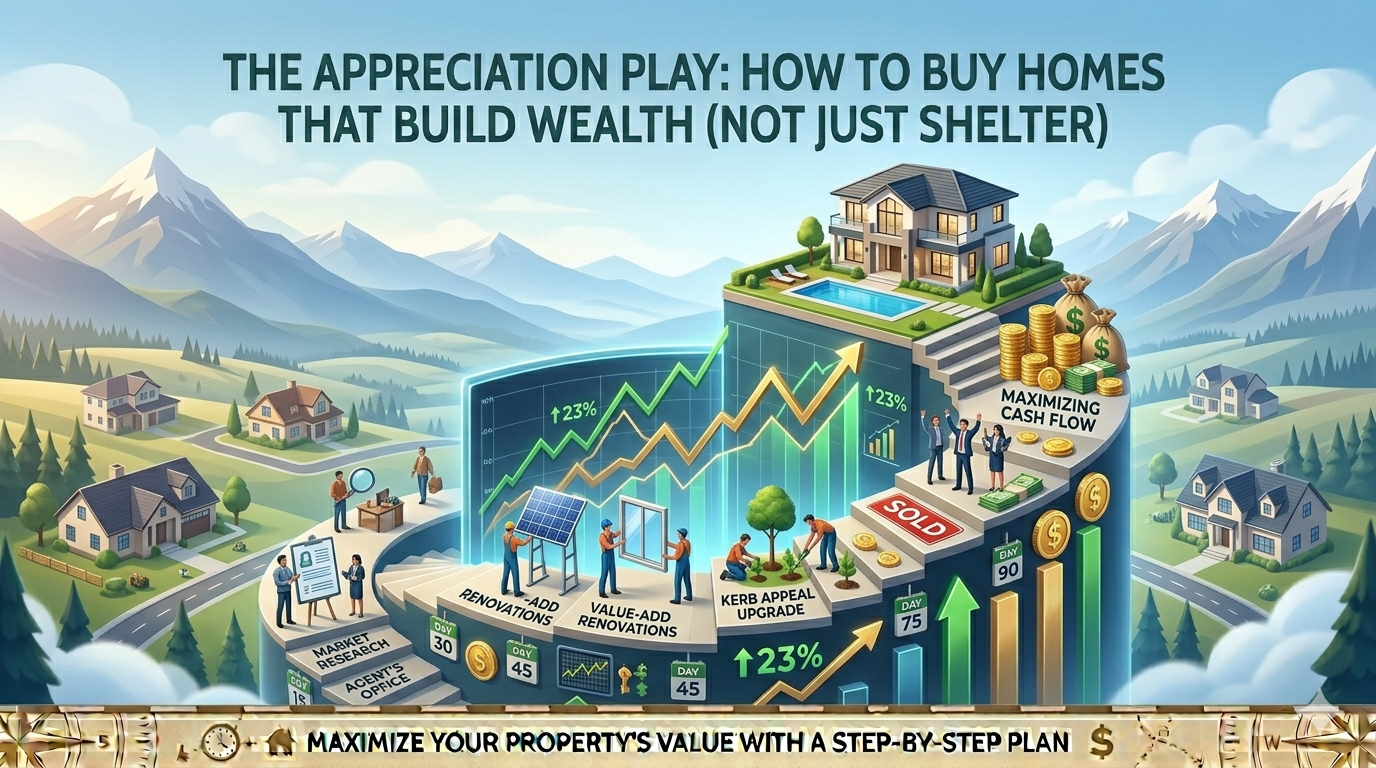
The Appreciation Play: How to Buy Homes That Build Wealth (Not Just Shelter)
Introduction
You're buying a home with a $650,000 budget.
You have two options:
Option A: A beautifully renovated bungalow in an established neighborhood. Stunning kitchen with quartz countertops and stainless appliances. Finished basement. Hardwood floors. Move-in ready. Nothing to do but unpack.
Option B: A dated 1980s bungalow in a neighborhood with a new LRT station under construction. Original kitchen and bathrooms (functional but ugly). Popcorn ceilings. Carpet throughout. But: solid foundation, new roof (2020), updated electrical panel, good bones.
Most buyers choose Option A without hesitation.
It's gorgeous. It's comfortable. It requires no work. You can move in and enjoy it immediately.
But here's what happens over the next 5 years:
Option A (Beautiful Move-In Ready Home):
Purchase price: $650,000
5-year appreciation: 2% annually (established neighborhood, modest growth)
Value after 5 years: $715,000
Equity gain: $65,000
Option B (Dated Home in Growth Corridor):
Purchase price: $650,000
Renovation investment: $35,000 (kitchen, bathrooms, flooring)
LRT station opens Year 2 → neighborhood values surge
5-year appreciation: 6.1% annually (infrastructure-driven growth)
Value after 5 years: $875,000
Equity gain: $190,000 (minus $35K spent = $155,000 net)
Wealth Gap After 5 Years: $90,000
Same starting budget. Different strategy. Nearly $100,000 difference in wealth accumulation.
This is The Appreciation Play — the strategy of buying homes not just as shelter, but as wealth-building assets.
Most buyers optimize for immediate comfort: beautiful kitchens, move-in condition, nothing to fix.
Strategic buyers optimize for appreciation potential: growth indicators, strong fundamentals, equity-building opportunities.
This post breaks down The Appreciation Play: how to identify neighborhoods with appreciation potential, how to evaluate property fundamentals that drive long-term value, why cosmetic appeal is often inversely correlated with wealth-building opportunity, and how to make home purchase decisions that build equity while you live there.
The Two Buyer Mindsets
Mindset 1: Home as Shelter
Primary Goal: Find a comfortable place to live.
Search Criteria:
Beautiful kitchens and bathrooms
Move-in ready condition
Modern finishes and aesthetics
Immediate comfort and enjoyment
Decision Factors:
Does it look good?
Can I move in without doing any work?
Do I love the finishes?
Outcome:
Find a comfortable home
Enjoy living there
Experience average market appreciation (2-4% annually)
5-Year Wealth Building: Modest
Mindset 2: Home as Wealth-Building Asset
Primary Goal: Find a property that builds equity while providing shelter.
Search Criteria:
Neighborhoods with growth indicators
Strong property fundamentals (bones)
Below-market pricing due to cosmetic issues
Appreciation potential exceeding market average
Decision Factors:
What are the growth signals in this neighborhood?
Are the bones solid (foundation, roof, structure, systems)?
Can I add value through strategic updates?
What's the appreciation trajectory?
Outcome:
Find a property with value-add opportunity
Invest in strategic updates
Experience above-market appreciation (5-8%+ annually)
Build significant equity
5-Year Wealth Building: Substantial
The Appreciation Play Strategy: Four Key Elements
Element 1: Identify Neighborhoods with Growth Indicators
The single most important factor in home appreciation is location. You can't change location. You can change everything else.
Strategic buyers don't just look at current neighborhood desirability. They look for growth indicators — signals that a neighborhood is about to become more desirable.
Growth Indicator 1: Infrastructure Projects
What to Look For:
Transit Expansion:
LRT/BRT station construction
New transit lines or extensions
Improved bus service frequency
Why It Matters:
Transit access increases property values by 10-25% within walking distance of stations.
Example (Calgary):
Green Line LRT under construction. Stations planned for Inglewood, Ramsay, Ogden, Lynnwood.
Strategic Play: Buy properties within 800 meters (10-minute walk) of planned stations before construction completes. Values surge once stations open.
Highway/Road Improvements:
New interchanges
Highway expansions
Ring road completions
Why It Matters:
Improved road access reduces commute times, increasing neighborhood desirability.
Example:
Stoney Trail completion opened up communities like Seton, Walden, Legacy — properties near new interchanges appreciated faster than market average.
Growth Indicator 2: Commercial Development and Rezoning
What to Look For:
Commercial Rezoning Applications:
Neighborhood shopping centers
Mixed-use developments
Restaurant/retail corridors
Why It Matters:
Walkable commercial amenities increase residential property values. Neighborhoods transition from car-dependent to walkable = higher desirability.
How to Find It:
Check municipal development permit applications:
City of Calgary Development Map: https://developmentmap.calgary.ca
Rocky View County development applications
Foothills County development applications
Example:
Marda Loop rezoning for mixed-use development (2010s) transformed the area. Property values surged as walkable retail/restaurants replaced old strip malls.
Strategic Play: Buy residential properties near planned commercial developments before they're built. Once complete, values increase.
Growth Indicator 3: Employment Center Expansion
What to Look For:
New Corporate Campuses:
Tech company headquarters
Major employer relocations
Business park developments
Why It Matters:
Employment centers create housing demand. Employees want to live near work. Nearby residential properties appreciate faster.
Example:
Amazon fulfillment center in Rocky View County (Balzac area). Nearby residential properties saw increased demand from employees seeking proximity.
Strategic Play: Identify employment center announcements early. Buy nearby residential properties before widespread demand drives prices up.
Growth Indicator 4: School Quality Improvements
What to Look For:
New School Construction:
New elementary/middle/high schools in developing areas
School Ranking Improvements:
Fraser Institute ranking increases
Specialty programs (IB, gifted, arts)
Why It Matters:
Families pay premium for homes in strong school catchments. School quality improvements drive residential demand and appreciation.
How to Track:
Fraser Institute school rankings (annual updates)
CBE and CSSD school construction plans
School catchment boundary changes
Strategic Play: Buy homes in catchments where new schools are planned or where existing schools are improving rankings.
Growth Indicator 5: Revitalization and Area Redevelopment Plans
What to Look For:
Municipal Area Redevelopment Plans (ARPs):
Neighborhoods targeted for revitalization
Infrastructure investment plans
Community improvement initiatives
Why It Matters:
ARPs signal municipal commitment to neighborhood improvement. Public investment attracts private investment → property values increase.
Example:
East Village ARP (Calgary). Massive public investment in parks, infrastructure, community facilities transformed area. Property values exploded.
How to Find ARPs:
Calgary Planning & Development: search "Area Redevelopment Plans"
Strategic Play: Buy in neighborhoods with recently approved ARPs before revitalization is complete.
Element 2: Evaluate Property Fundamentals (The Bones)
Location determines appreciation potential. But property fundamentals determine maintenance costs and resale value.
Strong Bones = Low Maintenance + High Resale Value
Poor Bones = Constant Repairs + Equity Drain
The Critical "Bones" to Evaluate
Foundation:
What to Check:
Cracks in foundation walls or floors
Signs of settling or movement
Water intrusion or moisture issues
Foundation type (poured concrete vs. block vs. preserved wood)
Why It Matters:
Foundation problems are expensive to repair ($10,000-$50,000+) and reduce resale value dramatically.
Strategic Play: Homes with solid foundations (no cracks, no movement, no water issues) have lower long-term costs and higher resale value.
Roof:
What to Check:
Roof age (shingles last 20-30 years)
Condition (curling, missing shingles, wear)
Evidence of leaks or water damage
Why It Matters:
Roof replacement costs $10,000-$20,000. Knowing roof age helps predict future costs.
Strategic Play:
New roof (0-5 years old) = no replacement cost for 15-25 years
Old roof (20+ years) = budget for replacement soon (but negotiate price reduction)
Electrical System:
What to Check:
Electrical panel capacity (100 amp vs. 200 amp)
Knob-and-tube wiring (fire hazard, insurance issues)
Aluminum wiring (safety concerns)
GFCI outlets in bathrooms/kitchen
Why It Matters:
Outdated electrical systems are safety hazards and insurance companies may deny coverage. Upgrading costs $8,000-$15,000+.
Strategic Play: Modern electrical (200 amp panel, copper wiring, up to code) = no upgrade costs. Outdated electrical = negotiate price reduction.
Plumbing:
What to Check:
Pipe material (copper vs. galvanized steel vs. PEX)
Signs of leaks or corrosion
Water pressure and drainage
Why It Matters:
Galvanized steel pipes corrode over time and need replacement ($8,000-$20,000). Copper or PEX = long-lasting, low maintenance.
Strategic Play: Homes with modern plumbing have lower long-term costs and fewer headaches.
HVAC (Heating, Ventilation, Air Conditioning):
What to Check:
Furnace age (furnaces last 15-25 years)
Heating system type (natural gas, electric, boiler)
Air conditioning (central vs. none)
Why It Matters:
Furnace replacement costs $4,000-$8,000. Knowing age helps predict replacement timeline.
Strategic Play: New furnace (0-5 years) = no replacement for 15-20 years. Old furnace (20+ years) = budget for replacement (negotiate price reduction).
The Appreciation Play Formula for "Bones"
Strong Bones + Growth Neighborhood = Maximum Wealth Building
Why:
Strong bones = low maintenance costs = more cash flow for strategic updates
Growth neighborhood = above-market appreciation
Strategic updates (cosmetic) = additional equity gain
Weak Bones + Growth Neighborhood = Equity Drain
Why:
Weak bones = constant repairs = cash flow drain
Even if neighborhood appreciates, repair costs eat into equity gains
Strong Bones + Stagnant Neighborhood = Modest Wealth Building
Why:
Low maintenance costs (good)
But limited appreciation (bad)
Weak Bones + Stagnant Neighborhood = Worst Scenario
Why:
Constant repairs + no appreciation = net loss
Element 3: Prioritize Appreciation Over Aesthetics
Here's the counterintuitive insight most buyers miss:
Cosmetic appeal is often inversely correlated with wealth-building opportunity.
Why?
Beautiful, Move-In Ready Homes:
Sellers charge premium for updated finishes
Buyers pay for aesthetics
Limited value-add opportunity (already updated)
Pay market rate or above for current condition
Dated, Cosmetically Challenged Homes:
Sellers can't charge premium (ugly finishes)
Buyers get discount for dated condition
Significant value-add opportunity (strategic updates)
Pay below market for strong bones in good location
Real Example: Cosmetic vs. Strategic Value
Property A: Beautiful Move-In Ready
Location: Established inner-city neighborhood (stable, modest growth)
Condition: Fully renovated (granite, stainless, hardwood)
Price: $700,000
Bones: Good (but you're paying premium for aesthetics)
5-Year Outcome:
Appreciation: 2.5% annually
Value after 5 years: $790,000
Equity gain: $90,000
Property B: Dated But Strong Bones in Growth Area
Location: Neighborhood with new LRT station under construction
Condition: Original 1980s kitchen, bathrooms, carpet (ugly but functional)
Price: $600,000 (discounted for dated condition)
Bones: Excellent (new roof, solid foundation, updated electrical)
Strategic Play:
Buy for $600,000
Invest $40,000 in kitchen, bathroom, flooring updates
Total investment: $640,000
5-Year Outcome:
Appreciation: 6% annually (infrastructure-driven growth)
Value after 5 years: $850,000
Equity gain: $210,000 (minus $40K invested = $170,000 net)
Wealth Gap: $80,000 more from Property B
Why Property B Wins:
Lower entry price ($600K vs. $700K) due to cosmetic discount
Higher appreciation (6% vs. 2.5%) due to growth location
Value-add opportunity ($40K updates add $50K+ value)
Forced equity (updates create immediate equity beyond appreciation)
The Cosmetic Update ROI Reality
Kitchen Renovation:
Cost: $20,000-$35,000 (mid-range)
Added Value: $25,000-$45,000
ROI: 90-130%
Bathroom Renovation:
Cost: $10,000-$15,000 (mid-range)
Added Value: $12,000-$18,000
ROI: 100-120%
Flooring (Carpet to Hardwood/Laminate):
Cost: $5,000-$10,000
Added Value: $8,000-$15,000
ROI: 120-150%
Paint (Whole House):
Cost: $3,000-$6,000
Added Value: $8,000-$12,000
ROI: 150-200%
Total Cosmetic Update Package:
Cost: $40,000-$65,000
Added Value: $55,000-$90,000
ROI: 120-140%
Key Insight:
Cosmetic updates are cheap relative to location and bones. You can fix ugly. You can't fix bad location or bad structure.
The Appreciation Play:
Buy strong bones in growth location with cosmetic issues. Get discount. Update cosmetics. Capture appreciation + update ROI.
Element 4: Assess Investment Fundamentals
Beyond growth indicators and bones, strategic buyers evaluate investment fundamentals that drive long-term demand.
Fundamental 1: School Catchment Quality
Why It Matters:
Families with children prioritize school quality. Homes in strong school catchments command 5-15% premium and sell faster.
How to Evaluate:
Fraser Institute rankings (annual school report cards)
CBE vs. CSSD vs. private school access
Specialty programs (IB, gifted, French immersion)
Strategic Play:
Buy homes in catchments ranked 7+ out of 10. Families always seek these areas = sustained demand = stable appreciation.
Fundamental 2: Walkability and Amenities
Why It Matters:
Walkable neighborhoods (grocery, coffee, restaurants, parks within 10-minute walk) command premium and appreciate faster due to lifestyle demand.
How to Evaluate:
Walk Score: https://www.walkscore.com
Proximity to parks, pathways, amenities
Pedestrian infrastructure (sidewalks, crossings)
Strategic Play:
Neighborhoods with Walk Score 70+ (Very Walkable) or 90+ (Walker's Paradise) have higher demand and appreciation.
Fundamental 3: Employment Center Proximity
Why It Matters:
Homes within 20-30 minute commute of major employment centers (downtown, business parks, corporate campuses) have sustained demand.
How to Evaluate:
Commute time to downtown Calgary
Proximity to major employers
Transit access to employment centers
Strategic Play:
Balance commute convenience with affordability. Properties 20-25 minutes from downtown often offer best value (close enough for daily commute, far enough for affordability).
Fundamental 4: Future Development Constraints
Why It Matters:
Neighborhoods with limited future development (geographic constraints, established boundaries, no vacant land) have supply constraints = higher appreciation.
How to Evaluate:
Is neighborhood fully built out?
Are there vacant parcels for new construction?
Geographic constraints (rivers, escarpments, parks limiting expansion)?
Example:
Inner-city Calgary neighborhoods (Kensington, Inglewood, Bridgeland) are fully built out. Limited supply + high demand = strong appreciation.
Strategic Play:
Established neighborhoods with limited new supply appreciate faster than new suburban developments with ongoing construction.
Putting It All Together: The Appreciation Play Checklist
Here's how to evaluate properties using The Appreciation Play framework.
Step 1: Identify Target Neighborhoods
Use Growth Indicators:
Transit projects (LRT, BRT)
Commercial development/rezoning
Employment center expansion
School improvements
Municipal revitalization plans
Create a List:
5-10 neighborhoods with multiple growth indicators.
Step 2: Evaluate Property Fundamentals
For Each Listing:
Foundation condition?
Roof age?
Electrical system (panel capacity, wiring type)?
Plumbing (pipe material, condition)?
HVAC age?
Filter:
Only consider properties with strong bones (or negotiate significant price reductions for weak bones).
Step 3: Assess Cosmetic Condition
Dated/Ugly = Opportunity
Original kitchens, bathrooms, flooring
Cosmetic discount = lower entry price
Value-add potential through updates
Move-In Ready = Premium Pricing
Already updated = paying for aesthetics
Limited value-add opportunity
Preference:
Strong bones + dated cosmetics in growth neighborhood.
Step 4: Calculate Investment Potential
Appreciation Projection:
Growth neighborhood: 5-7% annually
Stable neighborhood: 3-4% annually
Stagnant neighborhood: 2-3% annually
Value-Add Opportunity:
Cost of cosmetic updates: $30,000-$60,000
Added value from updates: $40,000-$80,000
Net value-add: $10,000-$30,000
5-Year Wealth Projection:
Purchase price + appreciation (5 years) + value-add - update costs = projected equity
Compare:
Property A (move-in ready, stable location) vs. Property B (dated, growth location)
Which builds more wealth over 5 years?
Step 5: Make Strategic Offer
For Properties with Appreciation Play Potential:
Offer based on bones + location + growth potential
Discount for cosmetic issues (don't pay for aesthetics you'll replace)
Factor update costs into offer price
Example:
Listed at $650,000 (dated condition).
Comparable updated homes in area: $700,000.
Cosmetic updates needed: $40,000.
Strategic Offer: $610,000-$630,000
Why:
You're buying bones and location. Not paying premium for dated cosmetics you'll update anyway.
Common Mistakes: Why Most Buyers Miss The Appreciation Play
Mistake 1: Falling in Love with Aesthetics
The Trap:
Touring beautifully staged, move-in ready homes. Falling in love with granite countertops and spa bathrooms.
The Result:
Paying premium for aesthetics. Limited value-add opportunity. Average appreciation.
The Fix:
View aesthetics as changeable. Focus on location and bones.
Mistake 2: Ignoring Growth Indicators
The Trap:
Buying in established neighborhoods without researching growth signals.
The Result:
Stable, modest appreciation (2-4% annually). Missing high-growth opportunities.
The Fix:
Research infrastructure, commercial development, employment centers. Target growth corridors.
Mistake 3: Overvaluing Convenience Over Wealth-Building
The Trap:
"I don't want to renovate. I want move-in ready."
The Result:
Paying premium for someone else's updates. Missing value-add opportunities.
The Fix:
Recognize that $40,000 in strategic updates can create $80,000+ in equity. Short-term inconvenience = long-term wealth.
Mistake 4: Emotional Decision-Making
The Trap:
Making offers based on feelings ("I love this house!") instead of data.
The Result:
Overpaying for emotional attachment. Weak investment fundamentals.
The Fix:
Separate emotion from investment analysis. Love the neighborhood and bones. Be neutral on cosmetics.
Who The Appreciation Play Works For
Profile 1: Strategic First-Time Buyers
Why It Works:
Limited budget requires maximizing value
Long time horizon (10-20+ years) allows appreciation to compound
Willing to invest sweat equity or manage renovations
Outcome:
Build significant wealth through strategic purchase + appreciation + updates.
Profile 2: Real Estate Investors (House Hackers)
Why It Works:
Buy duplex or home with rental suite in growth area
Live in part, rent part (offset mortgage)
Capture appreciation + rental income + value-add
Outcome:
Accelerated wealth building through multiple income streams.
Profile 3: Move-Up Buyers with Equity
Why It Works:
Equity from first home provides down payment
Experience from first purchase informs strategy
Can afford updates (renovation budget available)
Outcome:
Upgrade to better location + larger home + continued wealth building.
Who The Appreciation Play Doesn't Work For
Profile 1: Buyers Who Need Move-In Ready
Why It Doesn't Work:
No time/energy for renovations
Need immediate comfort
Can't handle construction disruption
Reality:
Pay premium for convenience. Accept average appreciation.
Profile 2: Buyers with Very Short Time Horizons
Why It Doesn't Work:
Appreciation takes 3-5+ years to materialize
Transaction costs (buying + selling) eat into gains
Need immediate liquidity
Reality:
Appreciation Play requires 5-10+ year hold for maximum benefit.
FAQ: The Appreciation Play
Can I still enjoy my home if I'm focused on appreciation?
Absolutely. You live in it daily. Make updates that improve your life AND build equity. It's not either/or.
What if I buy in a "growth neighborhood" and it doesn't grow?
Risk exists. Mitigate by targeting neighborhoods with multiple growth indicators (not just one). Diversify signals.
How much should I budget for cosmetic updates?
$30,000-$60,000 for kitchen, bathrooms, flooring, paint (mid-range updates). ROI typically 120-150%.
Should I hire a realtor who specializes in investment properties?
Yes. An investment-minded realtor helps identify growth indicators, evaluate fundamentals, and negotiate strategically.
What if I overpay for "bones" and location?
Overpaying negates advantage. Use comps, appraisals, and strategic offers to ensure fair pricing based on fundamentals.
Conclusion
The Appreciation Play: buying homes not just as shelter, but as wealth-building assets.
Most buyers optimize for:
Beautiful kitchens and bathrooms
Move-in ready condition
Immediate comfort
Result: Average appreciation (2-4% annually), modest wealth building.
Strategic buyers optimize for:
Growth neighborhoods (infrastructure, development, employment)
Strong fundamentals (foundation, roof, electrical, plumbing)
Value-add opportunities (cosmetic updates with high ROI)
Investment metrics (schools, walkability, demand drivers)
Result: Above-market appreciation (5-8%+ annually), significant wealth building.
The Wealth Gap:
Same $650,000 starting budget. Over 10 years:
Shelter-focused buyer: $100,000-$150,000 equity gain
Appreciation Play buyer: $250,000-$350,000 equity gain
Difference: $150,000-$200,000 in net worth from strategic decision-making.
Your home is your largest asset. Make purchase decisions that build wealth while you live there.
If you're ready to stop just house hunting and start building wealth through real estate, comment WEALTH below, and I'll share my appreciation indicators checklist — or DM me if you want help identifying properties with appreciation potential.
Related Reading
If you found this useful, these posts go deeper on strategic home buying:
The 35-Minute Trade-Off: How Commute Distance Shapes Your Home Value and Lifestyle
The $1M Calgary Comparison Trick: What Your Money Actually Buys
City Bungalow vs. Rocky View Acreage: The Real Cost Comparison
About Kristen Edmunds
Kristen Edmunds is a Calgary-area REALTOR® and Associate Broker with KIC Realty, specializing in acreages, luxury homes, and smart buy/sell strategies. With expertise in rural properties (water wells, septic, equestrian facilities) and a client-obsessed approach, Kristen helps buyers and sellers achieve their real estate goals with confidence and ease.
Ready for backend SEO details when you are!