
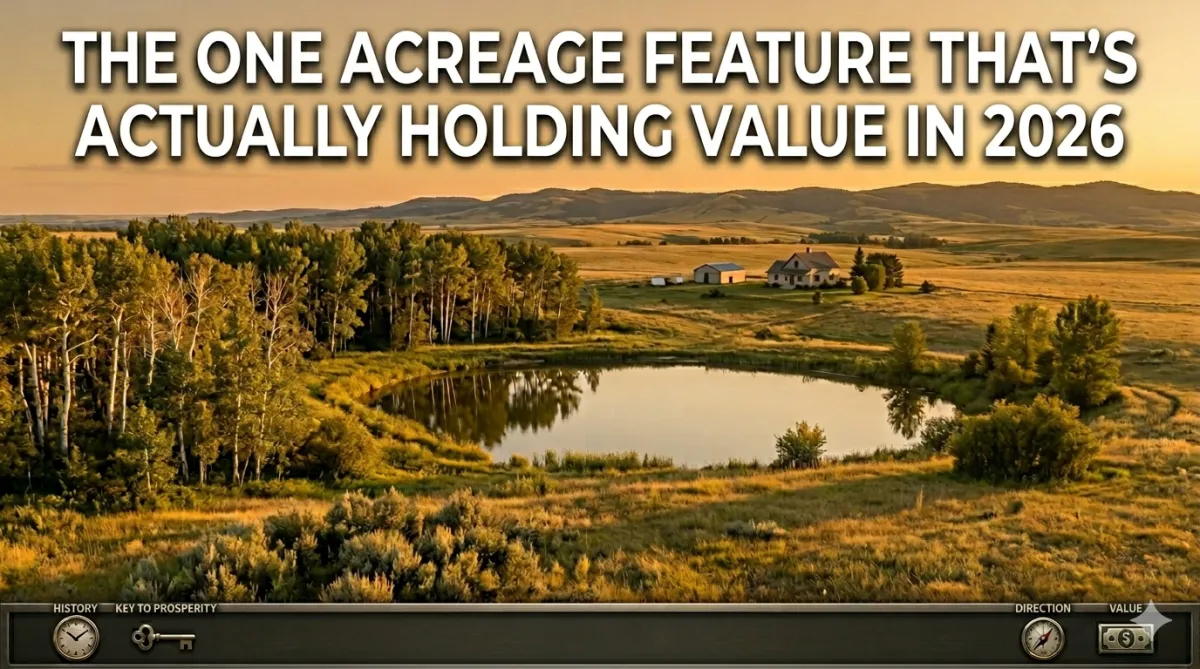
The One Acreage Feature Holding Value in 2026
The single feature actually holding and growing acreage value across the Calgary corridor in 2026 isn't a renovated kitchen, a high-end shop, or even a mountain view. It's water. And the gap between acreages with documented, reliable water and those without is widening faster than most sellers and most buyers fully appreciate.
What follows is a calm walk-through of why water has become the binary factor in Alberta acreage value, what "good water" actually means in practical terms, the real market premium documented water commands, and what to do whether you're buying, selling, or holding an acreage in this environment.
Why Water Is the Binary Factor
Three forces are stacking to make water the single most important acreage feature in 2026 and the years ahead.
First, Alberta's water licence system is functionally closed in most over-allocated basins. New wells in much of the rural corridor — including significant portions of Rocky View, Foothills, Mountain View, and Wheatland County — cannot legally be created without a water diversion licence, and the licences are not generally being issued. That makes existing, licensed water supply increasingly valuable in a way that didn't apply a decade ago.
Second, the drought cycle of 2021–2023 left a lasting mark on producer and homeowner thinking. Buyers who watched neighbours drill replacement wells at $20,000 to $40,000 and still get marginal yield are no longer assuming that "we'll figure out water later." Water security has moved from a background assumption to a foreground decision criterion.
Third, the demand pool for acreages — Baby Boomer downsizers, high-equity Calgary homeowners, out-of-province inflow, and operating producers — all share one trait: they understand the question now in a way the 2018 buyer often didn't. The water conversation happens earlier, sharper, and more decisively.
What "Good Water" Actually Means
"Good water" on an Alberta acreage is not a single number. It's three components together, each of which a buyer in 2026 is increasingly likely to evaluate independently.
Flow rate.A sustained flow of 5 gallons per minute or better under load (typically measured through a 4-hour pump test or longer) is the working benchmark for a residential acreage. Lower yields work for smaller households or properties with significant storage, but the resale value drops meaningfully below 3 gallons per minute. Higher yields (8 to 15+ gallons per minute) command real premium for properties supporting cattle, horses, or larger households.
Water quality.Lab-tested results within Alberta drinking water standards — bacterial (total coliforms, E. coli), chemical (iron, manganese, sulphates, nitrates, hardness, total dissolved solids), and where relevant, arsenic and uranium. Quality issues are often treatable, but treatment systems cost $3,000 to $15,000 to install and ongoing dollars to maintain. Buyers price these in.
Water rights and licence.A registered diversion licence where applicable (typically required for higher-volume uses, agricultural use, or some acreages on certain basins), and clear documentation of the well's legal standing. Properties with proper paperwork sell faster and at better numbers than properties with question marks.
Acreages with all three documented and clean are increasingly the ones capturing the strong end of the market. Acreages with documented gaps in any of the three — particularly flow rate or licence — are seeing those gaps priced in by buyers, often more aggressively than sellers expect.
The Market Premium
The numbers are specific and observable across recent transactions in the Calgary corridor.
On a 10 to 20 acre parcel in the $750,000 to $1,200,000 range, an acreage with strong, documented water typically captures $40,000 to $100,000 more than an equivalent parcel with marginal or undocumented water. The gap widens on properties intended for cattle, horses, or larger water-use lifestyles, where the difference can be considerably larger.
This isn't a 2026 phenomenon. It's a structural shift that started becoming visible in 2022 and has accelerated each year since. The trajectory points toward a continued widening of the gap, not a narrowing.
For sellers, this means the documentation is almost as valuable as the water itself. An acreage with strong actual water and no documentation captures a smaller premium than an acreage with the same water and clean paperwork. The cost of producing the documentation (water testing, flow testing, licence verification) is typically $400 to $1,500. The return on that documentation, in sale price, is consistently many times that figure.
What Kills Water Value
Three patterns reduce acreage value most reliably in the water dimension.
First, the unknown well. A property with a well that hasn't been tested in years, no recent flow data, no maintenance records, and no clear understanding of depth or aquifer is in the most penalized position. Buyers don't differentiate between "unknown but probably fine" and "actually marginal" — they price for the risk.
Second, the failing well that hasn't been addressed. A well producing below 3 gallons per minute, water quality outside acceptable ranges, or visible mineral or bacterial issues is a meaningful price reducer. The fix (rehabilitation, deepening, drilling new) ranges from $5,000 to $40,000 depending on scope.
Third, the missing or unclear licence. An acreage that should have a water diversion licence but doesn't, or one where the licence's standing is unclear, creates a real legal liability that sophisticated buyers will not accept without resolution.
How to Assess Water Before Buying
For acreage buyers in 2026, the water diligence has moved from a nice-to-have during conditions to a foundational requirement at the offer stage.
The minimum acceptable diligence: a current water quality test from an accredited Alberta lab (bacterial and chemical, full panel), a flow test of at least 4 hours documenting sustained yield, a review of the property's water licence position if applicable, and a conversation with neighbouring property owners or a local well contractor about aquifer behaviour in the immediate area. Total cost: typically $400 to $1,500. Total time: 2 to 3 weeks.
The right offer structure includes a water condition with enough time to complete this diligence properly — typically 10 to 14 business days in the conditional period. Compressing this below 7 days often produces an inspection that doesn't actually answer the questions that matter.
What to Do If You Own and Want to Improve
For acreage owners thinking about selling in the next 12 to 36 months, three practical moves before listing.
First, get the current testing done now. A recent (within 6 months) bacterial and chemical water quality test from an accredited lab, plus a current flow test, plus any maintenance records. This is the foundational asset for the sale.
Second, address any treatable issues. Iron or manganese can be filtered. Hardness can be softened. Bacterial issues from a recent contamination can typically be resolved with shock chlorination and re-testing. Most of these fixes cost $2,000 to $10,000 and recover 3 to 10 times that in sale price.
Third, document the licence position clearly. If your property has a water diversion licence, verify it's current. If you've been operating without one and probably should have one, talk to a water rights lawyer before listing — this is fixable, but it takes time, and selling without addressing it usually costs more than fixing it.
Frequently Asked Questions
What if my acreage has a cistern instead of a well?
Cisterns are a legitimate alternative for properties without viable well water, and many work well — but they affect the buyer pool. Operating producers and most acreage lifestyle buyers prefer wells. Cistern properties often sell to a more specific subset of buyers, typically at slightly lower numbers per equivalent acre. The right preparation for a cistern property includes documentation of the cistern condition, the water hauling arrangement, and the typical annual cost of water delivery.
How much does drilling a new well actually cost?
In the Calgary corridor in 2026, a new well typically runs $15,000 to $30,000 for drilling, casing, and basic pumping infrastructure. Costs rise meaningfully for deeper drilling, difficult geology, or wells requiring specialized completion. Permits and licence application costs (where applicable) add another $500 to $2,500. The math gets harder when an existing acreage's licence position complicates new drilling.
Do new acreage subdivisions get water licences?
Rarely, in most over-allocated basins. This is a meaningful piece of the supply constraint discussed in earlier pieces about the corridor. New subdivisions that lack guaranteed water rights face a serious development challenge, and the inventory of newly created acreages with reliable water is shrinking accordingly.
Is water quality treatment a deal-breaker for buyers?
Not usually, if it's disclosed and addressed properly. Most quality issues are treatable, and a buyer who walks into a property with a clear understanding of "the water needs a softener and a basic iron filter, here's the cost, here's the system already in place" will price that into the offer without it killing the deal. The deal-breaker is usually the unknown — water that hasn't been tested, treatment that hasn't been documented, or quality issues that surface late in the diligence process.
Closing Thought
The acreage market across the Calgary corridor is changing in ways the broader real estate commentary hasn't fully caught up with. Many of the features that mattered most in 2018 (granite countertops, finished basements, even certain location premiums) matter less now than they did. Water — the one feature that can't be created where it doesn't exist — matters more.
If you own an acreage and haven't documented your water position recently, the work to do so is small relative to the value it preserves and creates. If you're looking at an acreage and not running the water diligence early, you're leaving the single most important variable to chance. The market in 2026 rewards the buyer and seller who understand which features are quietly becoming binary — and water has been the clearest example of that shift across the corridor.
The work I do at this stage is structured, water-specific where it needs to be, and built around understanding the full water position of any property before either side commits to a number. If you're a seller within 12 to 36 months of listing, or a buyer evaluating any acreage in the next 6 months, the conversation about water is worth having before the conventional ones do.