
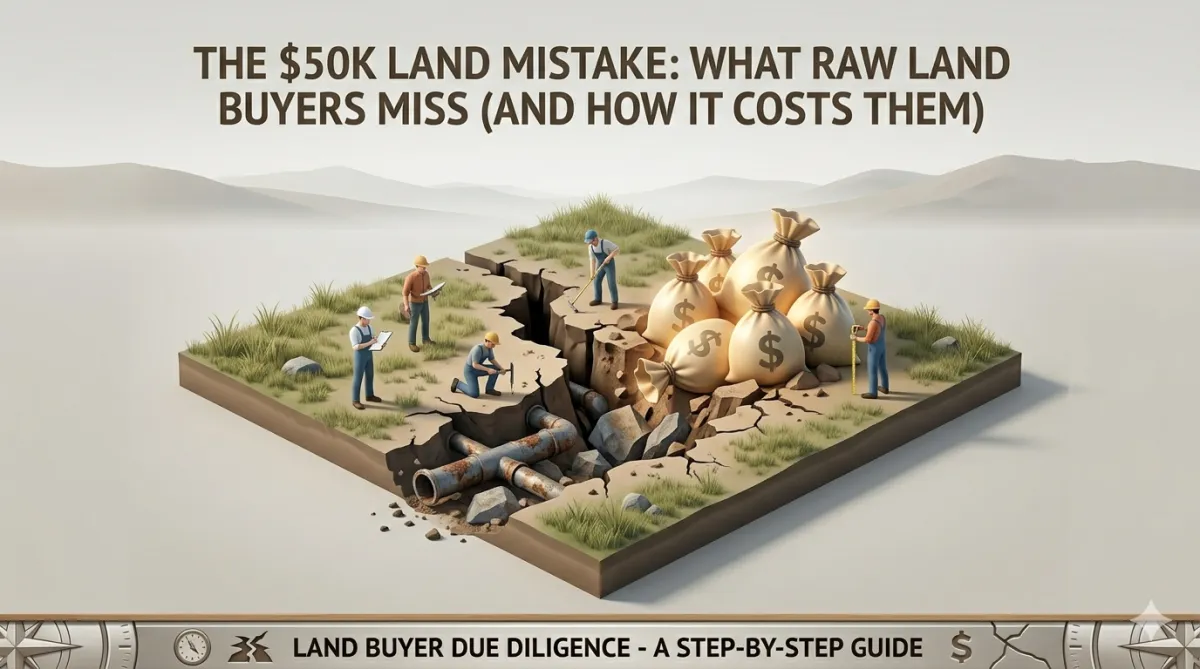
The $50K Land Mistake: What Raw Land Buyers Miss (And How It Costs Them)
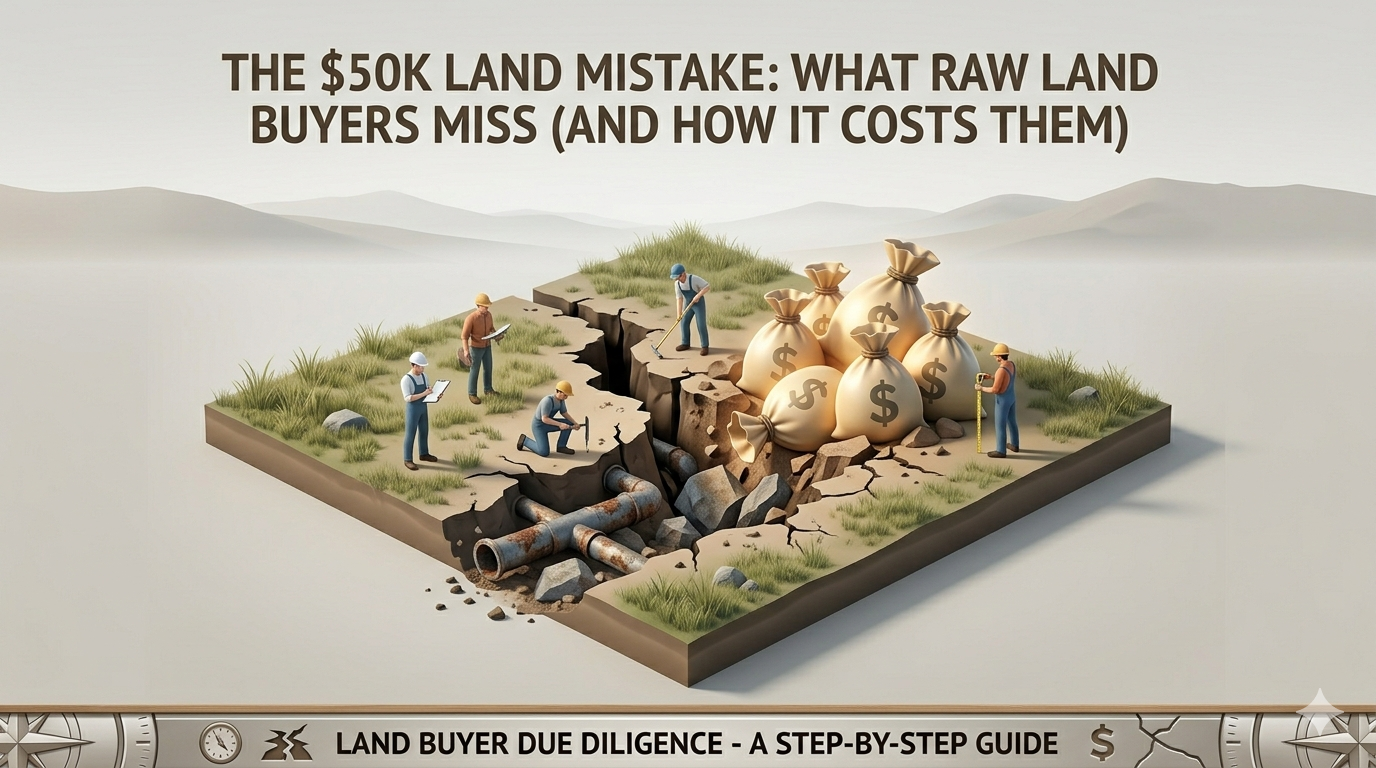
The $50K Land Mistake: What Raw Land Buyers Miss (And How It Costs Them)
Introduction
You found it. The perfect piece of land.
5 acres of beautiful rural property just outside Calgary. Trees. Rolling terrain. Mountain views in the distance. Privacy. Peace.
And the price? $180,000.
You've been looking at serviced residential lots in the city for $400,000-$500,000. This is less than half the price and you get 5 acres instead of a 5,000 sq ft lot.
It's a no-brainer. You make an offer. The seller accepts. You close.
You're thrilled. You own land. You're going to build your dream home.
And then you start the planning process.
Week 1: You contact the municipality to inquire about building permits.
They ask: "What's the zoning?"
You look it up. Agricultural.
They say: "Agricultural zoning requires 32 hectares minimum lot size for residential subdivision. Your parcel is 2 hectares. You can't build a residential home without rezoning."
Rezoning cost: $15,000-$25,000 in application fees, studies, and legal costs. Timeline: 18-24 months. Approval: Not guaranteed.
Week 2: You get quotes for utility connections.
Electrical service is 1.8 kilometers from your property. Extension cost: $95,000.
No municipal water available. You need a well: $28,000-$35,000.
No municipal sewer. You need septic: $30,000-$40,000.
Total utility costs: $153,000-$170,000.
Week 3: You hire an environmental consultant (something you should have done before purchase).
They discover: 40% of your property is wetland. Provincial regulations require 30-meter setback from wetlands. After setbacks, 70% of your property is unbuildable.
Week 4: You realize there's no legal road access to your property.
The previous owner accessed the land via a neighbor's driveway (informal verbal agreement). The neighbor is now refusing access.
You need to negotiate a legal easement. Legal fees: $10,000-$20,000. Outcome: Uncertain (neighbor may refuse).
Total Unexpected Costs Discovered After Purchase:
Rezoning (if even possible): $18,000
Utilities (electrical, well, septic): $160,000
Easement negotiation: $15,000
Total: $193,000
You paid $180,000 for the land.
To make it buildable, you need another $193,000.
Total investment: $373,000 — and the property still might not be approvable for rezoning.
Market value of landlocked, unbuildable 5-acre parcel with wetland and zoning issues?
Maybe $80,000-$100,000.
Your loss if you sell: $80,000-$100,000.
This is The $50K Land Mistake — though it's often much more than $50,000.
Buyers see "cheap" rural land and purchase without proper due diligence. Post-closing discoveries reveal zoning restrictions, utility costs, environmental constraints, access issues, or soil problems that make the land unbuildable or financially unviable.
The prevention cost? $3,000-$8,000 in pre-purchase due diligence.
The consequence of skipping it? $50,000-$150,000+ in losses.
This post breaks down the five critical mistakes raw land buyers make, what proper due diligence actually entails, real examples of catastrophic oversights, and how to protect yourself before you close.
Mistake 1: Assuming "Rural Land" Means "No Zoning Restrictions"
The Assumption
"It's rural. It's agricultural. There are no rules. I can build whatever I want."
The Reality
Every municipality has zoning bylaws that regulate:
Minimum lot sizes for residential development
Permitted uses (agricultural, residential, commercial, industrial)
Setback requirements (distance from property lines, roads, water bodies)
Building height and size restrictions
Accessory building regulations (barns, sheds, workshops)
Rural and agricultural zoning often has more restrictions than urban residential zoning, not fewer.
Common Zoning Issues That Kill Raw Land Purchases
Issue 1: Minimum Lot Size Requirements
Example (Rocky View County):
Agricultural District: Minimum 32 hectares (80 acres) for residential subdivision.
What This Means:
If you buy a 5-acre (2-hectare) parcel zoned Agricultural, you cannot build a residential home without rezoning.
Rezoning Process:
Application fee: $10,000-$15,000
Required studies (traffic, environmental, land use): $10,000-$20,000
Legal and consulting fees: $5,000-$10,000
Timeline: 18-24 months
Approval: Not guaranteed
Total Cost: $25,000-$45,000 + 2 years of uncertainty.
Outcome:
Many rezoning applications are denied due to:
Municipal development plan restrictions
Community opposition
Environmental constraints
Infrastructure limitations
Issue 2: Permitted Use Restrictions
Example:
You buy land zoned "Agricultural" intending to build a single-family home.
Agricultural Zoning Permitted Uses (typical):
Farming and ranching
Farm buildings (barns, equipment storage)
Single-family dwelling for farm operator
Not Permitted:
Residential home for non-farm operator
Subdivision into smaller lots
Commercial or industrial uses
Problem:
If you're not actively farming, your residential home may not be a permitted use. You need a development permit or rezoning.
Issue 3: Setback Requirements
Setbacks = mandatory distance from property lines, roads, or features.
Typical Setbacks:
Front yard (from road): 20-40 meters
Side yards: 10-15 meters
Rear yard: 10-20 meters
Watercourses (streams, wetlands): 30-100 meters
Problem:
On a small or irregularly shaped parcel, setbacks can eliminate most buildable area.
Example:
5-acre rectangular parcel: 100m x 200m
Setbacks:
Front: 30m
Sides: 15m each
Rear: 20m
Stream on east side: 30m additional setback
Buildable area after setbacks: 40m x 100m = 4,000 sq meters (1 acre)
80% of your property is unbuildable due to setbacks.
How to Avoid This Mistake
Step 1: Verify Zoning Before Purchase
Contact the municipal planning department:
What is the exact zoning designation?
What are permitted uses?
What is the minimum lot size for residential development?
What are setback requirements?
Step 2: Review the Land Use Bylaw
Every municipality publishes its Land Use Bylaw online. Read the section for your property's zoning district.
Rocky View County: https://www.rockyview.ca (search "Land Use Bylaw")
Foothills County: https://www.foothills.ca
Step 3: Consult a Land Use Planner
Hire a professional planner ($500-$1,500 consultation) to review zoning and assess development viability.
Cost: $500-$1,500
Value: Prevents $25,000-$50,000 rezoning costs or discovering unbuildable property post-purchase.
Mistake 2: Ignoring Utility Infrastructure Costs
The Assumption
"Utilities are everywhere. We'll just hook up to the grid."
The Reality
Rural land often has no utilities at the property. You pay to extend them — and it's expensive.
Utility Cost 1: Electrical Service Extension
The Situation:
Your property is 800 meters from the nearest electrical service pole on the road.
What's Required:
Transformer Installation: If the existing transformer can't handle additional load, a new transformer is required. Cost: $15,000-$25,000
Pole Installation: Electrical poles every 50-100 meters. Cost: $3,000-$5,000 per pole × 8-16 poles = $24,000-$80,000
Underground Option: If you want underground service (cleaner, no poles), trenching and conduit required. Cost: $50-$100 per meter × 800 meters = $40,000-$80,000
Service Connection: Connection from poles/underground to your building site. Cost: $5,000-$10,000
Total Electrical Extension Cost: $44,000-$115,000
Who Pays: You, the property owner.
Utility Cost 2: Water Supply
Option A: Municipal Water Extension
If municipal water exists nearby (rare for raw rural land):
Cost: $150-$300 per meter
Example: Water line is 1,200 meters away. 1,200m × $200/m = $240,000
(Usually prohibitively expensive — most buyers choose well instead.)
Option B: Well Drilling
Cost: $20,000-$40,000 depending on depth and geology
Plus:
Pump and pressure system: $3,000-$8,000
Water treatment (if needed): $3,000-$10,000
Total Well Cost: $26,000-$58,000
Utility Cost 3: Sewer/Septic
Option A: Municipal Sewer Extension
If municipal sewer exists (very rare for raw land):
Cost: $200-$400 per meter
Example: Sewer line is 1,500 meters away. 1,500m × $300/m = $450,000
(Prohibitively expensive — septic is standard.)
Option B: Septic System
Conventional Septic: Cost: $20,000-$30,000
Advanced Treatment System (required in some areas): Cost: $30,000-$50,000
Mound or At-Grade System (required for poor soil/high water table): Cost: $40,000-$70,000
Total Utility Infrastructure Costs
Low End (Short Distances, Well, Conventional Septic):
Electrical: $50,000
Well: $30,000
Septic: $25,000
Total: $105,000
High End (Long Distances, Deep Well, Advanced Septic):
Electrical: $120,000
Well: $45,000
Septic: $50,000
Total: $215,000
Common Scenario: You buy raw land for $150,000 thinking you got a deal. Then discover utility costs are $150,000-$200,000.
Total investment: $300,000-$350,000 before you even start building the house.
How to Avoid This Mistake
Step 1: Identify Nearest Utility Services
Before purchase:
Contact the utility company (Fortis, ATCO) and ask: Where is the nearest electrical service? What's the estimated cost to extend to this property?
Contact the municipality: Is municipal water/sewer available? If not, confirm well/septic are permitted.
Step 2: Get Quotes
Request formal quotes for:
Electrical service extension
Well drilling (contact local well drillers for estimates based on area geology)
Septic system design and installation
Cost: $0 (quotes are usually free)
Value: Know real utility costs before you buy.
Step 3: Factor Costs Into Purchase Decision
If land is $150,000 and utilities are $180,000:
Total cost before construction: $330,000
Compare to serviced residential lot at $400,000-$450,000. Is the raw land actually a better deal? Maybe not.
Mistake 3: Overlooking Environmental Constraints
The Assumption
"The land looks great. It's flat, it's dry, there's no standing water. We're good to build."
The Reality
Environmental regulations restrict development even if the land looks buildable.
Environmental Constraint 1: Wetlands
What They Are:
Wetlands = areas with water saturation (marshes, swamps, bogs, sloughs).
Why They Matter:
Provincial and federal regulations protect wetlands. You cannot fill, drain, or build on wetlands without permits (rarely granted).
Setback Requirements:
30-100 meter setback from wetland boundaries (varies by jurisdiction and wetland class).
Example:
You buy 5-acre property. Environmental assessment reveals 2 acres are wetland. Provincial 30-meter setback applies.
After setback, 70-80% of property is unbuildable.
Your Options:
Apply for wetland alteration permit (expensive, rarely approved)
Build on remaining buildable area (may be too small or poorly located)
Accept the property is largely unbuildable
Environmental Constraint 2: Floodplains
What They Are:
Floodplains = areas at risk of flooding (100-year flood zone).
Why They Matter:
Building in floodplains is restricted or prohibited to protect structures and occupants.
Consequences:
Building permits denied
Flood mitigation required (elevating structures, flood-proofing: $30,000-$80,000)
Insurance unavailable or extremely expensive
Example:
Property is adjacent to creek. Looks fine (no visible flooding).
Floodplain map shows property is within 100-year flood zone.
Result: Cannot build without expensive mitigation or permit denial.
Environmental Constraint 3: Contaminated Soil
What It Is:
Previous land use (industrial, fuel storage, agricultural chemical storage) contaminated soil or groundwater.
Why It Matters:
Contaminated sites require remediation before development permitted.
Remediation Costs: $50,000-$500,000+ depending on contamination type and extent.
Example:
Property was previously a farm with fuel storage tanks (diesel for equipment).
Phase II Environmental Assessment reveals soil contamination from historic fuel spills.
Remediation Required: $80,000
Your Options:
Pay for remediation
Walk away from property (lost deposit, due diligence costs)
How to Avoid This Mistake
Step 1: Review Environmental Maps
Wetlands: Alberta Merged Wetland Inventory: https://www.alberta.ca
Floodplains: Municipal floodplain maps (available from planning department)
Step 2: Hire Environmental Consultant
Phase I Environmental Site Assessment:
Desktop review of historical land use, aerial photos, environmental records.
Cost: $1,500-$3,000
Identifies: Potential contamination, wetlands, environmental risks
Phase II Environmental Site Assessment (if Phase I identifies concerns):
Soil and groundwater sampling and testing.
Cost: $3,000-$10,000
Identifies: Actual contamination levels, remediation requirements
Step 3: Make Offer Conditional on Satisfactory Environmental Assessment
Include condition in purchase agreement:
"This offer is conditional upon buyer obtaining, at buyer's expense, and being satisfied with a Phase I Environmental Site Assessment."
Timeline: 10-15 business days for assessment
If assessment reveals major issues, withdraw from purchase before closing.
Mistake 4: Not Verifying Legal Access
The Assumption
"There's a driveway to the property. We have access."
The Reality
Physical access ≠ legal access.
Access Issue 1: No Road Frontage
The Problem:
Property is landlocked — no direct access to a public road.
Previous Owner's "Solution":
Informal verbal agreement with neighbor to use their driveway.
Your Problem:
Verbal agreements are not legally binding. Neighbor can revoke access at any time.
Legal Solution:
Negotiate a registered easement (legal right-of-way) across neighbor's property.
Costs:
Legal fees: $5,000-$15,000
Compensation to neighbor: $5,000-$30,000 (or more, depending on negotiation)
Survey and registration: $3,000-$5,000
Total: $13,000-$50,000
Outcome: Not guaranteed. Neighbor may refuse. You may be stuck with landlocked, inaccessible property.
Access Issue 2: Unmaintained Road Allowance
The Problem:
Property has road allowance (public right-of-way) but the road is unmaintained (overgrown, impassable).
Your Responsibility:
You must develop and maintain the road at your own expense.
Costs:
Road construction (clearing, grading, gravel): $20,000-$60,000+ depending on length and terrain
Ongoing maintenance: Your responsibility
Access Issue 3: Seasonal Access Only
The Problem:
Road access exists but is impassable in winter (snow) or spring (mud).
Consequences:
Cannot access property several months per year
Emergency services cannot reach property
Utility companies may refuse service due to access issues
How to Avoid This Mistake
Step 1: Verify Legal Access in Title Search
Title search (conducted by lawyer during purchase) shows:
Registered easements
Road allowances
Right-of-way agreements
If no registered access: Red flag. Investigate before purchase.
Step 2: Survey Confirms Access
Hire surveyor to:
Confirm property boundaries
Identify legal road access
Map any easements
Cost: $2,000-$4,000
Step 3: Physically Inspect Access
Drive to the property in different seasons/weather:
Is the road passable?
Is it maintained?
Can emergency vehicles access?
Step 4: Make Offer Conditional on Legal Access Verification
"This offer is conditional upon buyer confirming legal road access to the property."
If access is uncertain or requires expensive easement negotiation, withdraw before closing.
Mistake 5: Skipping Geotechnical and Soil Testing
The Assumption
"The land looks solid. The ground is firm. We can build on it."
The Reality
Subsurface conditions determine buildability and foundation costs.
Soil Issue 1: High Water Table
The Problem:
Water level underground is close to surface (high water table).
Consequences:
Basements flood or cannot be built
Septic systems fail (requires mound or at-grade system: $40,000-$70,000)
Foundation issues (moisture, settling)
Soil Issue 2: Unstable or Expansive Soil
The Problem:
Clay soils expand and contract with moisture changes (swelling and shrinking).
Consequences:
Foundation cracking and movement
Requires engineered foundation (pilings, reinforced footings): $30,000-$80,000 additional cost
Soil Issue 3: Bedrock Proximity
The Problem:
Bedrock is close to surface (within 1-2 meters).
Consequences:
Cannot excavate for basement without blasting (expensive: $20,000-$50,000)
Septic system installation difficult/impossible (requires mound system)
Well drilling costs increase (drilling through rock)
How to Avoid This Mistake
Step 1: Hire Geotechnical Engineer
Geotechnical Assessment:
Engineer drills test holes, analyzes soil composition, water table, bearing capacity.
Cost: $2,000-$5,000
Report Includes:
Soil type and stability
Water table depth
Bearing capacity (foundation requirements)
Recommendations for foundation design
Step 2: Review Neighboring Properties
Ask neighbors:
Do you have basements? (Indicates water table depth)
What type of foundation? (Indicates soil conditions)
Any foundation issues? (Indicates soil stability)
Step 3: Make Offer Conditional on Satisfactory Geotechnical Report
"This offer is conditional upon buyer obtaining and being satisfied with a geotechnical assessment."
If soil conditions require expensive engineered foundations or prohibit building, withdraw before closing.
The Comprehensive Due Diligence Checklist for Raw Land
Here's what proper raw land due diligence looks like:
1. Zoning and Land Use Verification ($500-$1,000)
Contact municipal planning department
Review Land Use Bylaw for zoning district
Confirm permitted uses and minimum lot sizes
Verify setback requirements
Consult land use planner if needed
2. Utility Feasibility Assessment ($0-$500)
Contact utility companies (electrical, gas)
Request service extension quotes
Contact well drillers for estimates
Contact septic designers for system estimates
3. Survey ($2,000-$4,000)
Legal boundary confirmation
Identification of easements, encroachments
Verification of legal road access
Topographic survey (if needed for design)
4. Environmental Assessment ($1,500-$10,000)
Phase I Environmental Site Assessment ($1,500-$3,000):
Desktop review of historical land use
Identification of potential contamination
Wetland and floodplain identification
Phase II (if Phase I identifies concerns) ($3,000-$10,000):
Soil and groundwater sampling
Contamination testing
5. Geotechnical Assessment ($2,000-$5,000)
Soil composition analysis
Water table depth
Bearing capacity testing
Foundation recommendations
6. Title Search and Legal Review ($500-$1,000)
Confirm ownership
Identify liens, encumbrances, easements
Verify legal access
Total Due Diligence Investment: $6,500-$21,500
Comprehensive: $10,000-$15,000 (survey, environmental Phase I, geotechnical, zoning, title)
Real Example: Due Diligence Saves $120,000 Loss
Buyer's Target:
10-acre rural parcel listed at $220,000.
Comprehensive Due Diligence:
Survey ($3,000): Confirmed boundaries, identified 50-meter power line easement crossing property (restricts building in easement area).
Environmental Phase I ($2,500): Revealed property was former industrial site (gravel pit). Recommended Phase II testing.
Environmental Phase II ($8,000): Soil contamination detected. Remediation required: $90,000.
Geotechnical Assessment ($4,000): High water table. Basement not feasible. Septic requires mound system (+$20,000 vs. conventional).
Zoning Verification ($500): Confirmed Agricultural zoning. Minimum 32 hectares for residential subdivision. Property is 4 hectares = cannot subdivide without rezoning ($25,000+ cost, uncertain approval).
Total Due Diligence Cost: $18,000
Discoveries:
Soil remediation required: $90,000
Septic mound system: +$20,000 vs. conventional
Power line easement: Reduces buildable area
Cannot subdivide without expensive rezoning
Buyer's Decision:
Withdrew from purchase.
Amount Saved:
$220,000 purchase price + $90,000 remediation + $20,000 septic premium = $330,000 investment for property with significant constraints and no subdivision potential.
Market value with contamination and constraints: ~$150,000-$180,000
Potential loss if purchased: $150,000-$180,000
Due diligence investment: $18,000
Return on investment: Saved $150,000+ loss for $18,000 spent.
FAQ: Raw Land Due Diligence
Can I skip due diligence if I'm buying land "as-is"?
No. "As-is" means the seller won't fix issues. It doesn't mean you shouldn't investigate before buying. You still need to know what you're buying.
What if the seller won't wait for due diligence?
Make your offer conditional on satisfactory due diligence (10-20 business days). If seller refuses conditions, walk away — too risky.
Can I do some of this research myself to save money?
You can research zoning and review environmental maps yourself. But survey, geotechnical, and environmental assessments require licensed professionals.
What if I discover issues during due diligence?
Renegotiate price (ask for reduction equal to remediation/development costs) or withdraw from purchase if issues are too severe.
Is title insurance enough to protect me?
No. Title insurance covers title defects (ownership issues, liens). It doesn't cover zoning, environmental, or physical land issues. You need due diligence.
How do I find qualified professionals for due diligence?
Ask your realtor for referrals to surveyors, environmental consultants, geotechnical engineers, and land use planners experienced with rural land.
Conclusion
The $50K Land Mistake — buying raw land without comprehensive due diligence — costs buyers tens of thousands (often $50,000-$150,000+) in unexpected expenses that make properties unbuildable or financially unviable.
Common Mistakes:
Assuming no zoning restrictions (Reality: strict minimum lot sizes, setbacks, permitted use regulations)
Ignoring utility costs (Reality: $100,000-$200,000+ for electrical, well, septic)
Overlooking environmental constraints (Reality: wetlands, floodplains, contamination restrict or prohibit building)
Not verifying legal access (Reality: landlocked properties require expensive easement negotiations)
Skipping geotechnical testing (Reality: unstable soil, high water table, bedrock require expensive engineered foundations)
Prevention:
Invest $6,500-$15,000 in comprehensive due diligence:
Zoning and land use verification ($500-$1,000)
Utility feasibility quotes ($0-$500)
Survey ($2,000-$4,000)
Environmental Phase I ($1,500-$3,000)
Geotechnical assessment ($2,000-$5,000)
Title search ($500-$1,000)
Outcome:
Identify issues before purchase. Renegotiate price, withdraw from deal, or proceed with full knowledge of costs.
The Math:
$10,000 due diligence prevents $50,000-$150,000+ post-purchase losses.
Don't let your dream build turn into a financial nightmare. If you're considering raw land purchase, reach out before you buy — proper due diligence is the difference between a smart investment and a catastrophic mistake.
Related Reading
If you found this useful, these posts go deeper on land buying and development:
The Calgary Acreage Secret Map: How to Find 70% of Hidden Inventory
The Acreage Rebuild Reality Check: Hidden Costs That Add 20-30% to Your Budget
The Last Cheap Land in Calgary? What "Affordable" Land Actually Costs
About Kristen Edmunds
Kristen Edmunds is a Calgary-area REALTOR® and Associate Broker with KIC Realty, specializing in acreages, luxury homes, and smart buy/sell strategies. With expertise in rural properties (water wells, septic, equestrian facilities) and a client-obsessed approach, Kristen helps buyers and sellers achieve their real estate goals with confidence and ease.