

The 35-Minute Trade-Off: How Commute Distance Shapes Your Home Value and Lifestyle
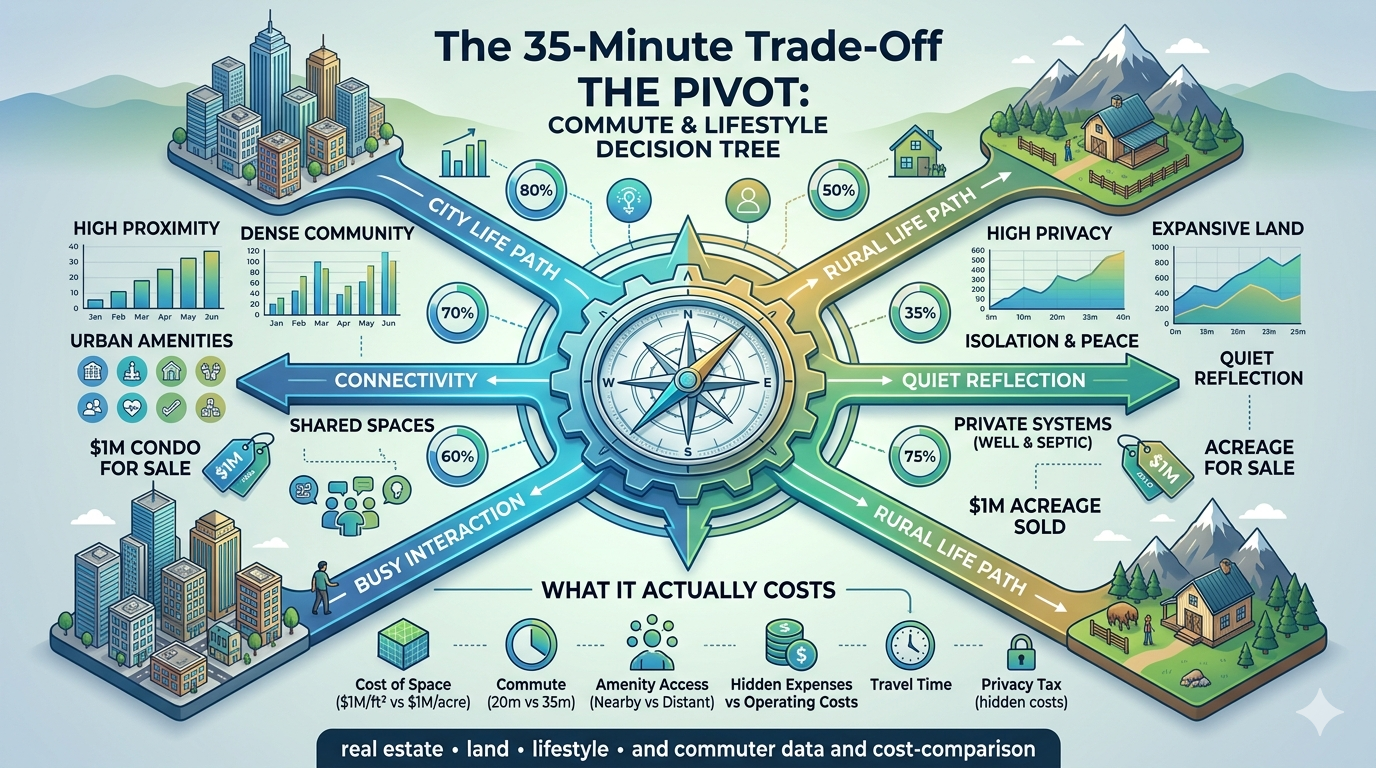
The 35-Minute Trade-Off: How Commute Distance Shapes Your Home Value and Lifestyle
Introduction
You're house hunting in Calgary with a $600,000 budget.
You work downtown. You want to minimize your commute. So you focus your search on inner-city neighborhoods and close-in suburbs.
You find a nice 1,500 sq ft townhouse in Inglewood for $625,000. Built in 1978. Shared walls. Small yard. Needs some updates. But it's only 12 minutes from your office.
Your realtor suggests: "Have you considered looking in Airdrie or Okotoks? You could get a lot more house for your money."
You hesitate. "Isn't that really far? I don't want a long commute."
Your realtor pulls up a listing: $525,000. Airdrie. 2,200 sq ft detached home. Built 2019. Modern finishes. Double garage. Big yard. No shared walls.
You're stunned. "How is this $100,000 cheaper and 700 sq ft bigger?"
The answer: The 35-Minute Trade-Off.
That property is 35 minutes from downtown instead of 12 minutes. And that 23-minute difference creates a massive value gap:
$100,000-$250,000 price difference
500-1,000 sq ft size difference
Older vs. newer construction
Townhouse/older home vs. detached modern home
But here's the question every buyer faces:
Is saving $150,000 and gaining 700 sq ft worth spending an extra 46 minutes per day (23 minutes each way) in your car?
Is it worth 230 minutes per week? 920 minutes per month? 11,000+ minutes per year?
Is it worth 190+ hours annually — nearly 5 full work weeks — of your life sitting in a car?
For some buyers, absolutely yes. For others, absolutely not.
This post breaks down The 35-Minute Trade-Off: what you gain, what you lose, the hidden time costs beyond commute, appreciation differences, and how to evaluate whether the trade-off makes sense for your life.
The 35-Minute Radius: What It Actually Means in Calgary
Let's start by defining what we mean by "35-minute radius."
Inner City / Close-In Suburbs (10-20 Minute Commute to Downtown)
Neighborhoods:
Kensington
Inglewood
Bridgeland
Marda Loop
Altadore
Mount Royal
Ramsay
Bankview
Windsor Park
Plus Close-In Suburbs:
Shawnessy
Somerset
Tuscany
Arbour Lake
McKenzie Towne
Commute to Downtown: 10-20 minutes (off-peak), 15-30 minutes (peak)
The 35-Minute Radius (Trade-Off Zone)
Communities:
Airdrie (35-40 minutes north)
Okotoks (35-40 minutes south)
Cochrane (35-45 minutes west)
Chestermere (30-35 minutes east)
Commute to Downtown: 30-45 minutes (off-peak), 40-60 minutes (peak with traffic)
The Value Differential: What You Get for That Extra 35 Minutes
Here's the dramatic difference in what your money buys.
Inner City Example: Inglewood Townhouse
Price: $625,000
Property:
1,500 sq ft townhouse
3 bedrooms, 2.5 bathrooms
Built 1978
Shared walls (attached on both sides)
Small yard (300 sq ft patio)
1 parking space
Needs updates (original kitchen, dated bathrooms)
Commute to Downtown: 12 minutes
Price per sq ft: $417/sq ft
35-Minute Radius Example: Airdrie Detached Home
Price: $525,000
Property:
2,200 sq ft detached home
4 bedrooms, 3 bathrooms
Built 2019
No shared walls (detached, standalone)
Yard (5,500 sq ft lot with grass and deck)
Double attached garage
Modern finishes (contemporary kitchen, updated bathrooms)
Commute to Downtown: 35-40 minutes
Price per sq ft: $239/sq ft
The Differential
Price Savings: $100,000 ($625K vs. $525K)
Size Gain: +700 sq ft (1,500 sq ft vs. 2,200 sq ft)
Age/Condition: 45 years older (1978) vs. brand new (2019)
Privacy: Shared walls vs. detached
Outdoor Space: 300 sq ft patio vs. 5,500 sq ft lot
Garage: 1 parking space vs. double garage
Condition: Needs updates vs. move-in ready modern finishes
The Time Cost
Additional Daily Commute Time:
Inner City: 24 minutes daily (12 min × 2) 35-Minute Radius: 70-80 minutes daily (35-40 min × 2)
Difference: +46-56 minutes daily
Annual Time Cost:
46 minutes × 250 work days = 11,500 minutes = 191 hours annually
That's nearly 5 full 40-hour work weeks spent in your car.
The Real Question: Is It Worth It?
Scenario 1: Yes, Absolutely Worth It
Profile:
Remote or hybrid worker (2-3 days per week in office, not 5 days)
Time Math:
If you commute 3 days per week instead of 5:
Annual extra commute time: 115 hours (instead of 191)
Still significant, but reduced impact
Value Math:
Save $100,000 upfront + gain 700 sq ft modern space + detached privacy
Lifestyle Math:
Home 120+ hours per week (remote work) = maximize value from larger, nicer space
Conclusion: Trade-off works. You get massive value for moderate time cost.
Scenario 2: No, Not Worth It
Profile:
Full-time downtown office worker (5 days per week in-person)
Time Math:
191 hours annually = 5 full work weeks sitting in a car
Value Math:
Yes, you save $100,000 and get more space. But you're spending nearly 8 full days per year (191 hours) commuting.
Lifestyle Math:
Value your time at $25/hour? That's $4,775 annually in lost time value.
Over 10 years: $47,750 in time value lost (nearly half the $100,000 savings)
Conclusion: Trade-off questionable. Time cost erodes financial savings.
Scenario 3: Depends on Full Daily Time Analysis
Profile:
Family with kids, both partners working
The Hidden Reality:
Commute time is only part of daily time spent driving.
Inner City Daily Time (Example: Marda Loop):
Commute: 30 minutes (15 min × 2)
Kids' school: 0 minutes (walkable to neighborhood school)
Groceries: 10 minutes (grocery store 5 min away)
Kids' activities: 20 minutes (soccer field, dance studio nearby)
Total Daily Driving: 60 minutes
35-Minute Radius Daily Time (Example: Airdrie):
Commute: 75 minutes (37.5 min × 2)
Kids' school: 20 minutes (10 min × 2, school in Airdrie)
Groceries: 20 minutes (grocery store 10 min away)
Kids' activities: 40 minutes (drive back to Calgary for activities, or limited local options)
Total Daily Driving: 155 minutes
Total Time Differential: +95 minutes daily (not just the +45 commute minutes)
Annual Impact:
95 minutes × 365 days = 34,675 minutes = 578 hours annually
That's 72 full 8-hour days — nearly 15 full work weeks — spent in a car.
Conclusion: When you account for total daily driving (not just commute), the time cost is much higher than the "35-minute trade-off" suggests.
The Hidden Time Costs Beyond Commute
This is what most buyers miss: the commute time is only part of the total time differential.
Factor 1: School Drop-Off/Pickup
Inner City:
Neighborhood schools within walking distance or 5-minute drive
Drop-off/pickup: 0-10 minutes daily
35-Minute Radius:
Schools within community (Airdrie, Okotoks) = 10-15 minute drive
OR: Private schools in Calgary = 30-40 minute drive back toward city
Time Differential: +10-40 minutes daily
Factor 2: Kids' Activities and Sports
Inner City:
Hockey rinks, soccer fields, dance studios, music lessons within 10-15 minutes
Multiple options, close proximity
35-Minute Radius:
Option A: Use local facilities in Airdrie/Okotoks
Limited options compared to Calgary
May not have specific programs you want
Option B: Drive kids back to Calgary for activities
35-40 minutes each way
Activity is 1 hour, but you spend 1.5 hours driving
Time Differential: +20-60 minutes daily (depending on activity frequency)
Factor 3: Grocery Shopping and Errands
Inner City:
Grocery stores, pharmacies, hardware stores within 5-10 minutes
Quick errands stay quick
35-Minute Radius:
Grocery stores in Airdrie/Okotoks = 10-15 minutes
Specialty stores (Costco, IKEA, etc.) = back to Calgary, 35-40 minutes
Time Differential: +10-20 minutes per errand
Factor 4: Social Life and Spontaneity
Inner City:
Friends live 10-20 minutes away
Dinner plans: "Meet at 7 PM" = leave at 6:45 PM
Spontaneous coffee, drinks, events = low friction
35-Minute Radius:
Friends live in Calgary (35-40 minutes away)
Dinner plans: "Meet at 7 PM" = leave at 6:15 PM
Spontaneous activities require 1+ hour round trip = high friction, less frequent
Time Differential: +20-40 minutes per social outing
Lifestyle Impact: Social activities decrease due to friction.
Total Actual Daily Time Differential
When you add up commute + school + activities + errands + social:
Inner City Total Daily Driving: 60-90 minutes
35-Minute Radius Total Daily Driving: 150-200 minutes
Actual Time Differential: +90-110 minutes daily
Annual Impact:
100 minutes × 365 days = 36,500 minutes = 608 hours = 76 full 8-hour days
This is the real 35-minute trade-off: not 191 hours annually (commute only), but 600+ hours annually (total lifestyle time cost).
The Appreciation Differential: Which Area Grows Faster?
Beyond purchase price and time, there's the appreciation question.
Inner City Appreciation
Historical Appreciation (Calgary Inner City):
Average: 4-6% annually (long-term)
Strong during boom periods (6-8%)
Moderate during soft periods (2-3%)
Drivers:
Limited supply (established neighborhoods, infill only)
High demand (walkability, amenities, proximity)
Desirable lifestyle (urban living trend)
Example:
$625,000 inner city townhouse appreciating at 5% annually:
Year 5: $797,000 (+$172,000)
Year 10: $1,018,000 (+$393,000)
35-Minute Radius Appreciation
Historical Appreciation (Airdrie, Okotoks, Cochrane):
Average: 3-5% annually (long-term)
Strong during boom periods (5-7%)
Moderate during soft periods (1-3%)
Drivers:
Growing demand (families seeking value and space)
New development (constant supply)
Remote work normalization (commute less important)
Example:
$525,000 Airdrie home appreciating at 4% annually:
Year 5: $638,000 (+$113,000)
Year 10: $776,000 (+$251,000)
Appreciation Gap
Year 5:
Inner city: +$172,000
35-min radius: +$113,000
Gap: $59,000 more appreciation for inner city
Year 10:
Inner city: +$393,000
35-min radius: +$251,000
Gap: $142,000 more appreciation for inner city
Does Appreciation Gap Close the Value Differential?
Initial Savings (35-min radius): $100,000 upfront
10-Year Appreciation Gap (inner city advantage): $142,000
Net Position After 10 Years:
If you bought the inner city property, you have $142,000 more appreciation, but you paid $100,000 more upfront.
Net advantage of inner city: $42,000 over 10 years
But: You lived in 700 sq ft less space for 10 years and spent 600+ hours annually (6,000 hours over 10 years = 250 full days) driving.
Is $42,000 appreciation advantage worth 700 sq ft less space + 250 full days in a car over 10 years?
That's the trade-off.
Who the 35-Minute Trade-Off Works For
Profile 1: Remote or Hybrid Workers
Why It Works:
Commute 0-3 days per week (not 5 days)
Time Cost:
Reduced by 40-60% compared to full-time commuters
115-150 hours annually instead of 191 hours
Value Gained:
Save $100,000-$250,000
Gain 500-1,000 sq ft
Modern vs. dated home
Spend 120+ hours weekly at home (maximize space value)
Conclusion: Excellent trade-off. Minimal time cost, massive value gain.
Profile 2: Families Prioritizing Space Over Convenience
Why It Works:
Value space for kids (yards, playrooms, bedrooms for each child) over urban walkability
Willing to Trade:
Accept 90-110 minutes daily driving (commute + kids' activities)
Accept suburban car dependency
Prioritize home environment over proximity to city amenities
Value Gained:
Kids have yards to play in
Each child has own bedroom
Home offices for both parents
Modern, spacious home vs. cramped older townhouse
Conclusion: Trade-off worth it if space and home environment are top priorities.
Profile 3: First-Time Buyers Maximizing Budget
Why It Works:
$600,000 budget gets you:
Inner city: 1,500 sq ft townhouse (cramped for growing family)
35-min radius: 2,200 sq ft detached (room to grow)
Value Gained:
$100,000 savings to put toward furniture, renovations, emergency fund
Space to grow into (don't need to move/upgrade in 5 years)
Lower mortgage payment (better cash flow)
Conclusion: Financial optimization makes trade-off worthwhile.
Profile 4: Retirees with Flexible Schedules
Why It Works:
No daily commute (not working)
Time Cost:
Only applies to errands, social outings (discretionary)
Can shop/run errands off-peak (avoid traffic)
Not time-constrained
Value Gained:
Larger, newer home for retirement years
More space for hobbies, guests, storage
Lower cost = more retirement savings preserved
Conclusion: Retirees get all value, minimal time cost.
Who the 35-Minute Trade-Off Doesn't Work For
Profile 1: Full-Time Downtown Commuters Who Value Time
Why It Fails:
191-250 hours annually commuting = 5-6 full work weeks in a car
Time Value:
Value time at $30/hour? That's $5,730-$7,500 annually in lost time
Over 10 years: $57,300-$75,000 (erodes savings significantly)
Lifestyle Cost:
Leave house earlier, get home later
Exhausted from long drives
Less time with family, hobbies, rest
Conclusion: Time cost too high, value eroded.
Profile 2: People Who Hate Driving
Why It Fails:
90-200 minutes daily in a car = misery
Psychological Cost:
Driving stress, traffic frustration, weather anxiety (winter driving)
Resentment builds over time
Quality of life decreases despite larger home
Conclusion: No amount of space/savings is worth constant driving stress.
Profile 3: Social People Who Value Spontaneity
Why It Fails:
35-40 minute distance from friends, restaurants, events = social life friction
Lifestyle Impact:
Spontaneous coffee dates, dinners, events become logistical challenges
Friends stop inviting you ("too far to drive")
Social isolation increases
Conclusion: Larger home doesn't compensate for social disconnection.
Profile 4: Families with Heavy Kid Activity Schedules
Why It Fails:
3 kids in hockey, dance, soccer = 5-10 hours weekly driving kids to Calgary activities
Time Cost:
90-110 minutes daily driving (commute + kids)
Entire evenings spent in the car
No family dinner time, constant rushing
Conclusion: Quality time with family decreases despite larger home.
The Middle Ground: 20-25 Minute Radius Options
If 35 minutes feels too far but inner city is too expensive, consider the middle ground.
Communities 20-25 Minutes from Downtown:
South:
Shawnessy
Somerset
Silverado
Walden
North:
Sage Hill
Evanston
Cityscape
West:
Aspen Woods
Springbank Hill
Westhills
East:
Mahogany
Auburn Bay
Seton
What You Get at 20-25 Minutes:
Price: $550,000-$650,000
Size: 1,800-2,200 sq ft detached homes
Commute: 20-25 minutes to downtown (vs. 12 min inner city, 35 min Airdrie)
Value: Better than inner city, not quite as good as 35-min radius
Time Cost: Moderate (less than 35-min, more than inner city)
Conclusion: Compromise position — some savings, some space gain, moderate commute increase.
How to Evaluate: The 35-Minute Trade-Off Decision Framework
Step 1: Calculate Your Real Time Cost
Don't just consider commute.
Map out your actual daily routine:
Commute (work days)
Kids' school drop-off/pickup
Kids' activities (sports, lessons)
Groceries and errands
Social outings
Calculate:
Inner city total daily driving time
35-min radius total daily driving time
Difference
Annual time cost: Daily difference × 365 days
Ask: Is that time cost acceptable to you?
Step 2: Calculate Your Financial Gain
Price difference: How much do you save buying in 35-min radius?
Size/quality difference: How much more space/better condition do you get?
Appreciation difference: Estimate 10-year appreciation gap (inner city appreciates ~1% more annually)
Net financial position after 10 years:
Savings upfront - appreciation gap = net financial advantage
Step 3: Value Your Time
What is your time worth?
If your time is worth $30/hour and you're spending 200 extra hours annually driving:
200 hours × $30 = $6,000 annually
Over 10 years: $60,000
Compare:
Financial savings from 35-min property: $100,000-$150,000
Time value cost over 10 years: $60,000
Net benefit: $40,000-$90,000
Is $40,000-$90,000 over 10 years worth it?
That's $4,000-$9,000 annually for significantly more space and newer home.
For some, yes. For others, no.
Step 4: Assess Lifestyle Priorities
Rank these priorities (1-10 scale):
Commute time (how much do you hate commuting?)
Home size and space (how much do you value spaciousness?)
Home condition (how important is modern vs. older?)
Walkability and urban amenities (how much do you value spontaneous access?)
Yard and outdoor space (how much do you use outdoor space?)
Social proximity (how important is being close to friends?)
If commute time and walkability score 8-10: Don't do the 35-minute trade-off.
If home size, space, and yard score 8-10: The 35-minute trade-off might be perfect.
Step 5: Test Drive the Commute
Before deciding, actually drive the route:
Drive from prospective 35-min property to your workplace at rush hour (both directions)
Do it on a rainy day, a snowy day, and a sunny day
Pay attention to how you feel during and after the drive
Ask yourself:
Can I do this drive 500 times per year and not hate it?
Does this drive stress me out or is it tolerable/enjoyable (podcast time, decompression)?
If the test drive feels unbearable: Don't do it. You'll regret it.
If the test drive feels fine: You can handle the trade-off.
FAQ: The 35-Minute Trade-Off
What if I'm hybrid (3 days in office, 2 days remote)?
Your time cost is 60% of full-time commuters. Run the numbers with 3 days instead of 5. Trade-off becomes much more favorable.
Do property values in Airdrie/Okotoks appreciate as well as Calgary inner city?
Historically, inner city appreciates ~1-2% more annually. But the gap is closing as remote work normalizes and demand for space increases.
What about winter driving on highways?
Legitimate concern. Highway 2 to Airdrie and Highway 2A to Okotoks can be treacherous in winter. If you're nervous about winter highway driving, the 35-minute trade-off might not be for you.
Can I reduce driving time by timing my commute off-peak?
If you have flexible hours, yes. Driving at 7 AM or 10 AM (instead of 8-9 AM rush) can save 10-15 minutes each way.
What if my job changes and I work somewhere other than downtown?
Risk factor. If you move jobs to a different Calgary location, your commute could increase or decrease unpredictably. Inner city is more central and flexible.
Conclusion
The 35-Minute Trade-Off: spending an extra 35 minutes commuting (each way) to save $100,000-$250,000 and gain 500-1,000 sq ft of living space.
What You Gain:
$100,000-$250,000 savings
500-1,000 sq ft more space
Newer, modern homes vs. older, dated properties
Detached privacy vs. shared walls
Larger yards
What You Lose:
46-56 minutes daily commuting (191-250 hours annually)
90-110 minutes total daily driving when including errands, kids' activities (600+ hours annually)
Spontaneity and urban walkability
Proximity to friends and social activities
1-2% annual appreciation advantage (inner city)
Who It Works For:
Remote/hybrid workers (reduced commute frequency)
Families prioritizing space over convenience
First-time buyers maximizing budget
Retirees with flexible schedules
Who It Doesn't Work For:
Full-time commuters who value time
People who hate driving
Social people who value spontaneity
Families with heavy kid activity schedules in Calgary
The 35-minute trade-off isn't just about time or money — it's about lifestyle. Urban convenience vs. suburban space and affordability. Your decision impacts your mortgage, your daily happiness, and your long-term wealth.
Think about your ideal 35-minute radius. Share your biggest commute challenge in the comments, or DM me to discuss how this trade-off impacts your home search.
Related Reading
If you found this useful, these posts go deeper on location and lifestyle decisions:
City Bungalow vs. Rocky View Acreage: The Real Cost Comparison
The $1M Calgary Comparison Trick: What Your Money Actually Buys
The Suburban Suffocation Realization: When Your Dream Home Feels Isolating
About Kristen Edmunds
Kristen Edmunds is a Calgary-area REALTOR® and Associate Broker with KIC Realty, specializing in acreages, luxury homes, and smart buy/sell strategies. With expertise in rural properties (water wells, septic, equestrian facilities) and a client-obsessed approach, Kristen helps buyers and sellers achieve their real estate goals with confidence and ease.